The government has committed up to A$7 billion to counter‑drone capabilities over the coming decade.
LAND 156: a fast purchase, a slow problem
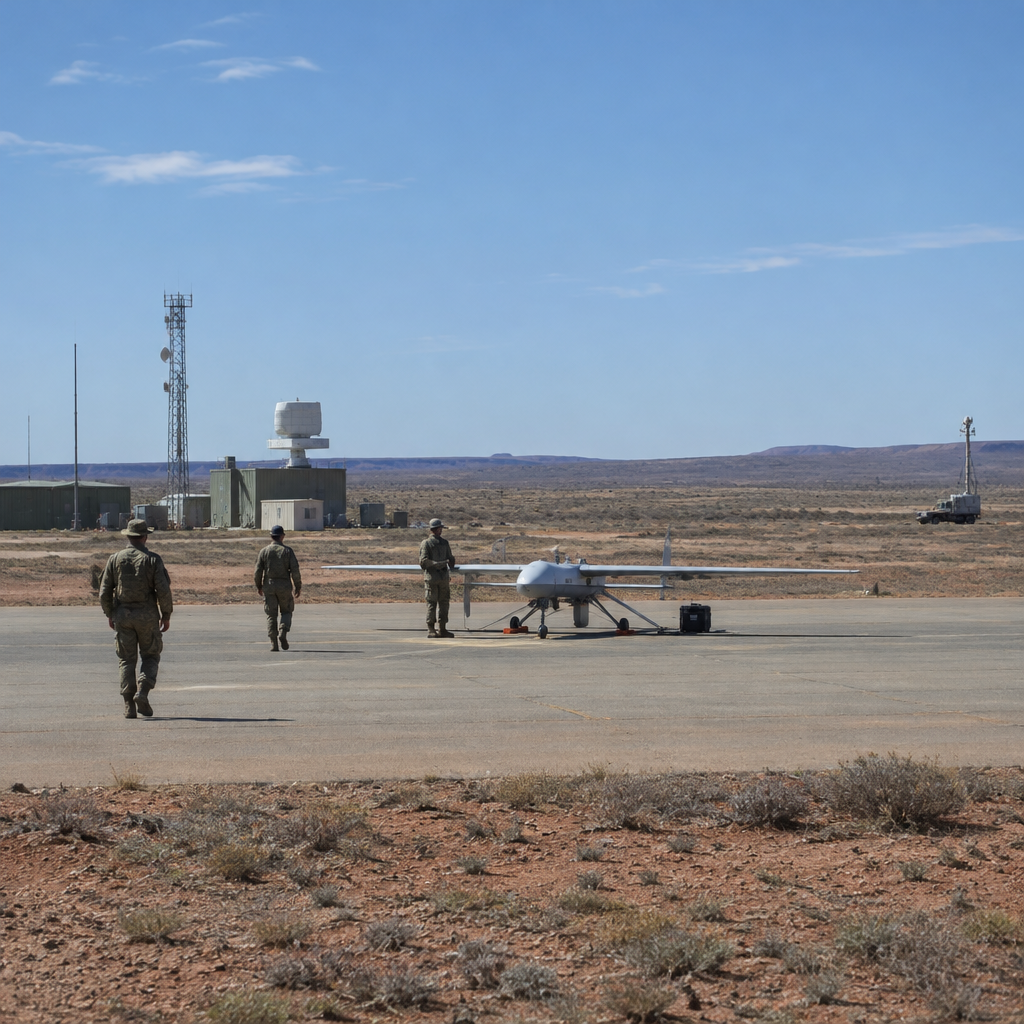
Defence’s counter‑drone program, known as LAND 156, has accelerated acquisition: soldiers at South Australia’s Cultana Training Area assessed 20 systems for defeating drones and selected eight for introduction into service. That pace meets an evolving threat, but the underlying point in the record is unambiguous: purchasing equipment is only part of the challenge. Australia must be able to repair damaged systems, replace components, update software and increase production as circumstances demand, and those industrial capabilities take years to develop.
Praetorian Aeronautics at Beatrice Hill: what northern testing can show
Testing in October by Praetorian Aeronautics at Beatrice Hill near Darwin illustrates the potential of northern trials. The Australian company tested its Arrow interceptor and Hadrian battle‑management system under northern conditions. The source cautions that developmental testing does not establish operational effectiveness, but it demonstrates how northern ranges can support continual improvement of emerging technologies when companies can work alongside military users.

This site is the portfolio.
OSINTSights runs on Cloudflare Workers, D1, R2, and Vectorize, with an AI pipeline on Hetzner ARM. Nubivance designed, built, and operates it. We do the same for clients.
See what we buildNorthern Territory sites and the case for a northern centre
The Northern Territory offers extensive training areas, vast distances, tropical conditions and proximity to operational bases — features identified in the source as making it a strong candidate to become a national centre for operational testing, adaptation and sustainment. Bradshaw, Mount Bundey and Delamere already provide substantial defence training infrastructure, while Darwin and Tindal are described as central to Australia’s northern defence posture. The Northern Territory government’s 2026 Defence Strategy already lists testing, evaluation and sustainment as priorities.
State competition, national requirements and complementary ranges
Several states are positioning to capture testing investment. South Australia has Woomera and Cultana; Queensland is supporting a three‑million‑acre weapons testing facility near Thargomindah, scheduled to become operational in 2028, alongside its existing Cloncurry Flight Test Range; Western Australia has testing infrastructure and ambitions in autonomous systems. The source warns that while competition can stimulate innovation, Defence’s decisions must ultimately be driven by national capability requirements rather than inter‑state competition. It argues the answer is not “another Woomera” but a complementary northern proving ground that combines existing infrastructure with sustained experimentation alongside operational forces, under realistic environmental and logistical conditions.
Infrastructure, procurement certainty and the limits of testing alone
Testing needs to be linked to industrial capacity. The Northern Territory must connect testing access with industrial land, reliable energy, transport, communications and workforce development, the source says. Defence procurement must provide sufficient certainty for companies to invest in permanent facilities and skilled workers, while rewarding the ability to expand production when required. The piece is explicit: testing alone will not create a scalable defence industry — without sustained procurement demand and opportunities for Australian firms to maintain, modify and produce equipment, economic benefits will remain limited. The objective described is a nationally integrated industrial network with critical testing, repair and adaptation capabilities positioned in the north and supported by suppliers across Australia, not an attempt to manufacture everything in Darwin.
What this means for technologists, policymakers, and manufacturers
- Technologists and security teams: opportunities to test systems like interceptors and battle‑management software under tropical, theatre‑relevant conditions — but developmental trials must be repeated alongside users to reveal weaknesses and drive redesign.
- Policymakers and procurement leaders: a need to match facility access with long‑term procurement certainty, and to coordinate territory and federal investments in industrial land, energy, transport, communications and workforce development.
- Manufacturers and maintainers: a clear incentive to locate repair, adaptation and limited production capacity where testing and operational units are co‑located, provided contracting gives them reasonable assurance of peacetime and surge demand.
The measure of success proposed is straightforward and operational: how quickly equipment can be tested, repaired, adapted and returned to service, and whether Australian industry can expand output when demand exceeds peacetime expectations. If Canberra and the territory can bind testing facilities to reliable supply chains, workforce programs and procurement certainty, the Northern Territory could be where Australia proves not only that its weapons work but that it can keep them working when it matters most.
Source: Australia's defence investment must build the industry to sustain a fight — The Strategist