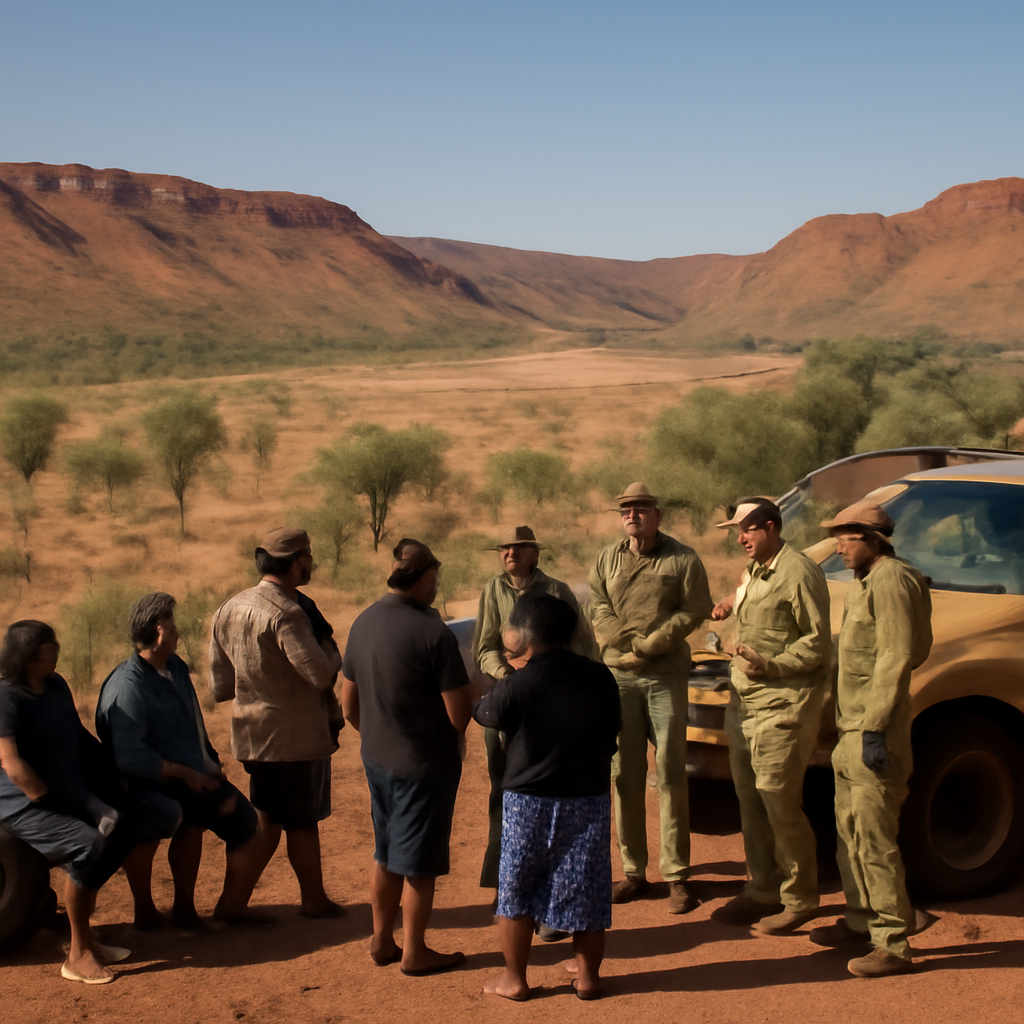
About 48 percent of the Northern Territory’s land mass and 80 percent of its coastline is Aboriginal land — a single fact that reframes how Australia must prepare the region to support military operations.
Northern Territory geography, communities and strategic mix
The Northern Territory combines expanding Australian Defence Force capabilities, United States force posture initiatives, strategically important ports and logistics corridors, energy and critical-minerals developments, space activities, northern agriculture and geographically dispersed communities. Distance, extreme weather, limited redundancy and long supply chains magnify the consequences of disruption. Indigenous partnerships are therefore fundamental to access, infrastructure and environmental management, not an engagement activity added after decisions have been made.
Civilian systems that generate and sustain combat power
The Australian Army does not own many of the systems that its future combat power depends on. Ports, fuel supplies, freight networks, telecommunications, electricity, cloud computing, satellite services and skilled workforces sit largely beyond the Department of Defence’s command. A failure outside Defence’s direct control could immobilise military capability without destroying any platforms.
Force structure alone is an insufficient measure of land power. Armies must move through, draw on and maintain relationships with the economic, social and physical systems of the places from which they operate. Traditional preparedness asks whether each organisation can perform its assigned function. An operational-ecosystem approach asks whether those functions can be recombined as conditions, priorities and constraints change.

Audit-ready is a season. It shouldn't be.
Evidence in spreadsheets, controls drifting between audits, frameworks multiplying on flat headcount. Nubivance runs continuous compliance on Rapid7 Cyber GRC - SOC 2, HIPAA, ISO 27001, PCI, CMMC.
End the scrambleShared infrastructure and where fragility shows up
Defence investment already reflects this interdependence. Infrastructure supporting Australian–US force posture initiatives extends across Robertson Barracks, the Royal Australian Air Force’s Darwin and Tindal bases, and northern training areas. RAAF Base Darwin, one of Australia’s main forward mounting bases, shares a runway with Darwin International Airport. Protected fuel storage at Tindal expands operational reach, but its continuing utility depends on civilian construction, transport, energy, utilities and maintenance workforces.
Darwin Port, including its East Arm and proposed Middle Arm logistics precincts, extends the same logic into the maritime and industrial domains. These are principally commercial assets and developments, not military installations. Yet their capacity, accessibility and resilience will influence Australia’s ability to receive, sustain, repair and reinforce forces across the north. Middle Arm remains proposed and contested, and its final industrial composition is unresolved. Its potential strategic value lies less in any single project than in the common‑user infrastructure, workforce and industrial capacity that could connect commercial activity with national preparedness.
A recurring Northern Territory operational-ecosystem stress test
Mapping what Defence depends on is only the first step. Australia must then identify who controls those systems and, hardest of all, whether those actors can change priorities together under pressure. A port, power network, telecommunications provider and military base could each be individually resilient yet collectively fail. They might restore their own operations while competing for scarce fuel, labour, transport or electricity.
Defence and the Northern Territory government should jointly conduct a recurring Northern Territory operational ecosystem stress test. Defence should define the required military effects and demand assumptions. The territory government should convene the infrastructure operators, industry, land councils, Indigenous organisations, local governments and emergency services needed to test whether those effects can be delivered.
Exercises should begin with operational demand, not a generic catalogue of assets. They should ask what military effects the territory could continue generating, at what scale and for how long, if several enabling systems failed concurrently. The test should identify critical dependencies, minimum operating thresholds, authorities for reallocating scarce resources, unresolved coordination problems and investments whose resilience value cannot be captured commercially. Exercises should test decisions and relationships, not merely whether individual assets survive.
What this means for Defence, the Northern Territory government, and Indigenous organisations
- Defence: must shift from protecting individual assets to specifying the military effects it requires, and to participate in exercises that probe whether those effects can be produced when civilian systems are degraded.
- Northern Territory government: should take the convening role — bringing together port operators, energy and telecom providers, industry, local governments and emergency services — to co‑ordinate stress tests and surface where orchestration is needed.
- Indigenous organisations and land councils: because nearly half the land and four‑fifths of the coastline are Aboriginal land, Indigenous partnerships will be central to access, infrastructure and environmental management and must be integrated into any operational‑ecosystem planning and exercises.
Resilience restores an existing operating model after disruption; adaptation changes the model when previous assumptions no longer hold. The Northern Territory must be prepared for pressure that is continuous, concurrent and cascading across military and civilian systems. The critical defence capability is not infrastructure alone, but the collective capacity to reprioritise and adapt that infrastructure under pressure. The territory should become the first Australian region deliberately governed, tested and developed as an operational ecosystem — where governments, industry and communities rehearse whether separately controlled systems can become a continuously adaptive source of combat power.
Source: The Northern Territory must become an operational ecosystem