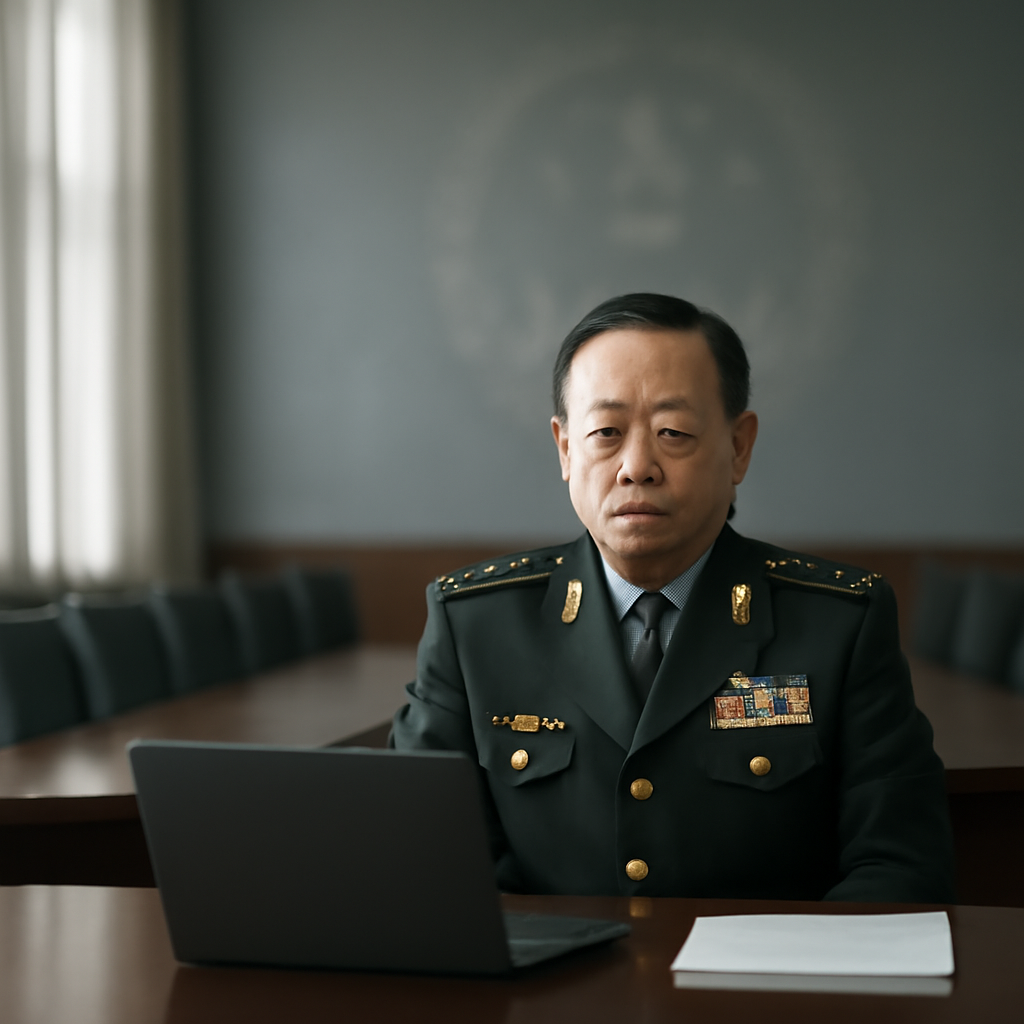
"political problems and economic problems were intertwined," the official statement said, summing up the charges that the Chinese Communist Party brought against two of the People’s Liberation Army’s most senior officers.
Zhang Youxia and Liu Zhenli
On 21 September, Xinhua News Agency announced that the Politburo of the CCP Central Committee had approved the expulsion from the party of Central Military Commission vice chairman Zhang Youxia and former chief of the commission’s Joint Staff Department, Liu Zhenli. Both men had already been expelled from military service, and their alleged criminal offences had been referred to military prosecutors, according to the announcement.
Corruption, patronage, and political disloyalty
The official statement framed the pair’s removal not merely as cases of financial wrongdoing but as a fusion of corruption and political failure. Zhang and Liu were accused of having “betrayed their original aspiration and mission,” “lost their party spirit and principles,” crossing political “red lines and bottom lines,” forming “self-serving cliques,” and being “disloyal and dishonest to the party.” The allegations also include violations of organisational, integrity, work and life discipline; using their positions to help others with promotions in exchange for large bribes; accepting gifts and money; failing to fulfil responsibilities for “rigorous party self-governance”; and failing to properly manage relatives and staff.

Audit-ready is a season. It shouldn't be.
Evidence in spreadsheets, controls drifting between audits, frameworks multiplying on flat headcount. Nubivance runs continuous compliance on Rapid7 Cyber GRC - SOC 2, HIPAA, ISO 27001, PCI, CMMC.
End the scrambleWhy promotions and patronage matter to party control
The statement makes clear why the party treats personnel management and promotion as political dangers. Control over promotions can enable senior officers to construct networks of patronage that create relationships of personal loyalty and obligation, the argument runs — relationships that can compete with the formal, vertical chain of authority stretching from the PLA, through the Central Military Commission, to the party centre. In the party’s framing, selling promotions and distributing favours are not merely financial crimes; they are organizational mechanisms that can erode party supremacy over the military.
Xi’s anti‑corruption drive: reach and limits
For more than a decade, the source notes, Xi Jinping — “as chairman of the commission” — has strengthened institutional mechanisms for party supervision of the PLA. The removal of officers as senior as Zhang and Liu serves two contrasting readings. On one hand, it demonstrates the formidable reach of the party’s disciplinary machinery and the willingness of the centre to act against extremely senior military figures. On the other, the persistence of corruption, patronage and alleged factionalism at the top of the military hierarchy after prolonged anti‑corruption campaigns and institutional reforms raises questions about how effective those mechanisms are as instruments of routine control.
What this means for the party centre, senior PLA officers, and personnel managers
- The party centre: The episode reinforces the centre’s strategy to fuse political reliability with military professionalism and indicates a willingness to deploy the disciplinary apparatus against top commanders when political loyalty is in doubt.
- Senior PLA officers: The cases signal that high rank does not shield officers from investigation or expulsion, and that control over promotions and personnel will be a focus of scrutiny.
- Personnel managers and promotion authorities inside the PLA: Allegations tying promotion decisions to bribery and patronage make personnel systems a central target for intensified party supervision and corrective measures.
The central paradox is sharp and deliberate: each purge both displays the party’s disciplinary power and underscores why the discipline has been repeatedly necessary. If the fall of Zhang and Liu demonstrates reach, it also signals that the party’s corrective machinery must be continually deployed — and perhaps made ever more intrusive — to maintain the fusion of “red” political loyalty and “expert” military competence that the leadership demands. The question the facts leave is not whether the purge shows power; it is whether repeated purges will become the routine instrument for preserving the party’s authority over an increasingly complex military.