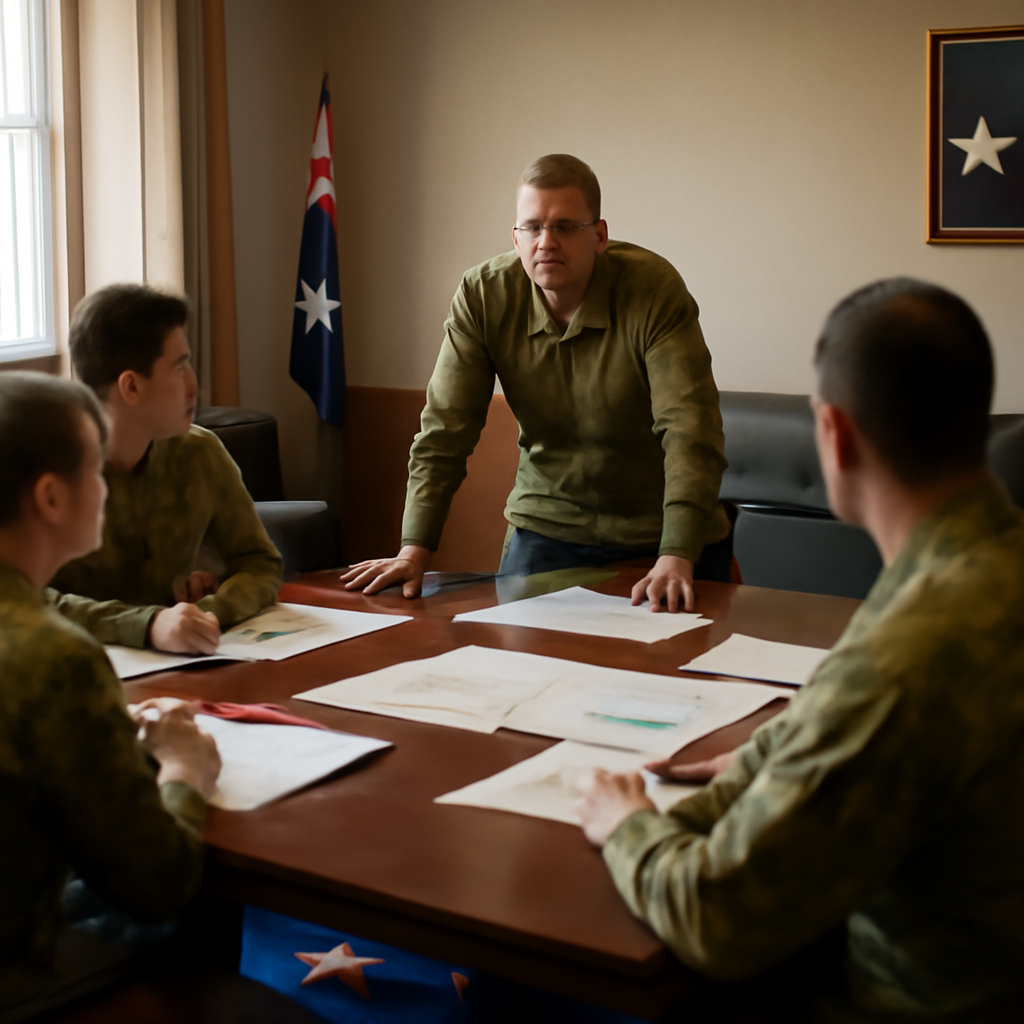
Lieutenant General Simon Stuart's tenure as chief of army ended on 8 July, closing a two-year internal review he designed to strengthen the Australian Army's professional discipline and command accountability.
Stuart’s review: diagnosis and remit
The review, conducted over two years, set out to reverse what Stuart diagnosed as “insufficient professional intellectual discipline for the rigours of a renewed age of great power competition.” It focused on three linked problems: a contraction and blurring of the army’s jurisdiction, an atrophy of expertise, and a diminished capacity for self-regulation that the review traces to the period during and after the wars in Iraq and Afghanistan. The stated long-term aim is to rebuild institutional muscle-memory for large-scale combat operations and sharpen land warfare concepts, doctrine, command and control, and capabilities.
Reviving the social contract: civil‑military relations and national resilience
The review argues for expanding the army’s social contract by reviving domestic civil‑military relations, beginning with frank dialogue among service members, the citizenry and elected representatives. It says enabling groups and non‑government agencies must engage and remain receptive to calls for ADF support so that future operations can draw on national support and industry. Stuart used a historical example to frame the moral and practical stakes: he reminded an audience that every soldier in the room would have fallen to take 15 metres of territory at Passchendaele in October 1917, only for it to be recaptured three days later — a reminder that violence of that scale has reappeared on modern battlefields and city streets and that reintegration after war demands societal preparation.

This site is the portfolio.
OSINTSights runs on Cloudflare Workers, D1, R2, and Vectorize, with an AI pipeline on Hetzner ARM. Nubivance designed, built, and operates it. We do the same for clients.
See what we buildTraining and education: The Soldier, the Land Combat College and a degree in war studies
Reform targets how recruits are prepared and how officers are educated. The review called for imparting the reality of war — its violence, unpredictability, paradox and ethical challenge — during initial training and follow‑on education so soldiers can adapt quickly to changing tactics and resist war’s corrupting effects. Recruits will receive more extensive training and copies of a new handbook titled The Soldier, which codifies professional obligations for all Australian soldiers. Officers will be encouraged to study a rebuilt curriculum at the Land Combat College and to obtain a bachelor’s degree in war studies at the ADF Academy; the degree course is scheduled to be introduced in 2027. The review identifies uptake of that degree as an indicator of long‑term interest in a professional military career.
The Sword and Baton: standards for generals and a renewed duty of care
To restore trust in the ADF’s ethical application of force, Stuart and senior army leaders developed a written code of honour for generals titled The Sword and Baton. The code establishes the standards expected of general officers and states that service and the interests of the nation must always come first. It also frames senior commanders’ duty of care as going “beyond societal norms,” extending whether soldiers are in or out of uniform, in sickness or in health, and reaching military spouses and family members. Practically, the army has been working to ensure soldiers with mental or physical health challenges can recover within their units and use discipline systems for support and redemption rather than be pushed toward more complex administrative remedies — an effort intended to reinvigorate the “chain of intimacy between soldiers and commanders” at all levels.
What this means for the ADF, industry, and the Australian citizenry
- The Australian Defence Force: The army will embed a campaign plan line of effort specifically to monitor and achieve professionalisation; success will be measured in part by education uptake, unit-level recovery practices, and commanders’ exercise of the new code.
- Industry and public servants: The review calls for closer linkages between the ADF, industry and public servants to build national resilience for any future Indo‑Pacific contingency and to supply the capabilities a renewed emphasis on large‑scale combat operations will demand.
- The Australian citizenry and elected representatives: The report places emphasis on an honest civic conversation about the nature and costs of using military force, urging receptiveness to requests for support and steadying expectations shaped by decades of “wars of choice” and domestic crisis responses.
The review does not mark an endpoint. Its campaign plan now formally includes a designated effort to monitor and achieve professionalisation — a practical inheritance for the next chief of army, Lieutenant General Susan Coyle. The source describes Coyle as a capable leader with an exemplary record of steering organisations through change; the text projects that she will reinforce the army’s people‑focused culture and accelerate the transformation Stuart began. Whether the reforms — new handbooks, a degree in war studies, The Sword and Baton, and renewed civil‑military dialogue — will restore the army’s institutional muscle‑memory and public trust will be measured over years, not months.