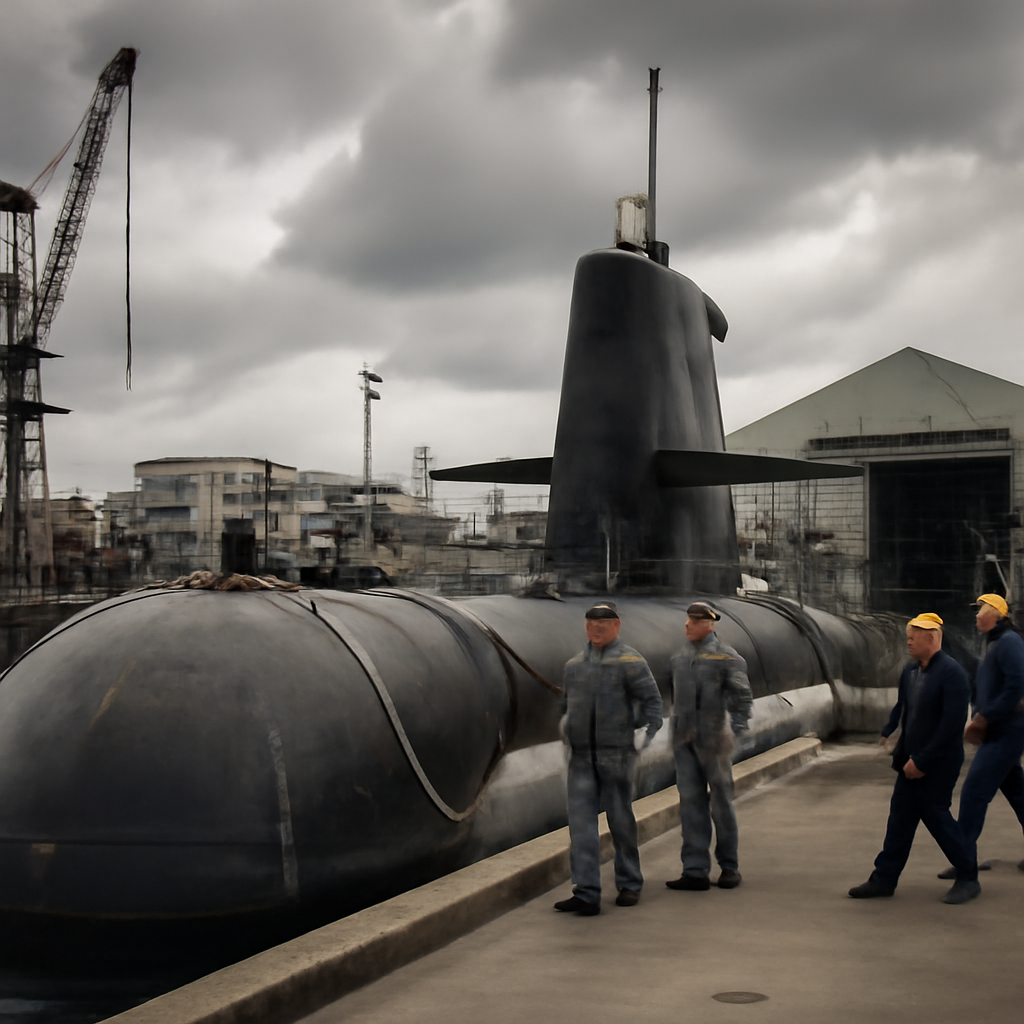
"AUKUS remains the best partnership for Australia to acquire the nuclear‑propelled submarines necessary for Australia to manage the most dangerous era since World War II," ASPI wrote — but the newly de‑scoped Collins life‑extension raises near‑term risks that make a Japanese fallback option worth preparing now.
The de‑scoped Collins LOTE and its new price tag
On 19 May the government announced a reduced Life‑of‑Type Extension (LOTE) for the six Collins‑class submarines. Under the revised plan, work will be limited to repairs and selective replacement “as judged necessary for each boat,” with a clear emphasis on maintenance and safety rather than capability upgrades. Sensors and weapons will be replaced where possible; replacement of diesel engines and generators will be carried out only if judged critical.
The cost of this reduced LOTE is estimated at around A$11 billion — roughly double what had been estimated for the full LOTE. ASPI notes that this jump is likely not only because earlier estimates were too low but also because aging equipment is becoming increasingly costly to sustain.
Availability, aging hulls and rising operational risk
The government plans to keep three Collins submarines in deep maintenance at any time, with two of the remaining three available for operations. Even if that cadence is achieved, ASPI warns that life‑extended Collins boats will be “possibly less stealthy and probably have less endurance than previously planned” and will progressively fall behind newer regional competitors.
Critical elements such as hulls and, in some cases, propulsion systems will be approaching or possibly exceeding 40 years of service by the end of the next decade. ASPI highlights the resulting rise in safety risk and the need for intensive monitoring and maintenance — factors that push up running costs and raise questions of value for money. At roughly A$1.8 billion per boat under the new plan, the Collins LOTE will buy only a retention of roughly current conventional capability, not parity with modern new conventional designs.

Audit-ready is a season. It shouldn't be.
Evidence in spreadsheets, controls drifting between audits, frameworks multiplying on flat headcount. Nubivance runs continuous compliance on Rapid7 Cyber GRC - SOC 2, HIPAA, ISO 27001, PCI, CMMC.
End the scrambleTiming pressures on AUKUS deliveries: Virginias and SSN‑AUKUS
The de‑scoped LOTE makes the remaining AUKUS milestones more consequential. ASPI underscores the centrality of two key steps: delivery of US Virginia‑class nuclear attack submarines (SSNs) to the Royal Australian Navy and local construction of the follow‑on Anglo‑Australian SSN‑AUKUS class. The Virginias are due to arrive in the early 2030s, and ASPI states they are “almost certainly not before 2032.”
ASPI also flags a distinct risk: deliveries could be delayed, or even withheld, if the United States judges it has too few SSNs for its own requirements. Because the Collins boats are losing competitiveness with age, such a delay could leave Australia without a modern crewed submarine capability for a decade or more.
Why ASPI recommends preparing a Japanese fallback
Given the elevated near‑term risk, ASPI reiterates a recommendation it made in the report Hedging our Bets: Canberra should approach Tokyo now to examine how it could buy or lease Japanese conventional submarines if needed in the 2030s. ASPI points to cost differentials as a rationale: Japan’s Taigei‑class submarines cost about A$600–700 million each — substantially less than the A$1.8 billion per‑boat price implicit in the de‑scoped Collins LOTE.
ASPI frames this as prudent contingency planning: preparing contractual and diplomatic options now to enable a rapid acquisition or lease if delays, technical shortfalls, or further de‑scoping of the Collins program make a smaller or increasingly fragile fleet untenable.
What this means for policymakers, the Royal Australian Navy, and procurement leaders
- Policymakers and diplomats: ASPI urges Canberra to open discussions with Tokyo about buy/lease arrangements so that contingency options are available in the 2030s if AUKUS deliveries are delayed.
- The Royal Australian Navy: the RAN faces an operational picture in which fewer boats may be deployable, life‑extended boats will likely have degraded stealth and endurance, and safety monitoring and maintenance needs will climb as hulls near 40 years.
- Procurement and defence planners: with A$11 billion committed to a reduced LOTE that buys only a retention of current capability, planners must weigh whether further de‑scoping, rapid retirements, or external sourcing (for example, from Japan) represent better value for money.
The de‑scoped Collins LOTE closes one chapter on capability enhancement and opens another on contingency planning. The program now costs more, buys less, and raises the probability that Canberra will need an executable backup if the Virginia and SSN‑AUKUS timelines slip. ASPI’s judgement is plain: prepare the diplomatic and procurement pathways to Japan now — not as admission of failure, but as pragmatic insurance against a decade‑long capability gap.