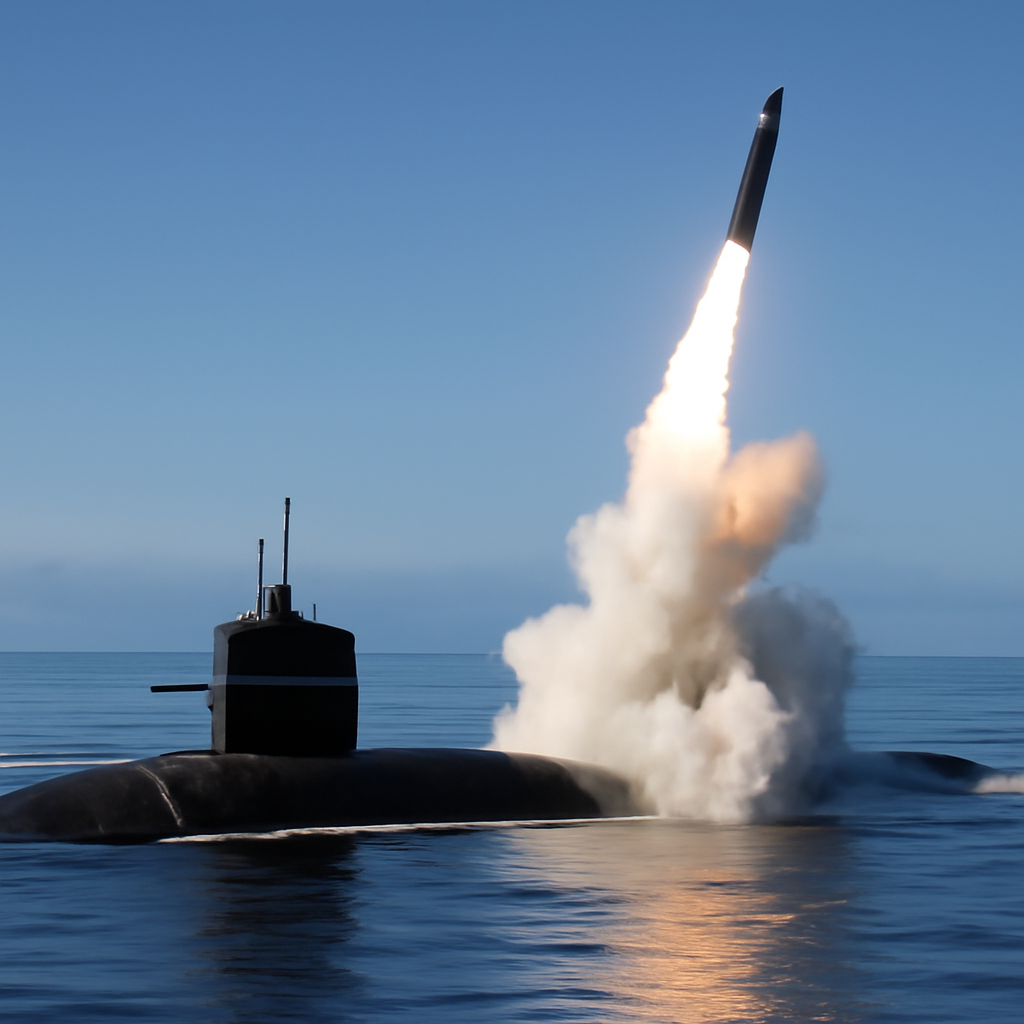
"On July 6, one strategic nuclear submarine of the Chinese People’s Liberation Army Navy [PLAN] successfully launched a submarine-launched strategic missile carrying a training dummy warhead toward the relevant high seas area of the Pacific Ocean, accurately landing in the predetermined sea area," according to a machine translation of an official PLAN statement.
PLAN statement and official framing
The People's Liberation Army Navy described the July 6 event as a routine component of annual military training, saying "relevant countries have been notified in advance" and that the test "complies with international law and international practices and is not directed against any specific country or target." The PLAN released official imagery of the launch but did not specify the launch platform, the missile type, or the precise launch point in its statement.
Where the missile(s) appear to have gone and the public evidence
Publicly available pre-launch navigation warnings suggested two distinct danger zones: one at the northern end of the South China Sea and one at the Yellow Sea, indicating preparations for launches from either or both areas. The dummy warhead "appears to have come down in the Pacific Ocean to the West of the Solomon Islands," and both sets of warning notices have since expired.
Japanese authorities were alerted in advance but, at the time of reporting, had not confirmed whether the missile passed over Japan — a detail that would point to a Yellow Sea launch if true. Taiwan's Secretary-General of the National Security Council, Joseph Wu, wrote on X that the missile flew "from the South China Sea past the Philippines." Independent analysts using NOTAMs and trajectory fitting reported an impact position near 174°E, 6°S and a suborbital launch profile with an impact time near 04:28 UTC.
Additional publicly tracked movements bolstered the picture: Yuan Wang-class missile-tracking ships were observed roughly along the routes analysts suggested, and the Liaowang-1 intelligence ship — described as capable of tracking objects in space — was also reported in the region in the days leading up to the test.

This site is the portfolio.
OSINTSights runs on Cloudflare Workers, D1, R2, and Vectorize, with an AI pipeline on Hetzner ARM. Nubivance designed, built, and operates it. We do the same for clients.
See what we buildWhich missile and which boat: JL-2, JL-3, and the Type 094 force
Chinese official channels and PLA mouthpieces mentioned the JL-2 and the JL-3; images released publicly are not definitive as to the missile model. The Pentagon has previously assessed JL-2 and JL-3 ranges at roughly 3,900 and 5,400 nautical miles, respectively (about 7,200 km and 10,000 km). Several analysts noted that the observed range and warning-zone geometry are consistent with a JL-2 fired from a Type 094-class submarine, though public reporting cautioned that the missile could have been a JL-3.
The PLAN’s only nuclear-powered ballistic missile submarines in service today are Type 094s; the country has at least six in service and reports say two more are under construction. A new Type 096 is under development. Each Type 094 can carry up to 12 missiles. Independent assessments cited in public reporting suggest JL-2 and JL-3 could be configured with multiple independently targetable reentry vehicles or with single, larger-yield warheads, but warhead loadouts for this test were not disclosed.
Regional and strategic signaling: triad demonstrations and the 'bastion' concept
Observers called the launch a notable demonstration of China’s sea-based nuclear capability, one of the three legs of a strategic nuclear triad China displayed together at a military parade last year when the JL-3 made its public debut. The 2024 precedent of a DF-31 ICBM fired from Hainan and passing near the northern Philippines is cited as a comparable example of demonstrations intended to prove operational capability.
Analysts have also linked the possible Yellow Sea or South China Sea origin to a so-called "bastion" concept of operations — launches from defended littoral waters to reduce vulnerability — a posture discussed in a 2021 Pentagon report. Broader naval trends were noted: the International Institute for Strategic Studies reported that China launched about 10 new submarines from 2021–2025, including two Type 094s, and that China was outpacing the United States in both total hulls and tonnage over that window. A now-retired senior U.S. commander had earlier suggested new Chinese submarines could approach parity with American counterparts within five to 10 years.
What this means for Taiwan, Japan, and Australia
- Taiwan: Taiwan’s National Security Council Secretary-General Joseph Wu publicly characterized the flight path as passing the Philippines and called the action a provocation. Taiwan will watch for how such demonstrations influence regional alerting and notification practices.
- Japan: Japanese authorities were notified prior to the launch; they had not confirmed an overflight at the time of reporting. Tokyo will likely track whether future tests follow similar corridors and how notifications are handled.
- Australia: Australian officials joined Japan, New Zealand, and Taiwan in issuing critical statements about the test's short notice and destabilizing impact, signaling concern among Indo-Pacific partners about both safety and strategic signaling.
Final assessment
This submarine-launched ballistic-missile test into the Pacific — described by the PLAN as routine training and by regional governments as destabilizing — is rare and symbolically weighty. It underlines a continued expansion of China’s nuclear and submarine forces, a pattern evidenced by silo construction, new mobile ICBMs, and an increasing warhead stockpile. The Pentagon reported that China’s stockpile "remained in the low 600s through 2024" and that the PLA "remains on track to have over 1,000 warheads by 2030" according to published assessments cited in open reporting.
Whether this launch marks an occasional demonstration or the start of more frequent SLBM testing into the Pacific will be a central question for regional capitals and analysts as China trains its growing submarine fleet and develops the command-and-control practices necessary for a sea-based deterrent.