"As we have discovered, overreliance on any single trading partner comes with significant risks." — Trade Minister Don Farrell, November 2022.
China's tariff action and its timing
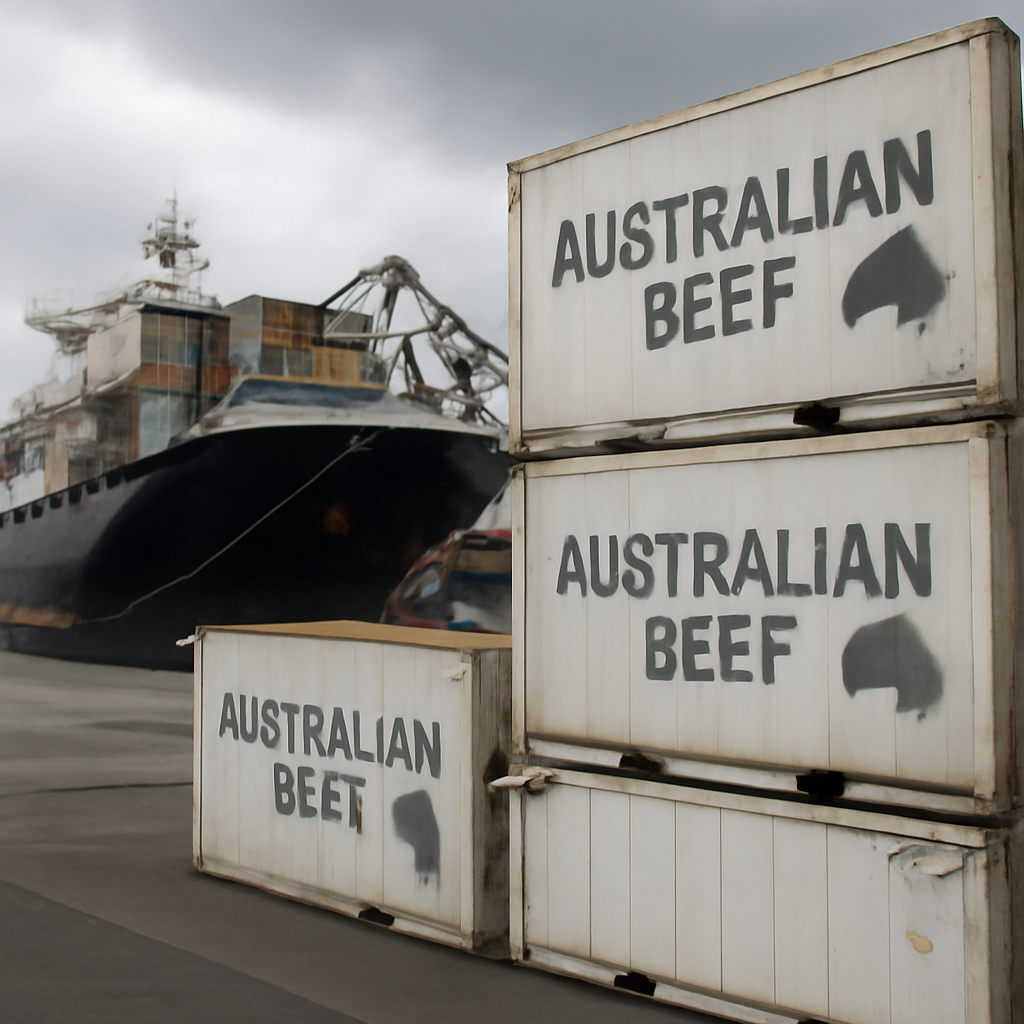
Beijing introduced a new tariff on Australian beef that took effect on 20 June. The tariff follows a December 2025 announcement that imports of Australian beef would be subject to a 2026 quota, and that once that quota was used the remaining imports would face a 55 percent tariff. According to the source, the quota "has indeed been exhausted," leaving Australian beef exporters to confront "a difficult job in selling to China for the rest of the year."
China's import strategy described in the piece
The article presents China’s policy as deliberate in reducing dependence: promoting domestic production where possible and spreading imports among multiple suppliers. The author argues this raises costs compared with textbook economic efficiency but is chosen to "reduce dependency and buy dependability" — framed explicitly as buying national security. The piece also asserts that China has "bought, stolen, subsidised and manipulated the market," and that some countries use trade as a weapon.

Your town's IT department is one person. Maybe.
Ransomware crews target small municipalities because nobody's watching. Nubivance gives Maine and New Hampshire towns a security program sized to a town budget.
Protect the town officeAustralia's exposure: export figures cited
The commentary notes Australia "still depended on China for 33 percent of its merchandise exports in 2024–25," only marginally down from "36 percent seen in 2018–19." Those two data points are used to underline the argument that many Australian exporters remain heavily reliant on a single market despite prior trade disruptions and political tensions.
Policy responses advocated: diversification and economic security
Policy prescriptions in the piece call for active government involvement rather than fatalism. Specific suggestions include reorienting trade promotion "to just about any market except China" and learning from Japan’s experience in responding to economic coercion, "including considering appointing an economic security minister." The article also notes that the US and European nations "are spending heavily on industry policy" and that national policies should "incorporate collective responses to counter economic coercion and strengthen supply chain resilience."
What this means for Australian beef exporters, rural producers, and policymakers
- Australian beef exporters: With the quota exhausted and a 55 percent tariff applying to further shipments, exporters face immediate pressure to find alternative markets for product that would otherwise go to China. The article urges exporters to "be looking hard" since December and cautions against seeking government concessions to restore access.
- Rural producers and mineral exporters: The piece singles out "various rural products but also some minerals" as goods China can easily source elsewhere; these producers are told to develop other markets and to expect that diversification could mean accepting lower prices in exchange for reduced dependency.
- Policymakers and trade officials: The article recommends that governments coordinate with allies to respond collectively to economic coercion and to bolster supply chain resilience; it emphasizes trade diversification as "the central plank of the government's trade policy strategy," echoing Don Farrell's November 2022 remark.
Political precedent and the cautionary tone
The commentary recounts past episodes when Australia experienced what the author calls Beijing’s "trade wrath": after supporting a Hague ruling on the South China Sea in 2016, after protections for a 5G telecommunications network in 2018, and after calls for an inquiry into the origins of Covid-19 in 2020. The author uses those examples to argue that trade pressures have been, and will remain, a plausible lever in strategic competition.
The core message is plain: the tariff on Australian beef is presented as both an immediate commercial shock and a broader strategic signal. The practical prescription is government-led diversification of markets and stronger economic-security frameworks, while firms are warned not to expect emergency policy concessions to bail out business models built around a single dominant trading partner.