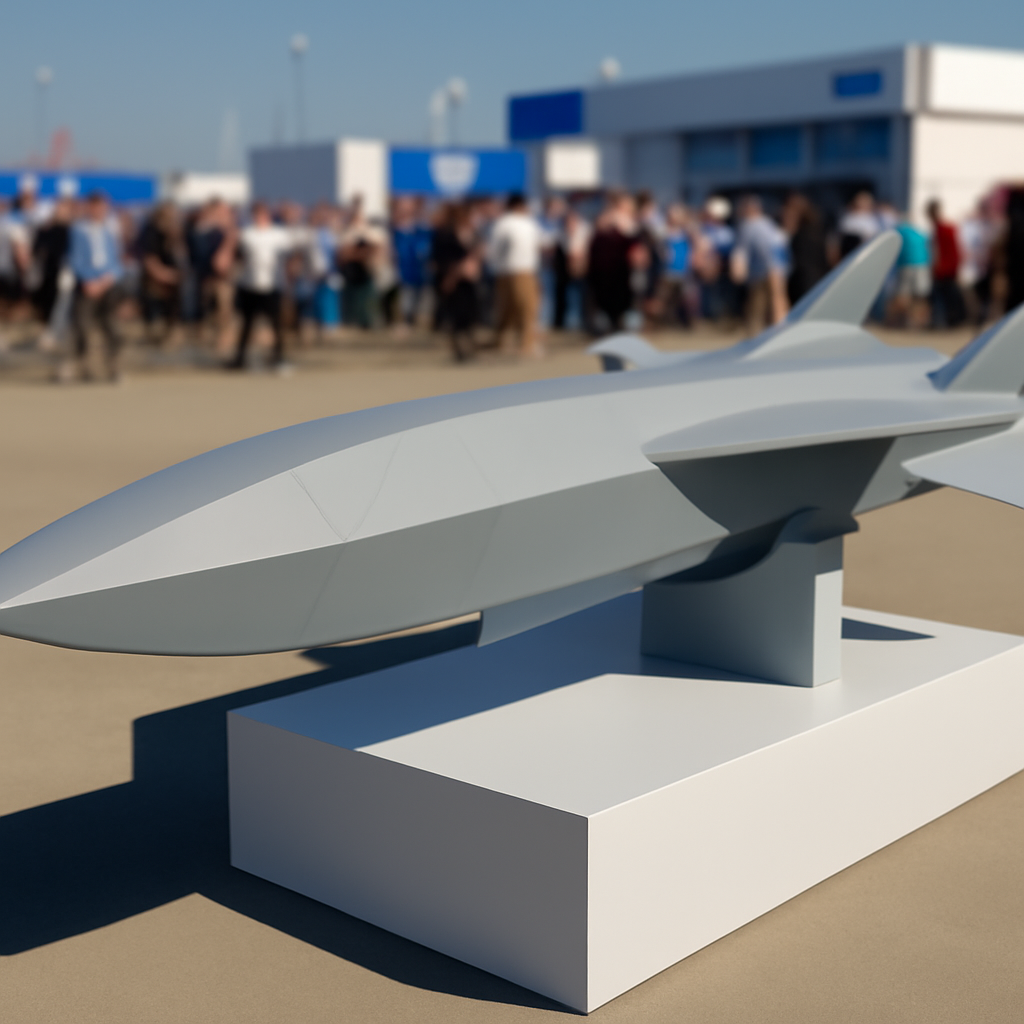
"The S-71M and the S-71K displayed alongside it ‘were designed for fifth-generation fighters,’" said the United Aircraft Corporation — a claim made public as Russia put three of its newest air-launched precision weapons on display at the El Alamein International Airshow in Egypt.
S-71 family: two low-cost standoff concepts
Seen in public for the first time at El Alamein, the S-71 series now includes two distinct variants that TWZ and Ukrainian intelligence have described in detail. The S-71M Monokhrom is a compact, turbojet‑powered weapon with a faceted, angular airframe intended to reduce radar signature. Imagery shows an optically flat transparency in the nose that could accommodate an infrared or TV seeker, sharply swept folding wings, and an inverted‑V tail. Ukrainian analysis found the S-71M carries an OFAB‑250‑270 high‑explosive fragmentation bomb and appears to rely primarily on inertial guidance; analysts also reported a largely fiberglass composite outer structure and no evidence of specialized radar‑absorbing coatings.
By contrast, authoritative accounts now identify the S-71K Kovyor as the more refined, more stealthy member of the family. Public images show a broader, compact fuselage with relatively thick folding wings and a smoother inverted‑V tail, giving it the appearance of a small uncrewed aircraft. The S-71K has been associated with electro‑optical guidance and greater onboard processing, suggesting a design emphasis on survivability and flexible terminal engagement compared with the more pre‑programmed S-71M.
S8000 Banderol: a smaller jet‑powered cruise option
The S8000 Banderol (also reported as "Dan‑T") represents a different approach to the same problem: a much smaller, jet‑powered cruise missile with a reported range of around 500 kilometers (311 miles) and a relatively small warhead, variously compared to a FAB‑100. TWZ's earlier reporting and captured imagery link Banderol to launch from drones and helicopters; recent photos show a Banderol mounted on a Mi‑28NM attack helicopter and footage released by Russia has depicted an Orion (Inokhodets) UAV carrying the weapon. TWZ's prior examination highlights the Banderol's use of commercially available components and foreign‑sourced electronics and propulsion technology, underlining a design philosophy of low unit cost and broad platform compatibility.

Audit-ready is a season. It shouldn't be.
Evidence in spreadsheets, controls drifting between audits, frameworks multiplying on flat headcount. Nubivance runs continuous compliance on Rapid7 Cyber GRC - SOC 2, HIPAA, ISO 27001, PCI, CMMC.
End the scrambleHow the weapons fit the operational lessons from Ukraine
TWZ ties the S‑71 family and the Banderol directly to lessons learned in the war in Ukraine. Russian forces have expended very large numbers of cruise and ballistic missiles and developed an extensive strike‑drone campaign, while Ukrainian air defenses have grown "progressively more capable." That environment has driven a preference for options that can be produced in greater numbers and used in combinations — missiles, drones, decoys and varied flight profiles — to penetrate or saturate defenses. The S‑71M was described as an intermediate choice between crude glide bombs that require aircraft to approach the frontline and full‑size, expensive cruise missiles: a powered, modestly survivable, and lower‑cost standoff weapon with a substantial warhead.
Unidentified munition and platform integration on display
At El Alamein the three named systems were displayed alongside a fourth, unidentified munition: a short, fat device with a cruciform tail and an optical window in the nose whose dimensions suggest it may be intended to arm drones. The S‑71 variants were shown in close association with a Su‑57 Felon — including imagery of S‑71 test articles under Su‑57 wings — and Banderol was depicted both under an Orion UAV and on a Mi‑28NM, demonstrating the emphasis on flexible carriage across fighters, helicopters and unmanned platforms.
Export prospects and economic constraints
The public unveiling also underlines a wider point made in the reporting: other countries face the same challenge of producing sufficient precision munitions at acceptable cost. But TWZ notes a major complication for Moscow’s potential customers. Buying weapons from Russia "has become considerably more difficult because of sanctions, restrictions on access to foreign technology and financing, and the wider political risks associated with maintaining a Russian defense relationship." Those non‑technical barriers, the report argues, may matter as much to a prospective buyer as the weapons' raw performance.
What this means for Ukrainian intelligence and air defenders, Russian operators, and prospective buyers
- Ukrainian intelligence and air defenders: imagery and captured examples have already enabled technical analysis — for example, assessments of warhead type, guidance approach and construction materials — that inform counter‑measure planning and assessments of likely employment profiles.
- Russian aircraft and drone operators: the S‑71 family and Banderol are presented as flexible, lower‑cost standoff options designed for carriage by fighters, helicopters and UAVs, expanding choices between risky close‑in glide bombs and expensive long‑range cruise missiles.
- Prospective foreign buyers and procurement officials: while the weapons address a real demand for attritable precision strike, TWZ highlights that sanctions, technology restrictions and political risk are significant constraints that will shape any export market for these systems.
The display at El Alamein offers more than static models: it is a snapshot of a deliberate shift toward cheaper, mass‑producible, harder‑to‑intercept air‑launched strike options. At the same time, the same reporting stresses that political and economic levers — sanctions and technology access — will strongly influence whether those weapons simply remain tools of a single war or become available to customers elsewhere.