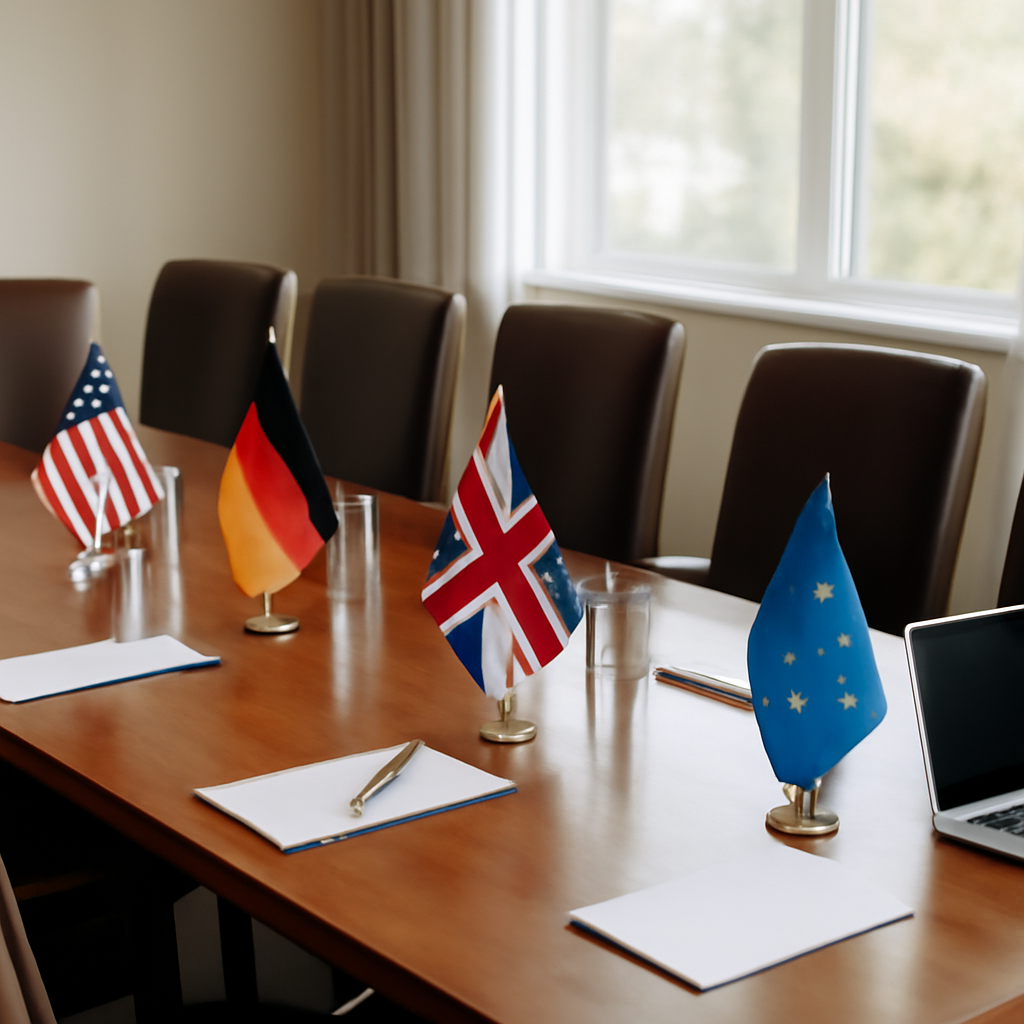
"Middle powers must act together because if you are not at the table, you are on the menu," Canadian Prime Minister Mark Carney told Davos this year.
Australia's structural dependence on US frontier AI
The central problem for Canberra is straightforward in the source material: access to frontier AI — the most advanced AI systems — is a prerequisite for prosperity, and Australia does not have a frontier model of its own. That absence leaves the country "structurally dependent on the United States." The prescription offered is not to seek independence from Washington, but to manage dependence deliberately: invest in strategic assets so Australia can hold "a significant enough stake across enough layers of the AI supply chain" to negotiate secure, ongoing access to frontier systems.
Supply‑chain assets already in play: minerals, chips, optics, memory and compute
Middle powers already own or can scale real assets across the AI supply chain. At the raw inputs level, Australia and Canada have important deposits of critical minerals outside China’s control. In chipmaking, the Netherlands’ ASML is the sole supplier of extreme ultraviolet lithography machines, Germany’s Zeiss supplies their optics, and Trumpf supplies their lasers. Japanese firms make half the world’s silicon wafers and the specialised chemicals used to print circuits. South Korea’s Samsung and SK Hynix produce roughly two‑thirds of the world’s memory chips and more than 80 percent of high‑bandwidth memory. British chip designer Arm — majority‑owned by Japan’s SoftBank — provides blueprints for processors that work alongside Nvidia’s top AI chips.
On computing power, Australia’s "vast land, abundant renewable energy and record of hosting trusted infrastructure such as Pine Gap" give it the potential to host data centres large enough to train frontier AI models. Canada and European countries could also host a significant share of the world’s AI data centres. For assurance and pre‑deployment evaluation, Britain’s AI Security Institute is cited as a global leader, with comparable institutes present among other partners; middle powers could expand independent third‑party evaluators beyond the handful of US organisations that currently dominate the field.

The cyber insurance questionnaire just landed. Now what?
SOC 2, HIPAA, insurance renewals - someone has to own security strategy. Nubivance provides fractional CISO leadership without the full-time salary.
Get a security leadA coalition of the dependent: pooling complementary assets
The core proposal is a coalition of like‑minded middle powers that pools complementary, scalable assets so partners collectively hold greater leverage in securing frontier AI access. The coalition would be "primarily a coordination mechanism, rather than a formal alliance." Coordination would centre on the terms partners negotiate with the United States and on preserving the resilience of the US‑led AI project while spreading ownership of the frontier AI supply chain across more players.
Practically, the coalition would maintain a shared assessment of each partner’s supply‑chain positions — where they are vulnerable and where joint or individual investment would complement and scale the group’s collective share. That shared inventory would guide where partners invest and what they jointly offer in negotiations with US providers.
Compute‑for‑access deals and common baselines
One specific bargaining tool discussed is the "compute‑for‑access" deal: conditioning fast‑tracked approvals for data centres on model‑access terms. The recommended approach is to establish a common baseline across coalition partners so no member accepts access terms inferior to those of US customers. A common baseline aims to prevent undercutting — where individual countries compete for investment by settling for weaker access terms — and to produce negotiating parity when partners align in broader discussions, including bilateral frameworks like the US "Technology Prosperity Deals" series.
What this means for policymakers, technologists, and data‑centre investors
- Policymakers and regulators: Expect to negotiate shared compute‑for‑access conditions and to coordinate positions in broader US‑facing technology talks. Building a clear, public rationale that this is managed dependence "under the US umbrella" is presented as essential to avoid misreading by Washington.
- Technologists and security teams: There is scope to scale independent third‑party evaluators for pre‑deployment testing, complementing Britain’s AI Security Institute and reducing reliance on a small set of US organisations.
- Data‑centre operators and investors: Countries with land and renewable energy — explicitly Australia, plus Canada and parts of Europe — could be pivotal hosts for training infrastructure, but approvals may carry negotiated access conditions as part of coalition bargaining.
The obvious political risk is how Washington will interpret a coalition that coordinates with the US but also bargains collectively. The source notes President Donald Trump called a recent proposal for Canadian associate membership of the EU a "hostile act" and threatened tariffs; that episode is invoked as a warning that any AI coalition must make its purpose unmistakable. The recommendation is explicit: the coalition’s aim should be managed dependence within the US orbit — sharing burden, reducing vulnerabilities, and securing allies’ continued access to technology that their own assets help produce.
Australia’s immediate task, according to the analysis, is twofold: realise the potential of its national assets (minerals, land, renewables and trusted infrastructure) and coordinate a trusted group of like‑minded countries to build collective leverage. Done clearly and collectively, the proposal argues, managed dependence can be a form of agency rather than subordination — a way for middle powers to ensure they remain, as Mark Carney put it, at the table.