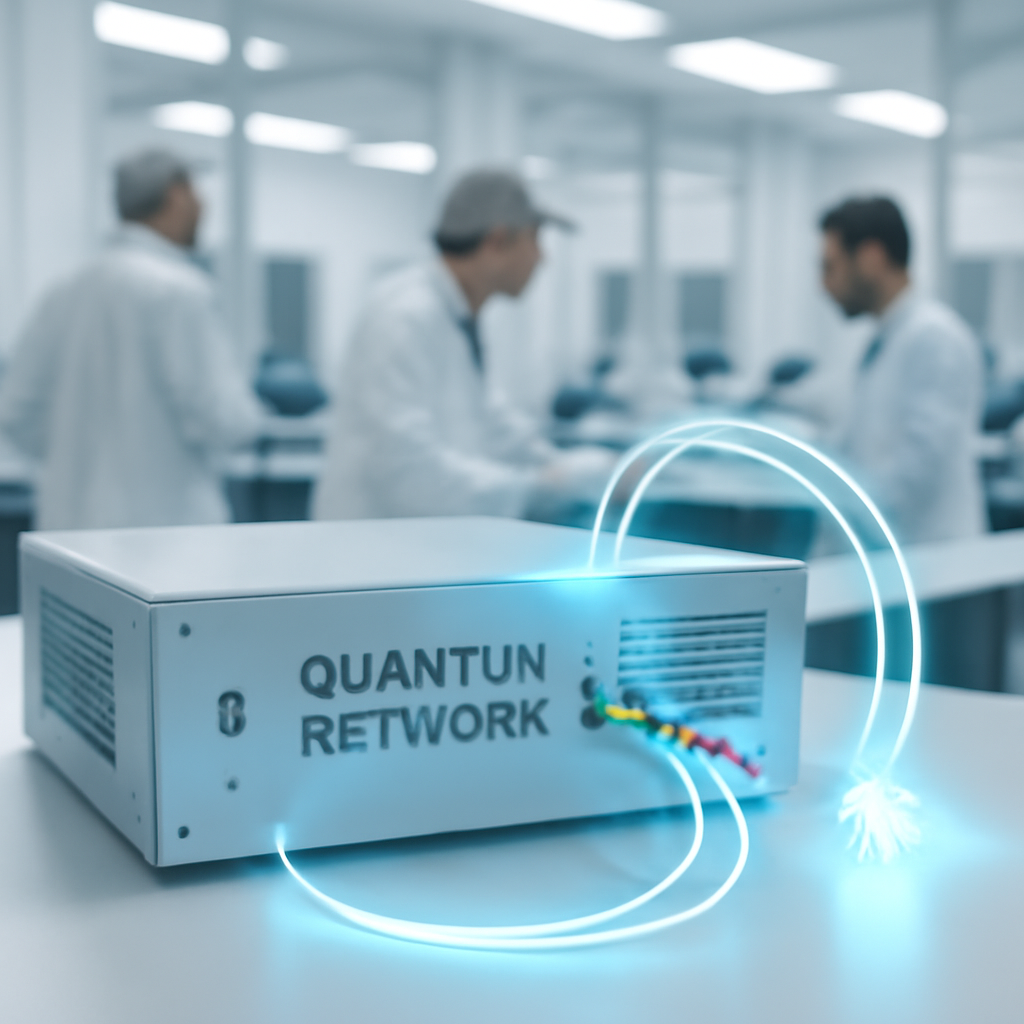
"We’re actually really hoping in the next year or two [to] release these as products that people can buy and integrate into their cybersecurity protocols," said Mehdi Namazi, co‑founder and chief science officer of the quantum networking company Qunnect.
Qunnect’s near‑term bet: commercial quantum hardware for telecommunications
Qunnect is pitching quantum technology not as a distant, sci‑fi threat to encryption but as near‑term commercial products aimed at telecommunications and cybersecurity. According to Mehdi Namazi, those offerings include quantum position verification — a way to verify the position and time of a transaction that “provides a physical receipt” — and quantum channel protection, in which “entanglement networks can supplement post‑quantum encryption to perfectly protect and monitor the communication networks to make sure no one is eavesdropping, no one is harvesting the data.”
Namazi also noted entanglement’s utility for precise time synchronization, down to “one trillionth of a second,” relevant to financial transactions and defensive systems. Qunnect counts In‑Q‑Tel, “an investment firm focused on intelligence and national security needs,” among its backers.
Technical and industrial constraints: hardware, form factors, and domestic manufacturing
Qunnect’s pitch is explicit about the practical constraints. These are “hardware‑based technologies,” Namazi said, and while Qunnect builds “everything to be compatible with the telecommunications infrastructure,” the technology still requires adding devices at different locations. He flagged two concrete hurdles: form factors that make sense for deployed networks, and manufacturing at scale — “you usually want [cybersecurity devices] to be manufactured [domestically]…in very large quantities.”

This site is the portfolio.
OSINTSights runs on Cloudflare Workers, D1, R2, and Vectorize, with an AI pipeline on Hetzner ARM. Nubivance designed, built, and operates it. We do the same for clients.
See what we buildHow the Pentagon and DARPA fit the picture
The private work on entanglement networks sits alongside public research. DARPA has explored entanglement networks through its Quantum Augmented Networks effort, the source notes, and broader policy steps are already shaping procurement. Following a White House executive order, the Pentagon released a quantum strategy that emphasizes network modernization — “integrating secure commercial products and using quantum‑resistant devices” — and it set 2030 as the deadline for all Pentagon systems to support post‑quantum cryptography.
GDIT and the prime‑startup pipeline: bringing lab ideas to missions
Amy Gilliland, president of GDIT, described primes’ role as finding startups and “show[ing] them how we can bring them to the mission.” Gilliland named IonQ as an example of a company with “great ideas” but limited certification or accreditation. She described a lab at the University of Maryland with “a big clock in there that’s ticking down to when they think Q‑Day is,” and said GDIT is already using quantum computing on an intelligence contract to “look through imagery and detect the tiniest of changes…so we can see what the enemy is doing in ways that conventional computers can’t today.”
GAO on Section 889: tools exist, but interagency sharing is limited
The Government Accountability Office reviewed implementation of Section 889 of the 2018 National Defense Authorization Act and found that the Pentagon and the General Services Administration developed processes and tools to comply, including “a search function for contracting officers to find out how companies ‘represent their compliance.’” But GAO said GSA and DOD “do not broadly share their insights from implementing Section 889 prohibitions with other government agencies.”
GAO highlighted an example: GSA plans to expand its use of customs data to identify the origin of goods — something GAO previously reported is difficult to do — and suggested that sharing experience could help other agencies prepare for upcoming statutory prohibitions, “such as on semiconductors.” GAO issued four recommendations, including two directed at DOD: share “subsidiary and affiliate information it collects with relevant federal agencies,” including the Cybersecurity and Infrastructure Security Agency; and coordinate with federal agencies on Section 889 implementation.
What this means for technologists, policymakers, and procurement leaders
- Technologists and security teams: Expect commercial quantum devices aimed at authentication, channel protection, and precision timing within a short commercial horizon if Qunnect’s timeline holds — and plan for hardware add‑ins and compatibility work alongside post‑quantum cryptographic upgrades.
- Policymakers and regulators: The Pentagon’s 2030 post‑quantum deadline and GAO’s recommendations place a premium on interagency coordination and on operationalizing customs and supply‑chain data to enforce statutory prohibitions.
- Procurement leaders and primes: Prime contractors that “bring” startups to missions — as GDIT describes — will need processes to help small quantum companies achieve certification and to solve manufacturing and form‑factor challenges at scale.
The picture that emerges from these disparate threads is straightforward: private firms are moving to productize quantum networking tools that promise new modes of authentication, monitoring, and timing; the Pentagon has set a firm migration to post‑quantum cryptography by 2030; and GAO is pressing for better interagency sharing of compliance data. The next move to watch is whether the operational and industrial steps — domestic manufacturing, device form factors, and interagency data flow — keep pace with the private sector’s push toward near‑term products.