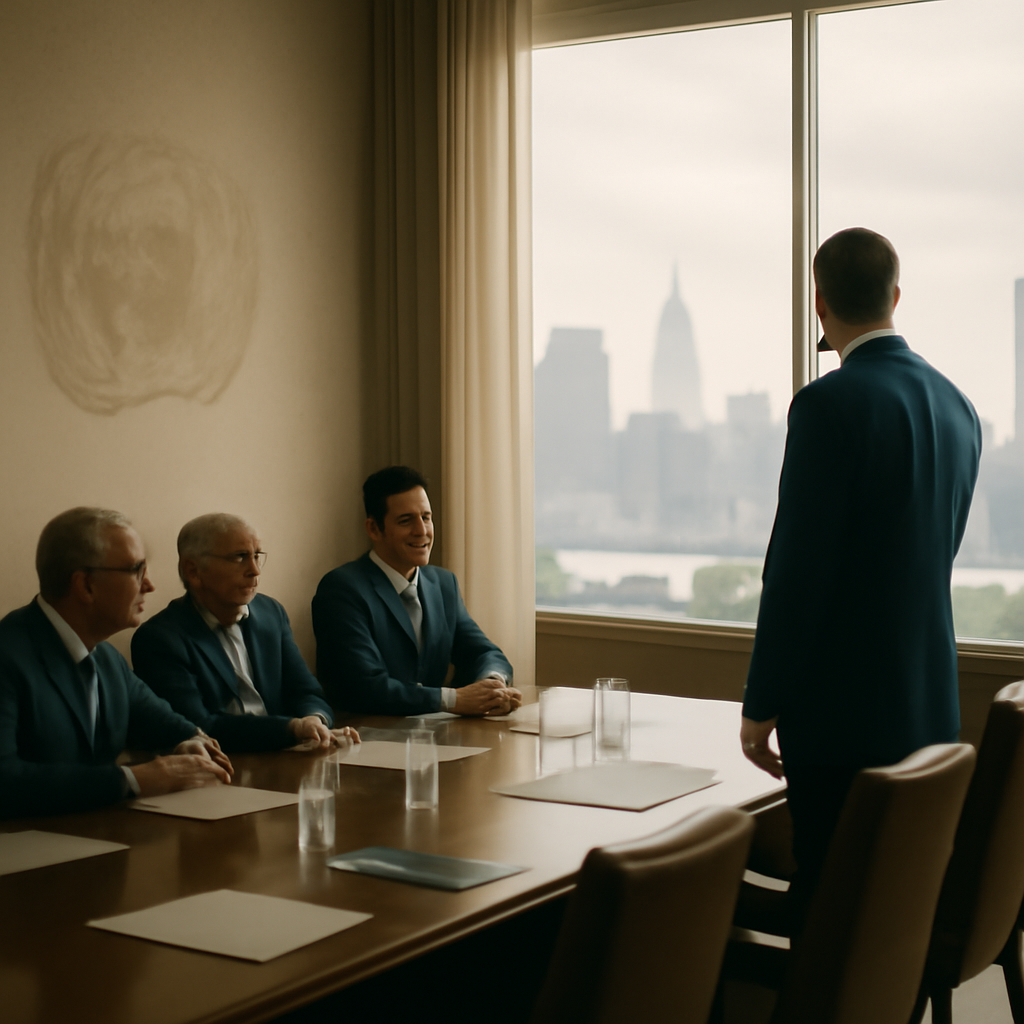
"If managed poorly, I even believe AI could be a risk to humanity as a whole," said Anthropic CEO Dario Amodei, a warning delivered amid a chorus of competing views at the United Nations.
Dario Amodei's existential caution
At a session of world leaders convened at the United Nations to discuss a range of issues including artificial intelligence, Anthropic CEO Dario Amodei delivered an unambiguous caution. His statement — “If managed poorly, I even believe AI could be a risk to humanity as a whole” — framed the technology not merely as an economic or regulatory issue but as one with consequences that, in his words, could touch the survival of humanity. That public framing pressed UN participants to consider controls focused on broad risk management rather than narrow commercial or technical fixes.
Sam Altman: loss of control as a core concern
OpenAI CEO Sam Altman added to the urgency, telling the same audience, “We could lose control of the future to AI.” His remark echoed Amodei’s existential theme but stressed a structural concern: that AI could shape the trajectory of society in ways that are not fully governed by existing institutions or norms. Both leaders used the UN platform to press national representatives to treat AI governance as a global issue.

Audit-ready is a season. It shouldn't be.
Evidence in spreadsheets, controls drifting between audits, frameworks multiplying on flat headcount. Nubivance runs continuous compliance on Rapid7 Cyber GRC - SOC 2, HIPAA, ISO 27001, PCI, CMMC.
End the scrambleCalls to prevent monopolization by a single company or country
Alongside warnings about risk, AI leaders in the meeting urged UN authorities to act to prevent concentration of power. The speakers explicitly called for the United Nations to ensure that “the power of AI is not monopolized by a single company or country.” That appeal linked two policy objectives: reducing systemic risk and preserving pluralistic access to a transformative technology.
President Donald Trump rejects restraints and reframes the debate
On Tuesday, President Donald Trump offered a sharply different message at the same international forum. He asserted that the United States “totally rejects” attempts to rein in the technology, calling those efforts a “globalist scheme.” He further said, “Whoever wins AI... wins.” According to the record of his remarks, he also insisted on changing the name of AI to “super intelligence” and compared concerns over AI’s risks with concerns over global warming, suggesting both were hoaxes. That sequence of statements positioned the United States, as represented in his remarks, in direct opposition to the regulatory approach urged by several prominent AI executives.
What this means for UN leaders, AI CEOs, and the United States
- UN leaders — Will be asked to reconcile urgent warnings from CEOs with overt political resistance. The appeals from Amodei and Altman press the UN toward international measures to manage risk and limit concentration, while the president’s remarks frame international restraint as politically unacceptable.
- AI CEOs and technologists — Have used the UN podium to push for global controls and to highlight long-term risk, including the possibility of losing control of AI’s societal trajectory and preventing monopoly by one company or nation.
- The United States — As articulated by President Donald Trump, formally rejects international efforts to limit or regulate the technology, recasting the conversation in geopolitical and ideological terms with statements such as “Whoever wins AI... wins” and labeling regulatory efforts a “globalist scheme.”
The exchange at the United Nations set two sharply divergent frames side by side: a cohort of AI leaders urging international controls to address existential and concentration risks, and a presidential position publicly rejecting such constraints and reframing the technology as “super intelligence” while dismissing the warnings as akin to hoaxes. Those contrasting messages now sit before UN delegates as they continue deliberations, crystallizing a central question for the global body: whether to act on the cautions voiced by industry leaders, or to accommodate the political rejection voiced by a leading national representative.