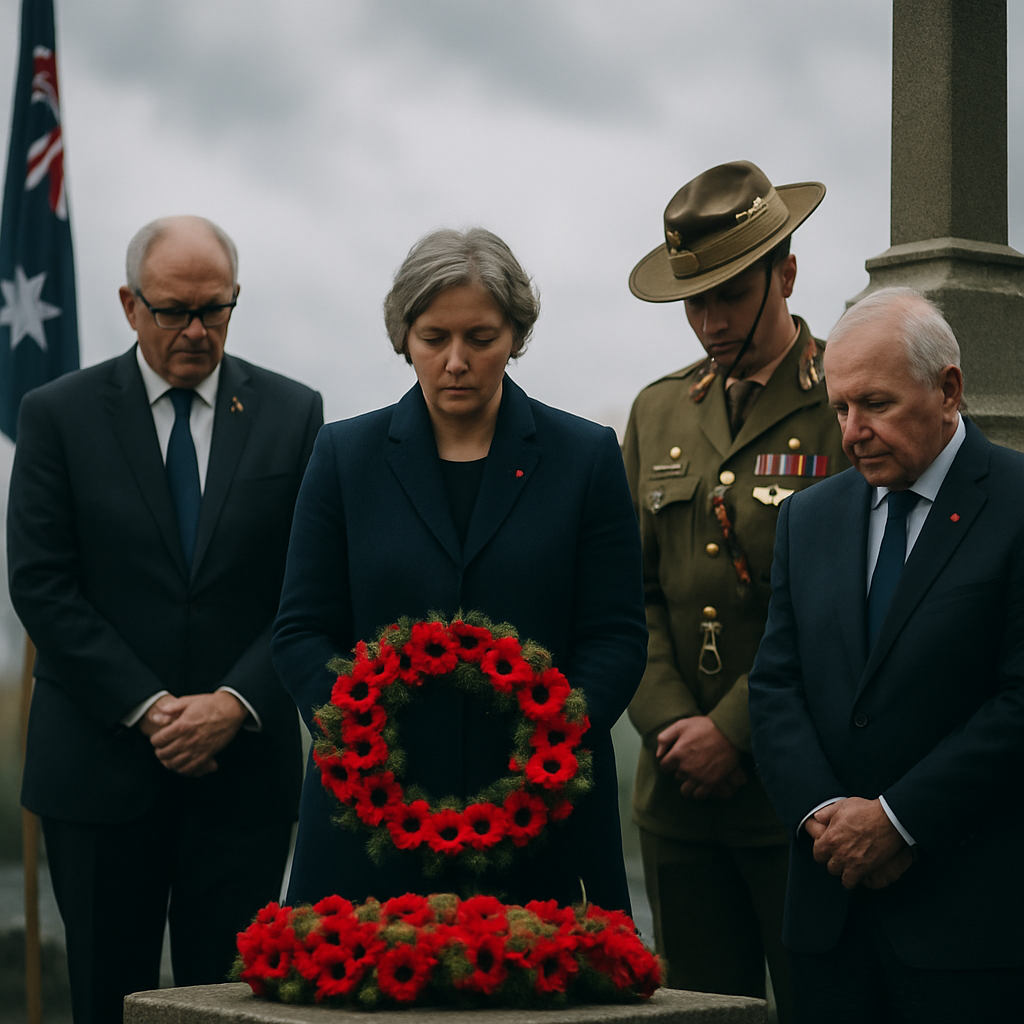
"lest we forget," the dignitaries said at Anzac Day ceremonies, offering the familiar reassurance that remembering the fallen is the best way to honour them.
Anzac Day dignitaries and the moral framing of war
The piece argues that Anzac Day reinforces a moral framing of war: it casts conflict as tragic, senseless loss and as something primarily to be remembered rather than prepared for. The author describes how ceremonial remarks — honouring courage, invoking "lest we forget" and proclaiming "never again" — provide a moral alibi that can discourage sober discussion about why wars are fought and how they ought to be conducted.
The article invokes religious and philosophical authority to underscore the moral dimension: it cites Pope Leo XIV's characterization of war as "a descent into darkness" and references the Catholic tradition of the just war, developed by St Augustine, to argue that moral judgment of war belongs to those with responsibility for governing.
Carl von Clausewitz and the strategic logic of war
Countering the tendency to view war as irrational, the author leans on Clausewitz's insight that war is "the continuation of politics by other means." The point is strategic: if two powers disagree and one calculates that the costs of war are bearable relative to the status quo, war remains a viable instrument of policy. The author stresses that wars are not merely the product of blind passion but of calculations about necessity, proportionality and political ends.
That calculus, the article insists, must be met by practical statecraft: rearming, building deterring alliances, strengthening national resilience and civil defence — measures intended to change an adversary's cost‑benefit calculation.

This site is the portfolio.
OSINTSights runs on Cloudflare Workers, D1, R2, and Vectorize, with an AI pipeline on Hetzner ARM. Nubivance designed, built, and operates it. We do the same for clients.
See what we buildRussia, China and the immediate strategic risks named
The article identifies concrete present and near‑term threats. It says the "Russian leader Vladimir Putin is embarked on a war of aggression in the pursuit of conquest." It names China as a power that "may embark on wars of conquest in Asia, as soon as early 2027" and quotes that "Chinese President Xi Jinping thinks differently" about the legitimacy of war in pursuit of the "great rejuvenation of China," with the "subjugation of Taiwan" described as central to that project.
How these leaders read the odds matters, the author stresses. Xi's calculations, in particular, are presented as sensitive to US and allied resolve, Taiwan's own defence posture and the actions of regional actors such as Japan, South Korea, Australia and possibly NATO.
US posture, Taiwan and Australia's shortfall
The article lays out specific levers that would alter risk calculations: US willingness to shore up Taiwan's capabilities, enhance forward presence, disperse forces — "including to northern and western Australia" — and build regional deterrence. It concedes the possibility that the US might judge its vital interests insufficiently engaged and decline to risk war over Taiwan.
For Australia, the assessment is stark: "we are not doing nearly enough to prepare for the possibility of a war in the Pacific in the near term." Even a modest assessed likelihood — the author gives an illustrative 10 per cent chance — is presented as reason to act now to reach a war footing. The suggested remedies are strategic and moral: rearmament, alliances and national resilience combined with a public, sober case for any use of force.
What this means for the Department of Home Affairs, Australian defence planners, and the public
- Department of Home Affairs: The author recalls sending an Anzac Day message to Department of Home Affairs staff five years earlier while serving as departmental secretary; that message drew notoriety and attention. The implication is that public servants should be prepared to engage seriously with strategic realities rather than retreating into ceremonial reassurance.
- Australian defence planners: They are told to press for rearmament, deterrent alliances, dispersal plans and strengthened civil defence. Specific options named include supporting Taiwan's defensive capabilities and hosting dispersed forward forces "including to northern and western Australia."
- The public: Citizens are asked to reconcile the moral repugnance of war with the duty to assess its possible necessity, and to accept that "strategic and moral rearmament will be necessary" if Australia is to be prepared for tests that may come soon.
The author's concluding challenge is unambiguous: ritual mourning and moral protest are necessary but insufficient. If "never again" becomes an excuse for strategic inaction, the country risks being unready when adversaries calculate that war is preferable to an unacceptable status quo. The choice set out is clear and stark — to prepare visibly and change an aggressor's odds, or to risk being tested without the means or public explanation required to meet that test.