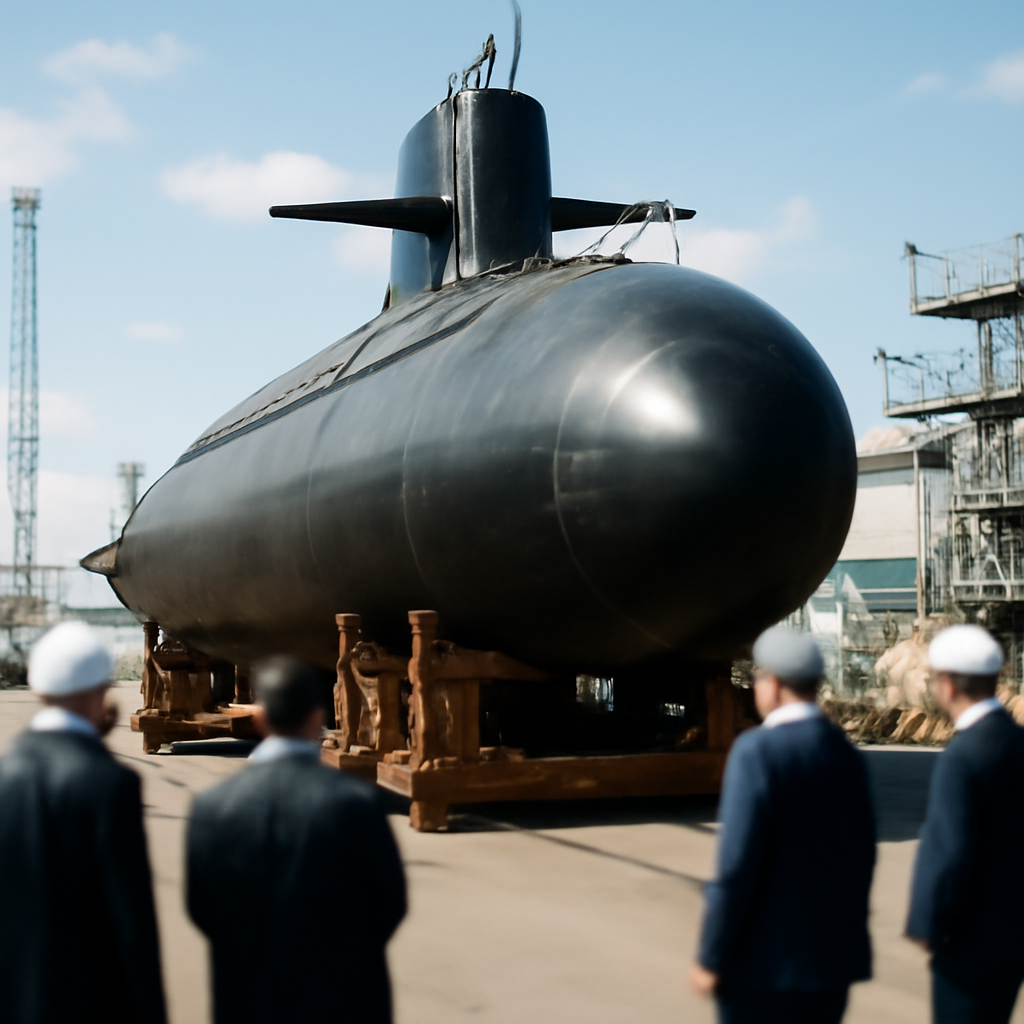
"To have a long-range capable submarine in the 2030s and 40s, it will need to have nuclear propulsion. And the one avenue which gives us the greatest sovereignty to achieve that is through a technology transfer from the United Kingdom and the US jointly to Australia," Deputy Prime Minister Richard Marles told the ASPI Defence Conference in Canberra.
AUKUS Pillar One and Australia's submarine fleet
At the ASPI Defence Conference on Thursday, Marles — who is also Australia’s defence minister — framed Pillar One of the AUKUS partnership as a choice about maintaining sovereign long-range submarine capability into the 2030s and 2040s. He said critics were "just not engaging with details" and set out a simple train of logic: without a long-range submarine capability Australia would be far more dependent on the US. He added that submarines will be "harder to operate" in those decades and therefore must be "so much more capable."
Why nuclear propulsion, according to Richard Marles and Peter Dutton
Marles drew a direct line from operational demands to propulsion. He argued that a long-range capability in the 2030s and 40s would require nuclear propulsion, and that the path to sovereignty on that technology is a joint technology transfer from the United Kingdom and the United States.
Marles did not elaborate on the technical details at the conference. The case was set out more fully by former defence minister Peter Dutton in 2022, when Dutton wrote in The Australian that experts had advised diesel submarines would be unviable against China in the South China Sea beyond 2035. Dutton described how new radar technologies would detect diesel boats when they extended breathing pipes, called snorts, above the waves to run engines for battery recharging — an activity nuclear submarines do not need to perform.

Audit-ready is a season. It shouldn't be.
Evidence in spreadsheets, controls drifting between audits, frameworks multiplying on flat headcount. Nubivance runs continuous compliance on Rapid7 Cyber GRC - SOC 2, HIPAA, ISO 27001, PCI, CMMC.
End the scrambleA shrinking club: who operates what today
Marles said the result of rising operational difficulty will be that submarine operation becomes the province of a smaller group of countries. The source material notes current patterns: the United States, Britain and France "gave up on diesel submarines decades ago" and "all their submarines are nuclear." China, by contrast, still builds diesel submarines as well as nuclear ones. Several Southeast Asian countries have acquired their first submarines since the 1990s — all diesels — and presumably operate or intend to operate them in the South China Sea.
Planned submarines and timeline under AUKUS Pillar One
Pillar One's specific fleet plans, as set out in the reporting, call for Australia to receive three second‑hand US Virginia‑class submarines in the 2030s. Beginning in the 2040s Australia is due to receive five boats of the SSN‑AUKUS class, to be built in a joint program with Britain. Those nuclear boats are intended to replace six diesel Collins‑class submarines that were commissioned between 1996 and 2003.
What this means for Australia, Japan, and South Korea
- Australia: Marles frames a binary choice — maintain and invest in submarine capability, and "be part of a smaller group of countries which do it, with more sovereignty as a result," or "let it go" and operate at a capability lower than in the year 2000.
- Japan: The story notes Japan operates more than 20 diesel submarines, and that the Japan Innovation Party — a member of the ruling coalition — called last week for a switch to nuclear propulsion.
- South Korea: The reporting records that South Korea, which has a similarly numerous fleet of diesel submarines, "has already launched a project to build nuclear boats."
Marles positioned Pillar One as a sovereignty-preserving program anchored in technology transfer from the United Kingdom and the United States. The immediate concrete steps on the timeline are the three Virginia‑class boats in the 2030s and the SSN‑AUKUS class beginning in the 2040s to replace the Collins class. Beyond those dates lie the operational assumptions Marles and others have cited: that detection technologies and evolving operating environments will make diesel propulsion increasingly impractical for countries seeking long-range, stealthy patrols in the decades ahead.
https://www.aspistrategist.org.au/aukus-to-keep-australia-in-a-shrinking-submarine-club-marles/