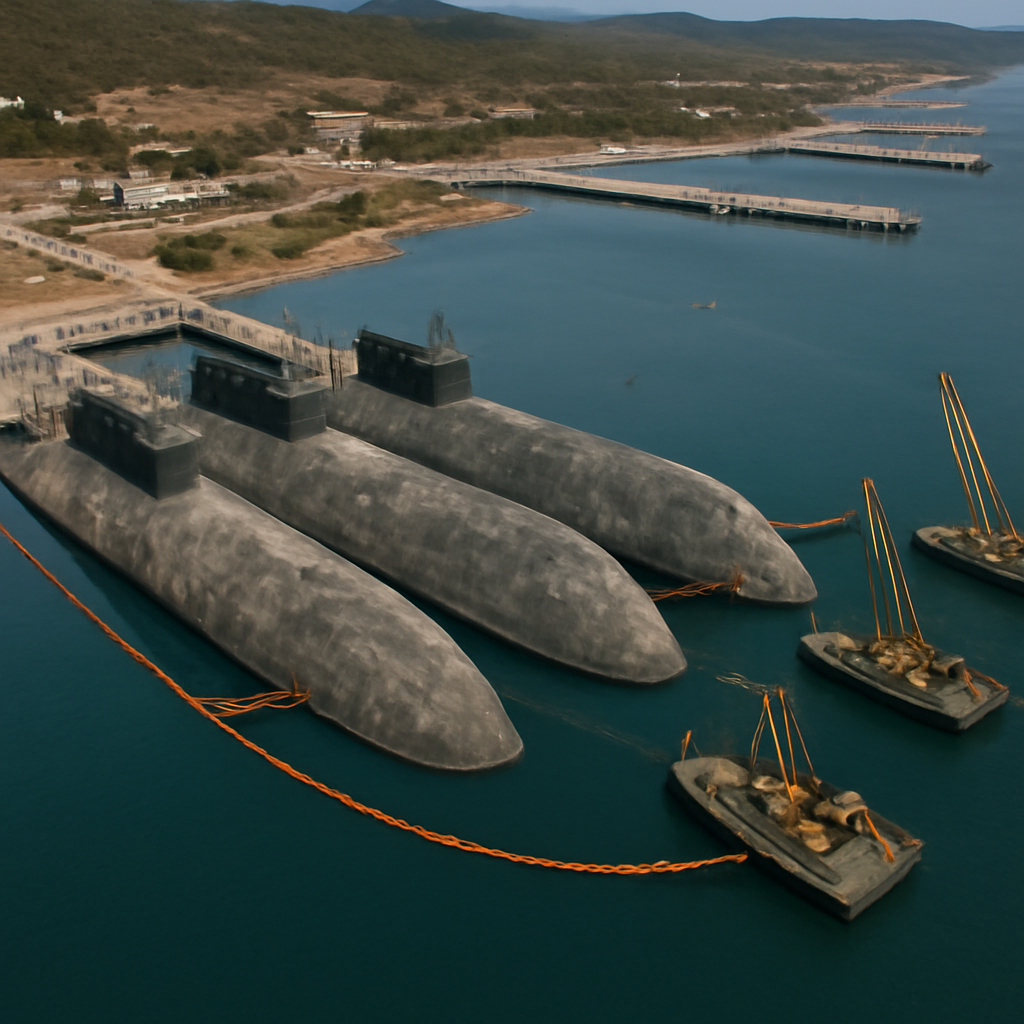
Satellite imagery dated August 4, 2026, shows multiple Russian Navy submarines at the Rybachiy base on the Kamchatka Peninsula fully covered by netting, an unusual sight at a facility home to the bulk of Russia’s Borei and Borei-A class nuclear ballistic missile submarines.
Rybachiy: nets, crane barges, and floating booms
Commercial imagery obtained by TWZ from Vantor and first reported by Business Insider shows elaborate netting draped over submarines moored at Rybachiy on August 4, 2026. Additional Vantor imagery from May 12, 2026, depicts crane barges being used to erect the same equipment, indicating the effort began at least in May. Floating booms are also visible strung around the piers at Rybachiy, a measure the imagery shows is now commonplace at Russian naval bases and intended to provide an additional barrier against surface threats such as explosive-laden kamikaze drone boats.
Novorossiysk: cages over conning towers and submerged Kilos
The United Kingdom’s Ministry of Defence published Vantor imagery from June 13, 2026, showing Kilo-class attack submarines in port at Novorossiysk. Three of the boats appeared to have anti-drone armor screens installed over their conning towers; imagery in Planet Labs’ archive suggested those screens were a relatively new addition at the time. The same June 13 images show several of the submarines partially submerged within the basin, with their conning towers still visible above the waterline. TWZ obtained that Vantor image directly and a follow-up Vantor image from June 17 shows the boats surfaced and moored in the usual manner.

Audit-ready is a season. It shouldn't be.
Evidence in spreadsheets, controls drifting between audits, frameworks multiplying on flat headcount. Nubivance runs continuous compliance on Rapid7 Cyber GRC - SOC 2, HIPAA, ISO 27001, PCI, CMMC.
End the scrambleBritish assessment: counter-UAS cages and force prioritization
The Ministry of Defence in the United Kingdom assessed the Novorossiysk imagery and noted: “The Russian Black Sea Fleet has equipped three of its four Kilo class submarines with counter-UAS [uncrewed aerial systems] cages covering the vessels’ conning towers. This was applied as a preventive measure in response to Ukraine’s increased ability to strike targets further from the front line.” The UK assessment added that a fourth submarine without a cage had “slipped its mooring lines, manoeuvred away from nearby surface vessels and submerged within the harbour,” and that the lack of a counter-UAS cage “likely signifies this vessel has been de-prioritised compared to the other three.”
Pattern: counter-drone shielding, evolving since 2024
The netting and armor screens at Rybachiy and Novorossiysk are consistent with counter-drone measures Russian forces have previously used in and around Ukraine and observed elsewhere globally. The reporting cites earlier instances in 2024: Novorossiysk showed a painted submarine silhouette and a mock conning tower on a pier, and the Delta-IV class SSBN Tula received a rudimentary overhead protection in Gadzhiyevo. The current screens over Novorossiysk and the more extensive coverings at Rybachiy represent a marked escalation in coverage and complexity compared with those earlier measures.
What this means for the Russian Navy, the United Kingdom’s defence analysts, and Ukrainian forces
- Russian Navy: The imagery indicates an expanded force-protection posture at both Pacific and Black Sea bases, employing both physical netting and floating booms to defend high-value submarines at their moorings.
- United Kingdom’s Ministry of Defence and Western analysts: The MoD’s public assessment frames the cages as preventive responses to Ukraine’s growing strike reach, and the imagery sequence (submerged on June 13, surfaced on June 17) raises questions about operational readiness, force prioritization, or short-notice protective measures.
- Ukrainian forces: The reporting links these defensive steps explicitly to the expanding set of Ukrainian offensive capabilities — including long-range kamikaze drones, cruise missiles, and uncrewed surface vessels — that have put targets deep inside Russian territory and maritime zones at risk.
The visible expansion of counter-drone defenses at Rybachiy, thousands of miles from the front lines, underscores that the threat environment prompting these measures is not confined to nearby bases. The record in the reporting connects these precautions to a suite of Ukrainian tactics: routine long-range strikes across western Russia, kamikaze USVs operating in the Black Sea, operations that have targeted Novorossiysk and Crimean bases, and the use of long-range drones equipped with miniaturized satellite communications to engage moving targets. The imagery raises practical questions about the durability and operational limits of physical shields — whether they will deter or merely complicate attacks — and it leaves open whether temporary submergence and other hardening measures will become routine across other high-value naval facilities.
Original reporting: TWZ — Russian Nuclear Ballistic Missile Submarines Are Now Cocooned In Nets