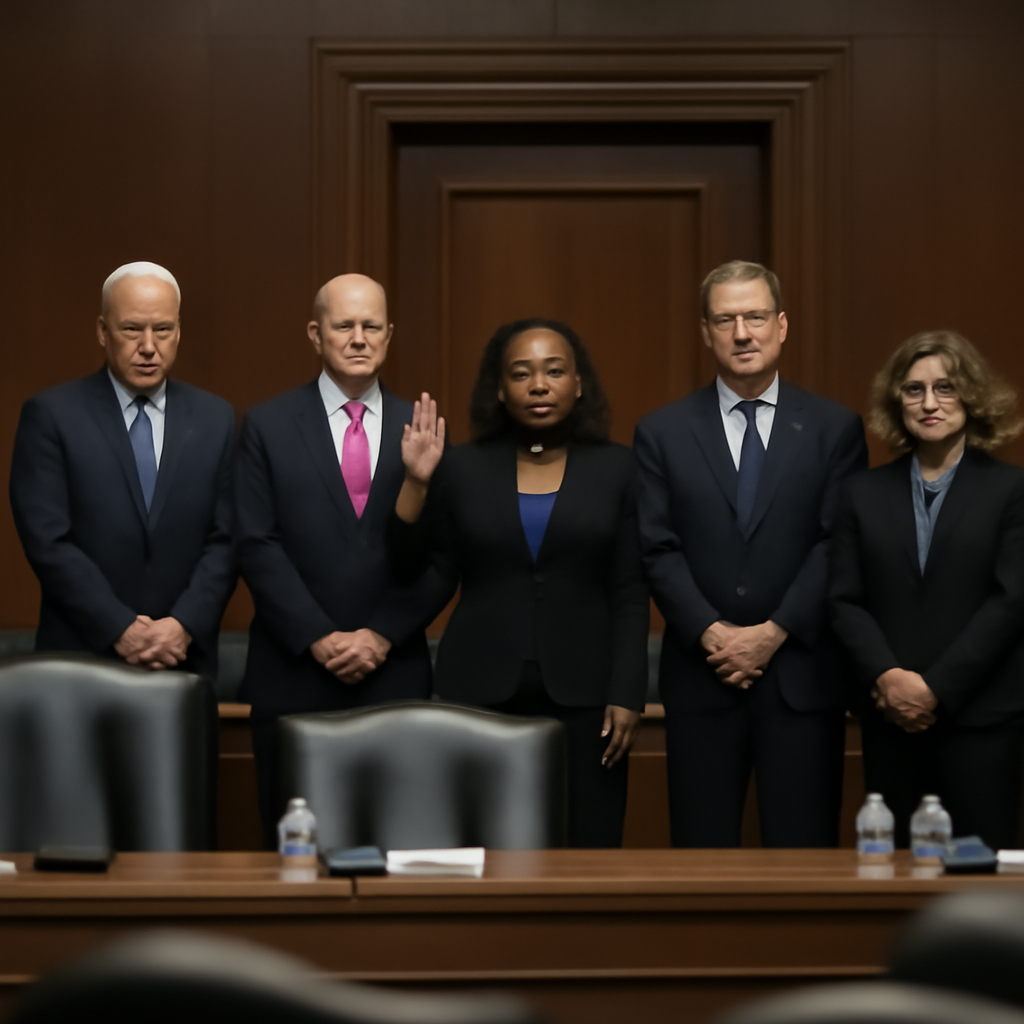
“The Senate voted 51-47 for Jules ‘Jay’ Hurst” — a narrow margin that ends 18 months without a confirmed Pentagon comptroller and places a familiar actor back at the center of defense budgeting at a time of intense fiscal pressure.
Senate confirmation votes and the new leadership lineup
The Senate approved a package of confirmations that included Jules “Jay” Hurst as Pentagon comptroller by a 51-47 vote and cleared 74 other nominees in the same voting bloc. The package also confirmed Erich Hernandez-Baquero as the Air Force assistant secretary for space acquisition and integration and approved Roger Mason as director of the National Reconnaissance Office (NRO).
Hernandez-Baquero, known publicly as “HB,” will replace Thomas Ainsworth, who was serving as the acting space acquisition lead at the Pentagon. Roger Mason, described in the Senate action as the Trump administration’s nominee to head the NRO, moves from industry — currently an executive at defense contractor V2X — to lead the spy-satellite agency, replacing the long-serving Chris Scolese.
Jules “Jay” Hurst’s stated priorities and immediate fiscal responsibilities
Hurst, who performed the duties of comptroller from August 2025 until May — stepping away after the White House appointed him to take over the role full time — will resume oversight of defense budgets and spending plans once sworn in. At his mid-July confirmation hearing he vowed to focus on three main priorities if confirmed: passing a clean audit by 2028; constructing budgets that align with ongoing evolutions in warfare while expanding the industrial base; and improving financial management systems and processes.
The incoming comptroller faces a heavy near-term agenda. Hurst will oversee Iran spending and associated supplemental funding expected to be in the tens of billions of dollars, manage the fiscal 2027 spending request that has not yet been approved, and craft the FY28 budget request. Simultaneously, his office confronts a contract-timing constraint tied to reconciliation funds: $152 billion in 2025 reconciliation spending must be under contract by the end of September or the remaining balance risks an 8.3 percent cut.

The cyber insurance questionnaire just landed. Now what?
SOC 2, HIPAA, insurance renewals - someone has to own security strategy. Nubivance provides fractional CISO leadership without the full-time salary.
Get a security leadSpace acquisition leadership and a rapidly growing investment profile
Erich Hernandez-Baquero will take on a role created by Congress in the 2020 National Defense Authorization Act and will be only the second permanent appointee to the post, following Frank Calvelli. The position carries responsibility for overseeing all Space Force acquisition programs.
The Space Force’s investment profile is expanding sharply on paper: the service’s FY27 budget includes approximately $59 billion in research and procurement, up from $18.9 billion in FY26. Hernandez-Baquero will manage that growth while implementing a major workforce realignment under the Space Force’s new portfolio acquisition executive (PAE) structure — a reorganization mandated by Defense Secretary Pete Hegseth. The Space Force announced on June 10 that it finalized the acquisition reorganization, adding three more PAEs to the six previously announced for a total of nine; the three newest PAEs cover Advanced Capabilities, Electromagnetic Warfare and Cyber, and Space Combat Power.
NRO leadership transition: Roger Mason’s background and the agency’s continuity
Roger Mason, who served from 2009 to 2014 as the first assistant director of national intelligence for systems and resource analyses within the Office of the Director of National Intelligence (ODNI), comes to the NRO from the private sector as an executive at V2X. The Senate’s approval installs him to replace Chris Scolese at the helm of the spy-satellite agency.
Mason’s confirmation closes a leadership chapter at the NRO and places an experienced intelligence systems and resource-analysis veteran in charge of an agency responsible for national reconnaissance programs.
What this means for Pentagon budget managers, Space Force acquisition leaders, and the NRO
- Defense budget managers and the comptroller’s office: They will be responsible for executing large supplemental spending around Iran, shepherding the FY27 request through an uncompleted approval process, and preparing the FY28 request — all while meeting an end-of-September contracting deadline tied to $152 billion in reconciliation funds to avoid an 8.3 percent cut.
- Space Force acquisition leaders and industry partners: The confirmation of Hernandez-Baquero coincides with a steep budget increase on the FY27 books (roughly $59 billion for research and procurement) and a mandated PAE-driven workforce realignment to nine PAEs, which will reshape acquisition portfolios for Advanced Capabilities, Electromagnetic Warfare and Cyber, and Space Combat Power.
- The NRO and intelligence program managers: With Roger Mason moving from industry back into government leadership and a background in ODNI systems and resource analyses, the agency will see continuity in experienced leadership as it transitions to Mason’s stewardship following Chris Scolese’s tenure.
The Senate votes close a period of acting leadership across several acquisition and intelligence posts and set new officials to confront a crowded calendar of fiscal deadlines and organizational changes. Hurst’s confirmation in particular ties leadership of the Pentagon’s purse strings to an immediate sequence of tasks — supplemental Iran funding, reconciliation contracting thresholds, and FY27/FY28 budget cycles — that will test the priorities he outlined at his hearing. The next measurable markers will be whether the comptroller’s office can meet the contracting deadline by the end of September and how quickly the Space Force’s acquisition reorganization and expanded FY27 investments move from plan to execution.