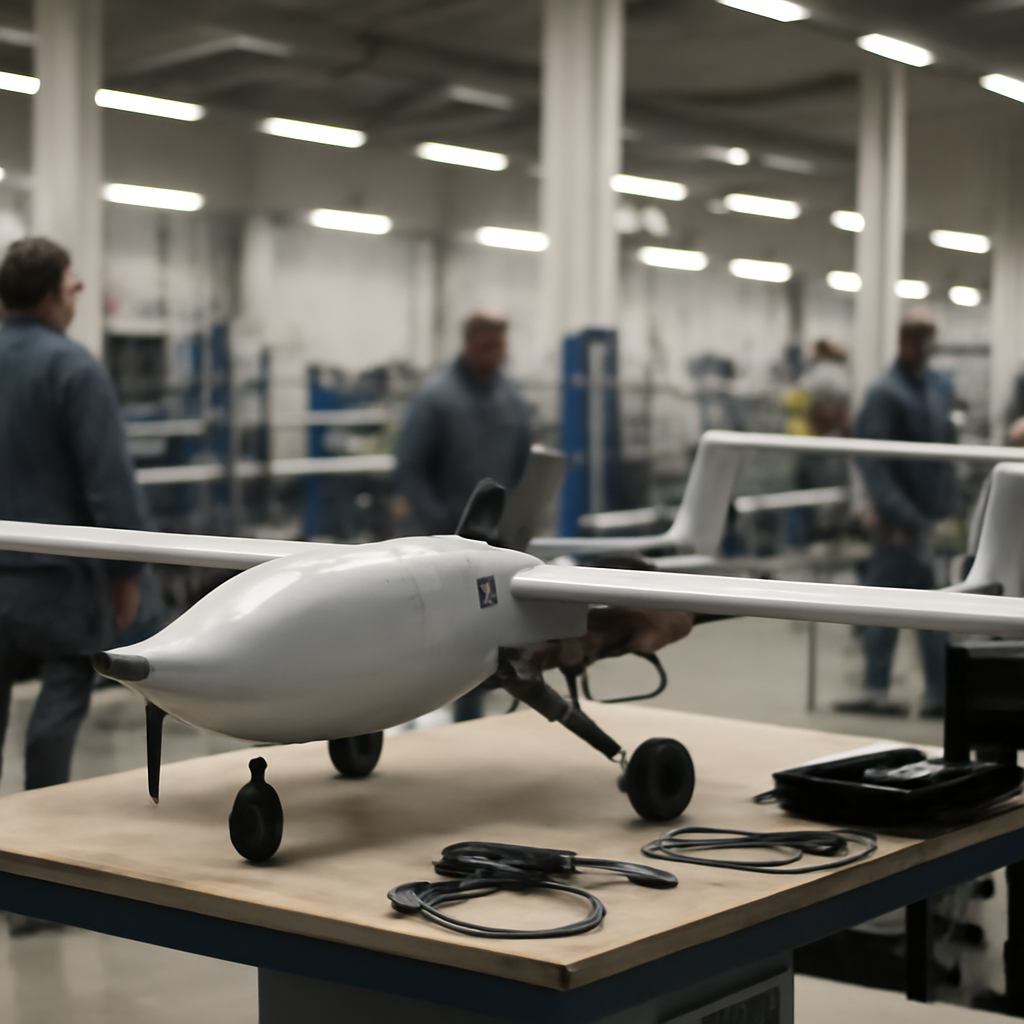
“AUKUS countries have established defense trade exemptions for around 80 percent of U.S. defense exports to Australia and the U.K. that were previously subject to the International Traffic in Arms Regulations (ITAR).” That regulatory milestone sits alongside a different story: critics who say Pillar II has been “failing” to deliver capabilities quickly enough, five years after the partnership’s launch.
Pillar II’s stated aims: six advanced-technology workstreams
Pillar II, labelled “Advanced Capabilities,” set out a broad agenda. The three partners agreed to collaborate across six technology areas: artificial intelligence (AI) and autonomy, cyber, electronic warfare, hypersonics and counter-hypersonics, quantum, and undersea warfare. The initiative is explicitly framed as joint development, fielding, and production of advanced military capabilities and of changes to the domestic “enabling environment” to permit deeper information and technology sharing among the three countries.
Demonstrations, a deployed AI algorithm, and the first signature project
Progress has been uneven but tangible in some places. Public reporting highlights cooperative research, development, and testing across Pillar II workstreams. One concrete example is a jointly developed AI algorithm for reconnaissance aircraft that was unveiled in December 2023 and used operationally in August 2025. After years without a clear, branded deliverable, AUKUS leaders announced the first Pillar II signature project in May 2026: jointly producing shared payloads and systems for uncrewed underwater vehicles (UUVs) by 2027.

Audit-ready is a season. It shouldn't be.
Evidence in spreadsheets, controls drifting between audits, frameworks multiplying on flat headcount. Nubivance runs continuous compliance on Rapid7 Cyber GRC - SOC 2, HIPAA, ISO 27001, PCI, CMMC.
End the scrambleRegulatory alignment: the 80 percent win and the remaining 20 percent
Perhaps Pillar II’s most visible achievement has been regulatory reform. The three countries have negotiated defense trade exemptions that cover roughly 80 percent of U.S. defense exports to Australia and the U.K. that were previously subject to ITAR. Experts cited in reporting agree these reforms are necessary to facilitate technology and industrial cooperation.
Yet about 20 percent of intra-AUKUS defense trade remains outside those exemptions as of September 2026. The uncovered areas include undersea acoustics, missile technology controlled under the Missile Technology Control Regime (MTCR), and sensitive technical data and source code connected to advanced weapons and fire-control systems. Addressing those gaps will require reconciling U.S. concerns about protecting sensitive technologies, maintaining competition in the U.S. defense industrial base, meeting non-proliferation obligations, and preventing compromise by strategic competitors.
Structural constraints: funding, scope, and competing national priorities
Pillar II’s breadth is both its promise and its problem. Unlike Pillar I — which is underpinned by clear national funding architectures tied to the acquisition and construction of nuclear-powered submarines — Pillar II cuts across many national programs and has had to draw resources from existing capability priorities. The partnership has not established a single dedicated funding stream; instead, its lines of effort must access national resources that are already in demand.
That diffusion has prompted calls for narrowing priorities. The U.K. Parliament’s Defense Committee concluded in its April 2026 AUKUS report that the breadth of Pillar II had become an impediment to delivery. The Pentagon, too, scaled back in late 2025 an initial list of 14 critical technologies to six: applied AI, biomanufacturing, contested logistics technologies, quantum and battlefield information dominance, scaled directed energy, and scaled hypersonics. AUKUS leaders have not yet clarified whether Pillar II will realign formally to operational challenges rather than its original technology categories.
What this means for technologists, policymakers, and naval planners
- Technologists and security teams: The deployed AI reconnaissance algorithm (unveiled December 2023, operational August 2025) demonstrates that joint R&D can move from labs to the field. These teams will watch whether the May 2026 UUV payload project meets its 2027 production goal and how remaining export controls affect access to source code and sensitive data.
- Policymakers and regulators: The remaining 20 percent of exports not covered by exemptions highlights the work left on export controls, MTCR-related missile technologies, undersea acoustics, and non-proliferation compliance. Resolving those issues requires balancing technology protection, industrial competition, and treaty obligations.
- Naval planners and procurement leads: The UUV signature project complements Pillar I’s undersea emphasis and offers interim maritime capabilities while national submarine programs proceed — Australia expects its first Virginia-class submarine in 2032, the U.S. is targeting an increase in submarine production from roughly 1.2–1.3 boats per year toward 2.33 per year, and the U.K. is focused on sustainment while Astute-class boats are in maintenance. The UUV effort is therefore a near-term operational hedge.
Pillar II’s record at five years is a mixed ledger: clear regulatory gains, selective operational demonstrations, and now a first signature project — counterbalanced by unresolved export-control gaps, dispersed resourcing, and debate over whether the initiative should narrow its focus. The partnership has established important groundwork; the coming 12–36 months will show whether that groundwork can be translated into the promised shared capabilities before national priorities and sensitive-technology limits reassert themselves.