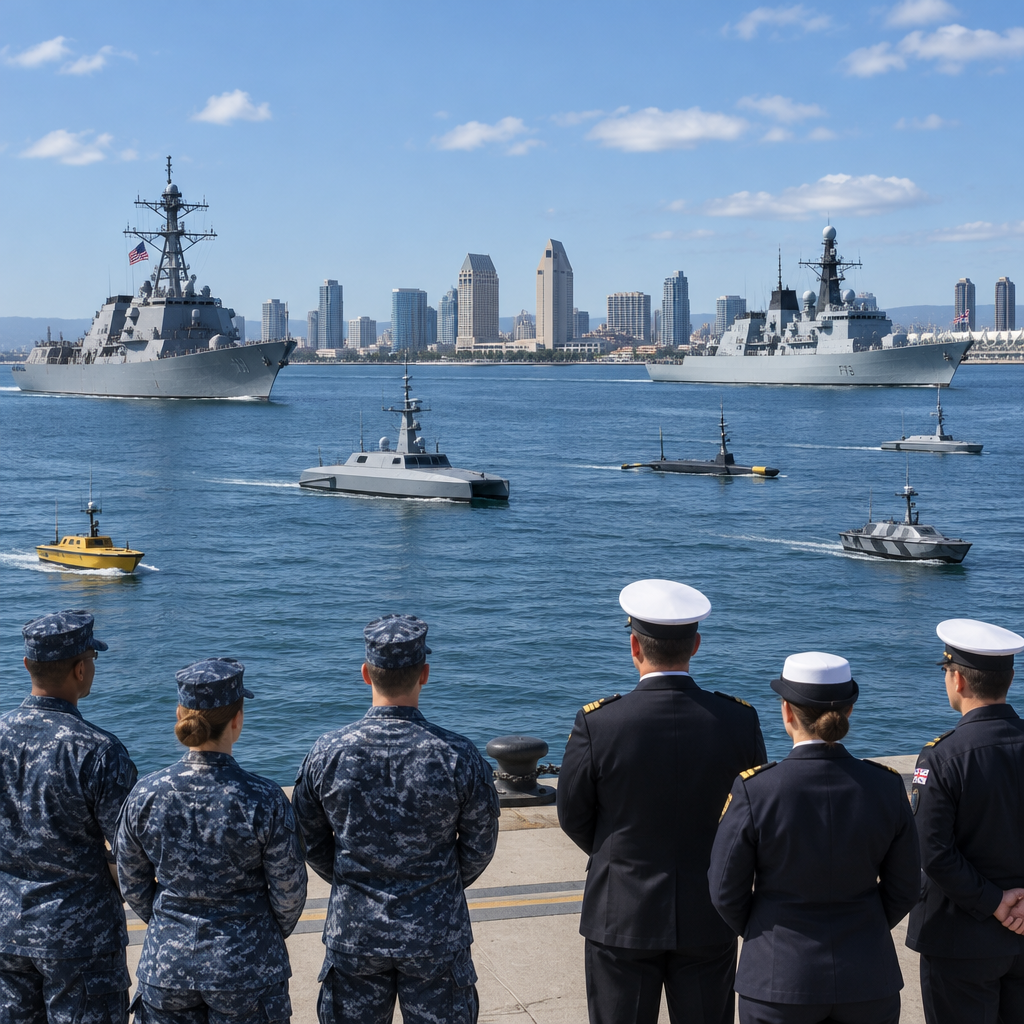
"Maritime Big Play demonstrates the real, tangible progress we are making with our AUKUS partners to deliver cutting‑edge autonomous capability at sea," Second Sea Lord Vice Adm. Paul Beattie said in a statement this month.
Maritime Big Play: the exercise and its stated goals
The United States, the United Kingdom and Australia completed a naval exercise off the coast of San Diego this month that the Royal Navy described as the three countries’ “largest ever demonstration of uncrewed and autonomous technology” under AUKUS Pillar II. The US Navy said the drill’s ultimate goal was to “achieve milestones in integrating mature robotics and autonomous systems within AUKUS coalition maritime operations.” According to the Royal Navy, Maritime Big Play was designed to showcase more than 40 technologies from the three AUKUS partners, spanning manned, unmanned and “multi‑domain autonomous” systems.
Anti‑submarine warfare focus and the mix of systems
The Royal Navy led the anti‑submarine warfare (ASW) portion of the exercise, employing “a range of uncrewed surface vessels, underwater gliders, drones and subsea vehicles,” and emphasizing both manned and unmanned systems for tracking and surveillance missions. The partners integrated autonomous systems into maritime operations that included tracking underwater threats and sharing data across platforms. The Royal Navy did not respond to a request for comment about how many and which specific unmanned systems were used.

This site is the portfolio.
OSINTSights runs on Cloudflare Workers, D1, R2, and Vectorize, with an AI pipeline on Hetzner ARM. Nubivance designed, built, and operates it. We do the same for clients.
See what we buildNew undersea sensor payloads and the 2027 timeline
At the close of Maritime Big Play the UK Ministry of Defence announced that the United Kingdom would lead development of three advanced undersea sensor payloads for unmanned systems that the ministry said would become “available” to the UK, Australia and the US in 2027, in support of AUKUS. The payloads are described as a synthetic aperture sonar, a deployable anti‑submarine warfare sensor and a deployable non‑kinetic effector. The ministry said the systems will be designed to conduct surveillance, collect underwater information and dispatch sensors that can track and identify underwater threats.
That announcement sits alongside the AUKUS framework’s existing commitments: the partners established AUKUS in 2021, with Pillar I focused on providing Australia with Virginia‑class nuclear‑powered submarines by 2032 and Pillar II on jointly developing and fielding advanced military capabilities.
European demand for maritime surveillance: north and south
The exercise comes as European nations weigh how to expand maritime surveillance using autonomous systems, with differing regional priorities. Bryan Clark, director of the Hudson Institute’s Center for Defense Concepts and Technologies, told Breaking Defense that countries in southern Europe tend to combine uncrewed aircraft with manned patrol ships to intercept migrants, while northern countries are buying manned ASW patrol aircraft such as the P‑8A Poseidon or Atlantique alongside uncrewed aircraft like the MQ‑9B SkyGuardian.
Zak Schneider, a visiting fellow at the Casimir Pulaski Foundation in Warsaw, emphasized the role maritime surveillance platforms play in monitoring Russia’s activity in the European theater. “Sensors, ISR, intel and other data feeds are vital to being able to act on/forecast in advance new attacks in the maritime domain,” Schneider told Breaking Defense, adding that surveillance increasingly depends on a proliferation of sensors, detectors and reconnaissance that can feed data into larger systems.
What this means for AUKUS naval operators, European policymakers, and technologists/procurement leaders
- AUKUS naval operators: Exercises like Maritime Big Play are intended to validate integration concepts—sharing data across manned and unmanned platforms and combining assets in ASW missions—while preparing for the UK‑led sensor payloads that the Ministry of Defence says will be made available in 2027.
- European policymakers and maritime patrol forces: The reported north/south differentiation in capability priorities — manned ASW aircraft plus uncrewed aircraft in the north; uncrewed aircraft plus manned patrol ships in the south — will shape procurement choices and interoperability demands as countries seek to plug surveillance gaps highlighted by regional security concerns.
- Technologists and procurement leaders: The commitment to field synthetic aperture sonar, deployable ASW sensors and non‑kinetic effectors for unmanned platforms creates a near‑term integration milestone (2027) that will require work on sensor integration, data sharing and platform commonality across three partner navies.
Maritime Big Play underlines two concurrent trajectories: rapid experimentation with unmanned systems in coalition operations, and an equally deliberate push to field advanced undersea sensors on a fixed timetable. The exercise showcased concepts for tracking underwater threats and sharing data across domains; the UK’s pledge to lead three payload developments sets a clear technical deliverable for 2027. Whether those systems will meet the interoperability and operational demands European and AUKUS navies see remains the practical question raised by the exercise itself.