"I think [industry has] the challenge of understanding what the demand signal is, and then again where to put their dollars," Warren Sponsler, chief operating officer of the National Advanced Mobility Consortium, said in a recent interview.
Warren Sponsler on why industry hesitates to scale UGV production
Sponsler, whose nonprofit NAMC positions itself as a bridge between the Pentagon and private firms working on ground drones, framed the core problem bluntly: companies want to know "what’s next" before committing capital. He said industry commitment exists, but the Army's commitment is "not distinct," a condition that discourages firms from investing in production capacity and supply chains.
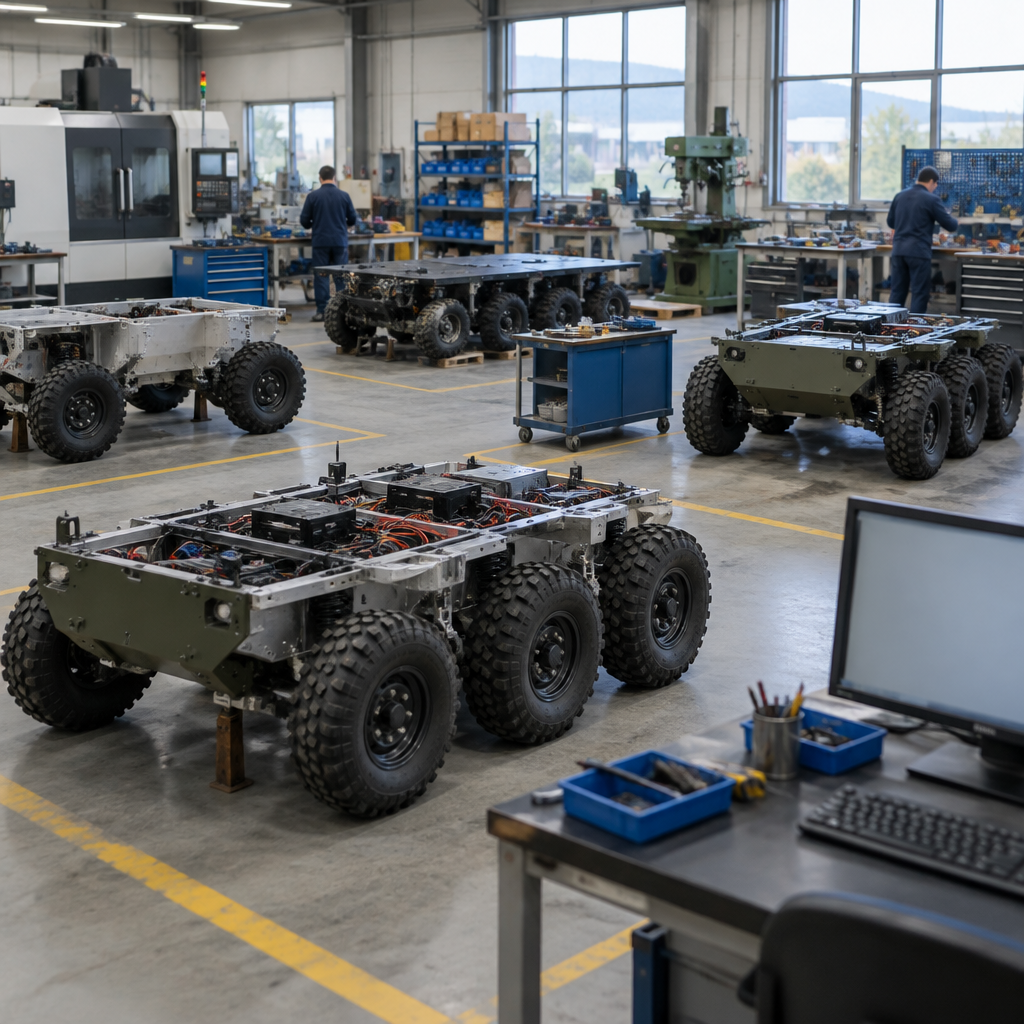
That hesitation plays out in practical terms: companies begin ordering parts and stressing suppliers before the Army has finalized contract mechanisms or defined specific capabilities, Sponsler said. The consequence, in his view, is a mismatch between industrial investment and the Army’s evolving acquisition posture — a barrier to producing unmanned ground vehicles (UGVs) at scale.
Army demonstrations and the "murky" demand signal
Sponsler described Army-sponsored demonstrations and exercises as an uneven signal to the market. While the Army has invited industry to field ground autonomy platforms at numerous events, Sponsler said the sheer number of opportunities and unclear mission objectives leave companies uncertain where to focus limited time and money.
"There are so many opportunities right now, and then companies, especially those small companies, are having to make often hard decisions as to which experiments they participate in, and which ones they choose not to," he said. He recommended "focusing some of the demonstration experimentation activities" to provide clearer direction to vendors about which capabilities the service intends to prioritize.

The cyber insurance questionnaire just landed. Now what?
SOC 2, HIPAA, insurance renewals - someone has to own security strategy. Nubivance provides fractional CISO leadership without the full-time salary.
Get a security leadFUZE xTech competitions: a clearer route to contracts
Sponsler held up the Army’s FUZE venture capital acquisition hub and its xTech competitions as a comparatively effective model. xTech demonstrations are embedded in larger competitions that culminate in contract awards — for example, demonstrations tied to autonomous logistics and sustainment and to autonomous breaching. In those cases, Sponsler said, the "path to revenue" is clear because companies can see how a demonstration connects to a potential contract.
He urged companies, "especially the nontraditionals," to enter such competitions, while also watching the Army’s programs of record as indicators of where the service plans to spend money.
Shifting programs of record: UxS, RCV, Project Sustainment, and Engineer Autonomous Breaching Capability
The Army’s program structure for ground autonomy has itself been in flux, complicating industry planning. Sponsler noted that within roughly 18 months the service altered its UxS program of record: the former Robotic Combat Vehicle (RCV) effort was transformed into the Unmanned Ground Commercial Robotic Vehicle program and then dispersed into Project Sustainment and the Engineer Autonomous Breaching Capability program.
The Army also relocated its acquisition office for autonomy, established a separate Portfolio Acquisition Executive for autonomy, and redesignated its Futures and Concepts Command as the Army Futures and Autonomous Systems Command (FASCOM). These moves reflect significant internal reorganization that, Sponsler suggested, has contributed to the lack of a steady, coherent demand signal for industry.
What this means for nontraditional vendors, small companies, and Army acquisition leaders
- Nontraditional vendors: Sponsler recommended entering targeted competitions such as xTech where the connection between demonstration and contract is explicit, giving these firms a clearer route to revenue rather than relying on uncertain exercise participation.
- Small companies: With limited resources, small outfits must be selective about demonstrations; they will benefit from a narrower set of focused experiments that signal which capabilities the Army will actually field and buy.
- Army acquisition leaders: Sponsler argued that clearer articulation of programs of record and more consistent contract mechanisms would help industry align investment and production. He said sustained follow-through on programs is "critical to maintain that relationship between government and industry."
Sponsler expressed guarded optimism that organizational changes could help. He said the newly redesignated Army Futures and Autonomous Systems Command and the Pentagon’s proposed Autonomous Warfare Command (AUTOWARCOM) should, in his view, "allow the Army and the Pentagon’s autonomy efforts to be better streamlined." He noted one explicit constraint: AUTOWARCOM "has yet to be formally established since it requires Congressional approval."
He argued the new structures should provide "additional focus to robotics and autonomy integration at the formation level, looking beyond a product and more to a capability," and help "align resources and leadership to best prioritize based on the services’ needs" while mitigating duplicative efforts across domains.
The message from NAMC’s COO is straightforward: industry will scale UGV production if it can see distinct, reliable signals that purchases and programs will follow demonstrations. Absent that clarity — and with programs and offices still moving around inside the Army and Pentagon — companies will continue to weigh risky investments against an uncertain pathway to revenue.