Can unmanned refueling aircraft change how the Army operates its new tiltrotors? The question surfaced in a recent post on The War Zone, which reports that the Army and Bell have looked to a Navy program as a possible model for aerial refueling of the service's next-generation tiltrotor.
What the Army and Bell have pointed to
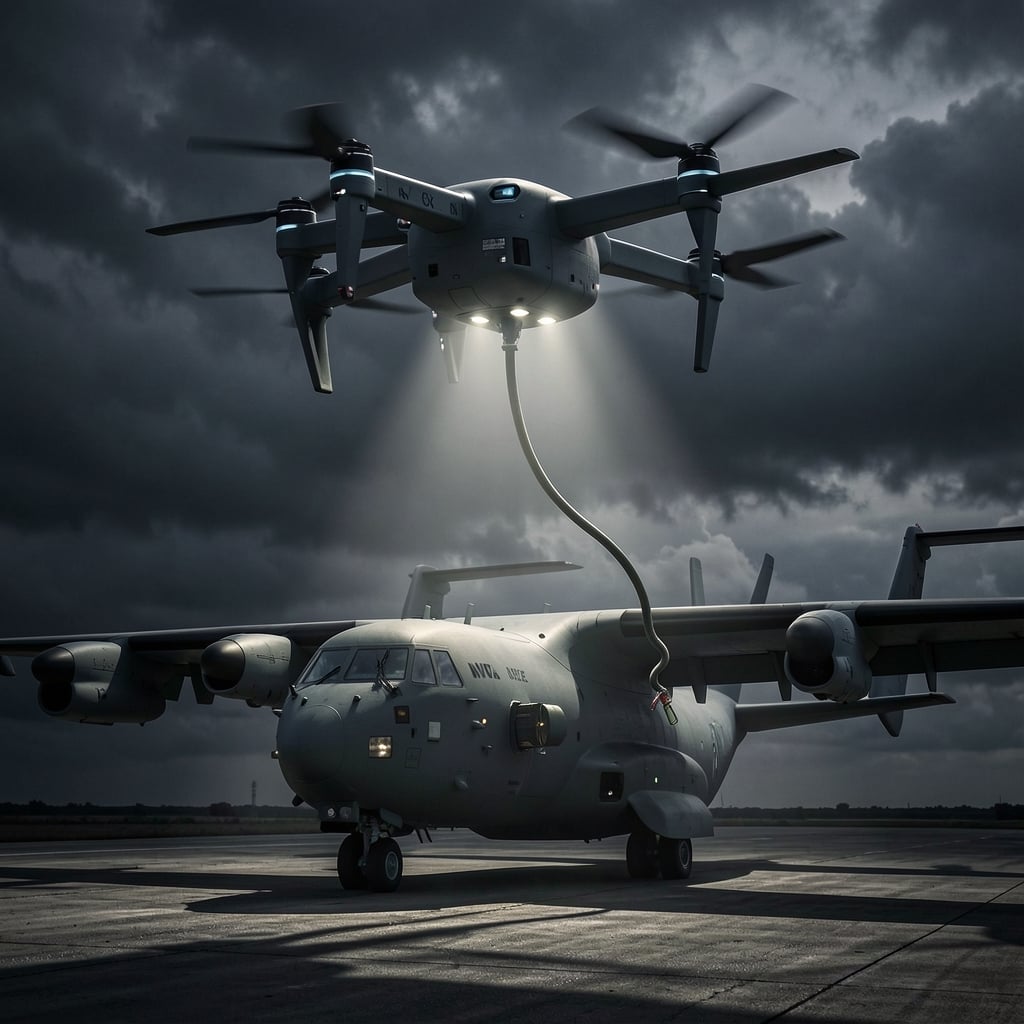
According to The War Zone, the Army and Bell have pointed to the U.S. Navy's MQ-25 Stingray drone tanker as an example of what could be on the horizon. That linkage frames the MQ-25 as a reference point for thinking about unmanned aerial refueling in a different service context.
The platform at the center: the MV-75 Cheyenne II tiltrotors
The discussion in The War Zone centers on refueling options for the new MV-75 Cheyenne II tiltrotors. The report notes the Army and Bell’s invocation of the MQ-25 Stingray when considering how drone tankers might support those tiltrotors.

Audit-ready is a season. It shouldn't be.
Evidence in spreadsheets, controls drifting between audits, frameworks multiplying on flat headcount. Nubivance runs continuous compliance on Rapid7 Cyber GRC - SOC 2, HIPAA, ISO 27001, PCI, CMMC.
End the scrambleWhy the comparison matters — questions to consider
Pointing to the MQ-25 raises several practical and strategic questions without committing to specific conclusions. Could an unmanned tanker architecture developed for naval operations offer useful design or operational lessons for Army tiltrotors? What interoperability, basing, or command-and-control issues would follow if unmanned refueling were adopted across services? How might users assess risk and benefit when applying a model built for one service to another?
Those are not assertions of policy or procurement decisions; they are the kinds of considerations the Army and Bell implicitly surface by using the MQ-25 as an example, according to The War Zone report.
Open questions and a closing thought
The War Zone item raises the prospect that unmanned refueling — exemplified by the MQ-25 Stingray in Navy service — could inform the Army’s approach to extending the reach of the MV-75 Cheyenne II tiltrotors. It leaves open how closely a naval drone-tanker model would map to Army requirements and what trade-offs that mapping would require.
If a cross‑service example like the MQ-25 becomes a template, will the operational benefits outweigh the challenges of adapting a naval concept for Army tiltrotors — or will the differences in missions and environments demand a distinct approach?