“There’s other aspects that we are absolutely evaluating, but that one is hyper important to me, and we are actually going to evaluate that as part of this selection process,” Brig. Gen. Troy Denomy said, summing the Army’s intent to make open systems architecture a decisive factor in selecting the XM30 winner.
Brig. Gen. Troy Denomy on open systems architecture
Denomy, the portfolio acquisition executive for ground maneuver, told Breaking Defense at the annual AUSA conference that the ability to rapidly adapt platforms and integrate new hardware and software will figure centrally in the XM30 downselect. He framed open systems architecture not as a checkbox but as operational necessity — particularly to keep pace with evolving threats such as the counter-unmanned aerial systems fight. Denomy added that the Army will evaluate openness as part of the formal selection process.
Prototypes and testing at Aberdeen Proving Ground
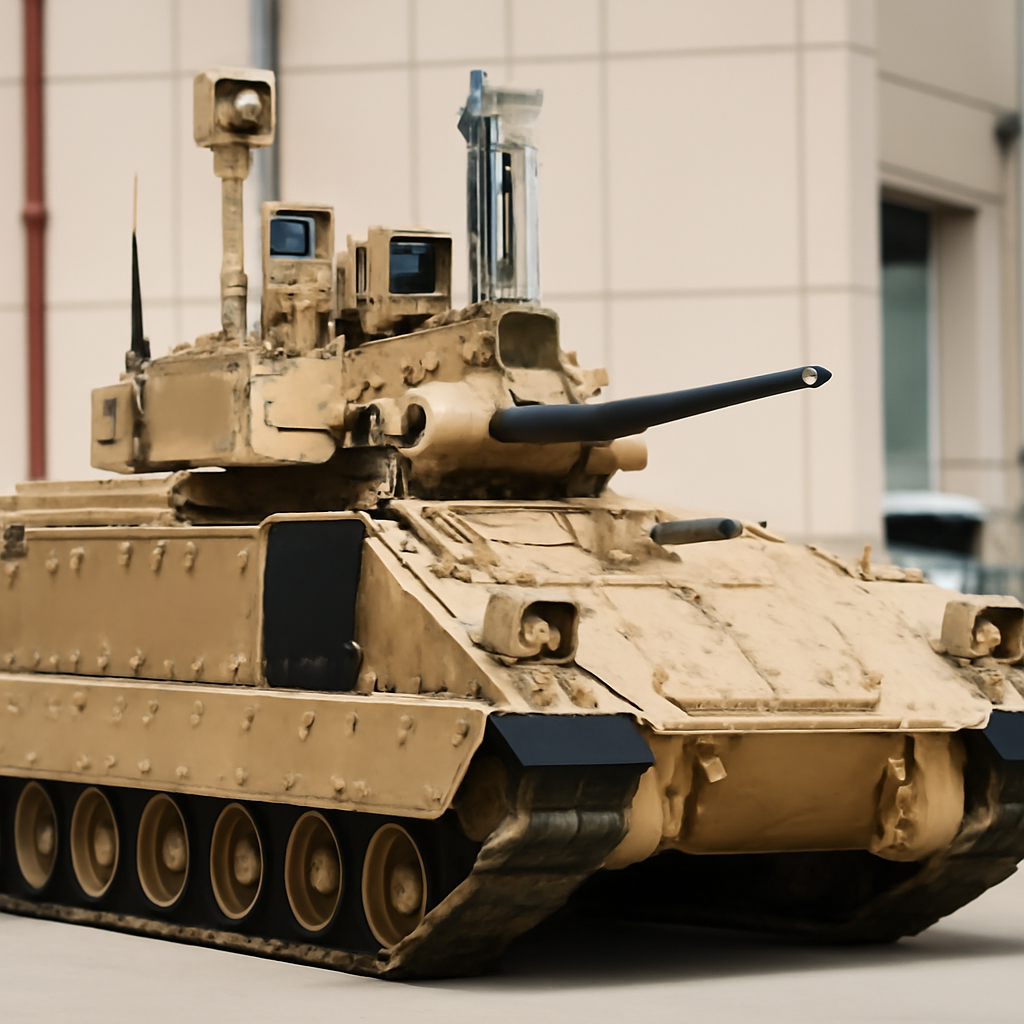
The Army has received one XM30 prototype from each competing vendor — American Rheinmetall and General Dynamics Land Systems (GDLS) — and is testing them at Aberdeen Proving Ground. Denomy said testing has identified software capabilities that need to be tweaked, especially those involving communications between platform subsystems. He characterized those fixes as “nothing atypical for a prototype” and said both vendors have been “very responsive” to required changes. Crucially, Denomy credited the open systems architectures of both designs with enabling rapid modifications during this early test phase.

Audit-ready is a season. It shouldn't be.
Evidence in spreadsheets, controls drifting between audits, frameworks multiplying on flat headcount. Nubivance runs continuous compliance on Rapid7 Cyber GRC - SOC 2, HIPAA, ISO 27001, PCI, CMMC.
End the scrambleBudget posture and congressional conversations
Program funding remains a live constraint: the Army requested $547 million to procure 19 XM30s in fiscal 2027, according to earlier reporting cited by Denomy. By contrast, the House Appropriations defense subcommittee drafted a version of the FY27 spending bill that would reduce the XM30 procurement line to $33.1 million. The service is operating under a continuing resolution and Congress has not yet passed the FY27 budget, but Denomy said the Army had spent a day with professional congressional staff during Army Modernization Days in Aberdeen and found the program’s rationale “positively received.” He said he believes the XM30 program will move forward and that the service is prepared “to execute the dollars with the appropriation forthcoming.”
AMPV-30 experiments and BAE Systems’ self-funded push
Separately, Denomy described experimental testing of BAE Systems’ Armored Multi-Purpose Vehicle equipped with a 30mm Kongsberg turret — the AMPV-30. That platform is being “exercised in an infantry fighting vehicle role” as part of a Transformation in Contact rotation. Denomy emphasized that the AMPV-30 and the XM30 have “significant differences” and cautioned against conflating the two, noting that the AMPV was originally designed as a replacement for the M113 family of armored personnel carriers and support vehicles.
Unlike the Army-funded XM30 program, Denomy said the AMPV-30 is self-funded by BAE. He praised the company for investing its own money to demonstrate a turreted variant and to explore additional mission roles beyond the AMPV’s program-of-record variants — general purpose, medical, and mission command — suggesting the AMPV-30 offers the Army an extra option to examine even as the XM30 competition proceeds.
What this means for American Rheinmetall, GDLS, and BAE Systems
- American Rheinmetall and General Dynamics Land Systems (GDLS): Both vendors have delivered XM30 prototypes and will be evaluated on how readily their open systems architectures allow software and subsystem communications changes. Denomy said it is “too early to tell” which vendor has implemented a more open architecture, and rapid responsiveness in the prototype phase will matter.
- BAE Systems: By funding the AMPV-30 variant internally, BAE is expanding the Army’s experimental options and demonstrating an infantry fighting vehicle role for a vehicle derived from the M113 replacement family. Denomy’s praise for that investment signals the Army’s willingness to examine privately funded demonstrations alongside formally funded programs.
Denomy closed by stressing the program’s momentum: “the commitment behind XM30 is real and it’s important, and we have two very viable offerings.” The immediate facts are straightforward — two prototypes, early software tweaks, open architectures that enabled quick fixes, and a funding gap between the Army’s $547 million FY27 request and a House subcommittee’s $33.1 million draft. How the downselect weighs openness against other performance factors, and how congressional appropriations align with the Army’s procurement plan, will determine whether that momentum converts into fielded vehicles.