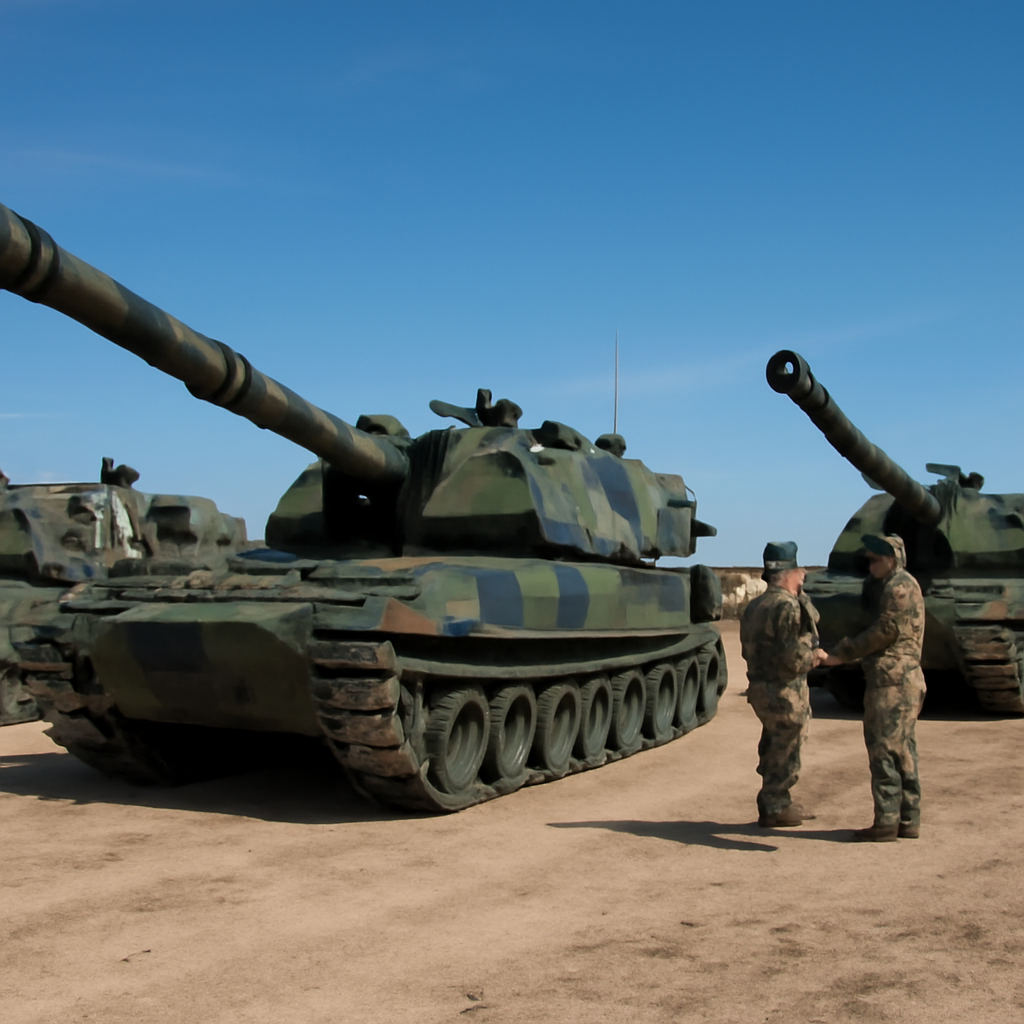
"The agreement provides for the accelerated delivery of six prototype MTC [Mobile Tactical Cannon] systems, with an option for an additional 12," the Army wrote — a compact sentence that sets the timetable and scale for the service's next attempt to modernize its artillery fleet.
Contract terms and prototype plan
The Army announced a deal with Hanwha Defense USA to deliver K9 mobile howitzer prototypes for the service’s self-propelled howitzer modernization program. The written announcement describes an accelerated delivery of six prototype Mobile Tactical Cannon (MTC) systems, with an option for an additional 12. The overall contract could reach $233 million, according to the release.
Soldiers will employ the platforms "in a series of operational experiments to assess performance, reliability, and supportability in realistic combat conditions." The Army said the "data and insights gained from these experiments will directly inform senior leaders’ decisions on future fielding."
Hanwha Defense USA’s wheeled K9 and U.S. production plans
Hanwha Defense USA — a subsidiary of South Korea’s Hanwha Aerospace — offered a wheeled variant of its K9 howitzer platform for the competition. The company is standing up a howitzer production facility in Opelika, Ala., described as an integration and test facility. The announcement notes Hanwha's prior international K9 deals with countries including Finland, Romania, Norway and Poland, among others.

Audit-ready is a season. It shouldn't be.
Evidence in spreadsheets, controls drifting between audits, frameworks multiplying on flat headcount. Nubivance runs continuous compliance on Rapid7 Cyber GRC - SOC 2, HIPAA, ISO 27001, PCI, CMMC.
End the scrambleCompeting platforms named in the competition
- Elbit America team (including Anduril and Oshkosh Defense) — SIGMA platform
- Leonardo DRS and KNDS — Caesar howitzer variant
- Rheinmetall (U.S. subsidiary of Germany’s Rheinmetall) — Remote Controlled Howitzer (RCH) 155 mm
- BAE Systems (through its American subsidiary) — Archer
Those platforms were among the fielded options the Army invited into the closely watched competition.
How the Army will use the prototypes and the decision timetable
The announcement frames the prototype phase as experimental and evaluative: soldiers will operate the MTC platforms under realistic combat conditions to generate performance, reliability and supportability data. That empirical approach is intended to supply senior leaders the information they need to make future fielding decisions.
The decision to evaluate existing systems follows a change in approach: rather than designing a new howitzer or extensively modifying an existing design, the Army opted to conduct a global roadshow, evaluate off-the-shelf options and host a competition among existing platforms. That plan was delayed by a few months to better align with the Army Transformation Initiative, and the award comes 11 months after the Army issued a request for information to industry "last September," according to the announcement.
What this means for soldiers, Hanwha Defense USA, and procurement leaders
- Soldiers: They will be the immediate operators and evaluators of the prototypes, executing the operational experiments that the Army says will test performance, reliability and supportability in realistic combat conditions.
- Hanwha Defense USA: The company will accelerate deliveries, stand up an Opelika-based integration and test facility, and expand production activity tied to the program if the prototype option quantities are exercised.
- Procurement leaders and senior Army decision-makers: They will use the experiment data to decide which platform, if any, will replace legacy systems — a decision tied directly to the program’s stated evaluation metrics and to prior program lessons.
The program is explicitly aimed at replacing both towed M777 howitzers and self-propelled M109A7s; the Army noted that the M109 family was originally fielded in the 1960s. The announcement also situates the move in a longer history of attempted replacements: the XM2001 Crusader effort was canceled in 2002, and the Non-Line-of-Sight Cannon was scrapped as part of the Future Combat Systems initiative in the late 2000s. More recently, the Army’s internally developed Extended Range Cannon Artillery (ERCA) effort — which tested a 30-foot, 58-caliber gun tube intended to reach 70 kilometers — was halted in 2024 after live-fire tests produced technical challenges including "excessive wear and tear on the cannon."
The immediate next step is straightforward and consequential: six prototype MTC systems are to be delivered on an accelerated schedule and placed into operational experiments. The Army will then weigh the resulting performance, reliability and supportability data as it decides whether to exercise options for additional units and which platform to field more broadly. How those experiments evaluate mobility, sustainment and combat performance will determine whether this procurement finally succeeds where past programs faltered.