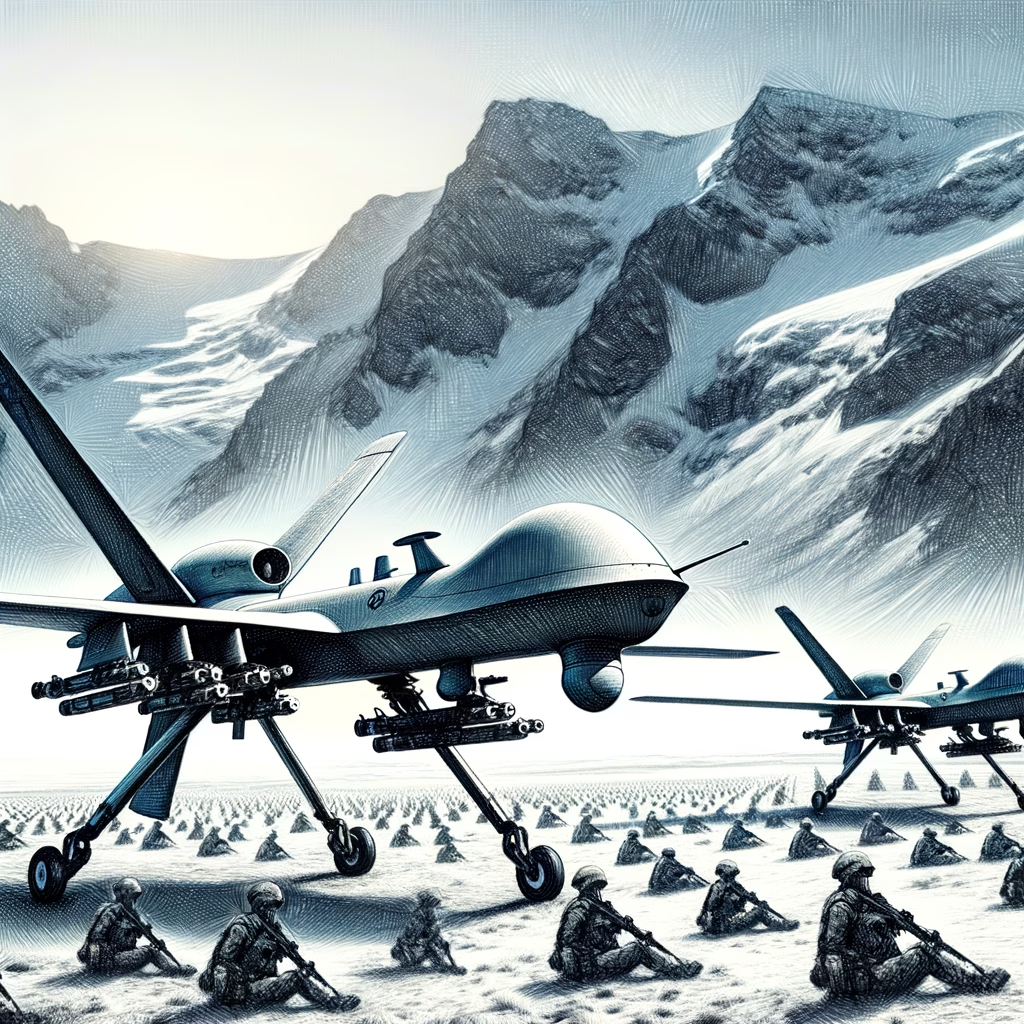
What does the battlefield of tomorrow look like when soldiers march beside mechanical quadrupeds armed with automatic rifles? This question no longer belongs solely to the realm of science fiction. The Chinese People’s Liberation Army (PLA) recently took a significant step toward answering it, conducting live-fire drills involving four-legged robotic dogs outfitted with assault rifles near its border with Russia, a move that has captured international attention and prompted a reevaluation of autonomous warfare technologies.
According to CCTV-7, China’s official military television network, troops from the PLA’s 76th Group Army carried out a series of field exercises in a hilly, rugged region of northern China. These maneuvers highlighted the deployment of advanced robotic canines equipped not just for reconnaissance but also for engaging enemy combatants with live ammunition. The demonstration underscores China’s growing ambition to integrate cutting-edge robotics into its military operations, potentially transforming traditional infantry tactics.
The emergence of armed robotic dogs is part of a broader trend in military modernization worldwide, where artificial intelligence and robotics promise to augment human soldiers or even replace them in highly dangerous missions. For years, robotic units such as Boston Dynamics’ “Spot” have been refined for civilian and industrial use, but equipping similar platforms with assault rifles represents a leap into autonomous lethality.
China’s deployment near the Russian border also signals strategic messaging amid a complex geopolitical backdrop. The region’s proximity to Russia invites questions about whether this is a demonstration aimed more at deterrence or genuine combat readiness. Chinese military analysts, quoted in state media, emphasize the drills’ role in testing new operational concepts, particularly in mountainous terrain, where robotic agility could prove advantageous.
From a technological standpoint, the integration of assault rifles onto robotic quadrupeds presents challenges and opportunities. Autonomous navigation combined with targeting systems must reliably function under combat stress, all while ensuring human oversight to prevent unintended engagements. Dr. Liu Yang, a robotics expert at Tsinghua University, told the South China Morning Post, “The key lies in balancing autonomy with control—robots can support soldiers, but ethical and practical constraints remain paramount.”
Policy experts warn that such developments raise profound questions about the future of warfare. Amanda D. Craig, a senior fellow at the Center for Strategic and International Studies, observed, “Robotic weapons systems challenge existing international norms and arms control frameworks. The risk of escalation or accidental conflict could increase if such systems are widely deployed without clear rules of engagement.”
On the ground, soldiers may find these robotic dogs both a boon and a potential source of unease. Proponents argue that these systems can undertake perilous tasks—scouting hazardous areas, carrying heavy loads, or providing suppressive fire—thus reducing human casualties. Critics caution, however, about the reliability of autonomous weapons in chaotic combat environments and the moral implications of delegating life-or-death decisions to machines.
Adversaries, too, are watching closely. The U.S. Department of Defense and NATO members have invested heavily in counter-robotic technologies, aware that future conflicts might involve autonomous units capable of swarming or rapid repositioning. The PLA’s recent exercises serve as a vivid reminder of how robotic warfare could reshape tactical doctrines and force postures worldwide.
As China pushes the envelope by arming robotic dogs, the world confronts a new frontier where innovation collides with ethical dilemmas and strategic uncertainty. Will these mechanized quadrupeds become indispensable comrades-in-arms, or will they herald an era of conflict increasingly divorced from human judgment? The answer may well shape the nature of warfare for decades to come.




