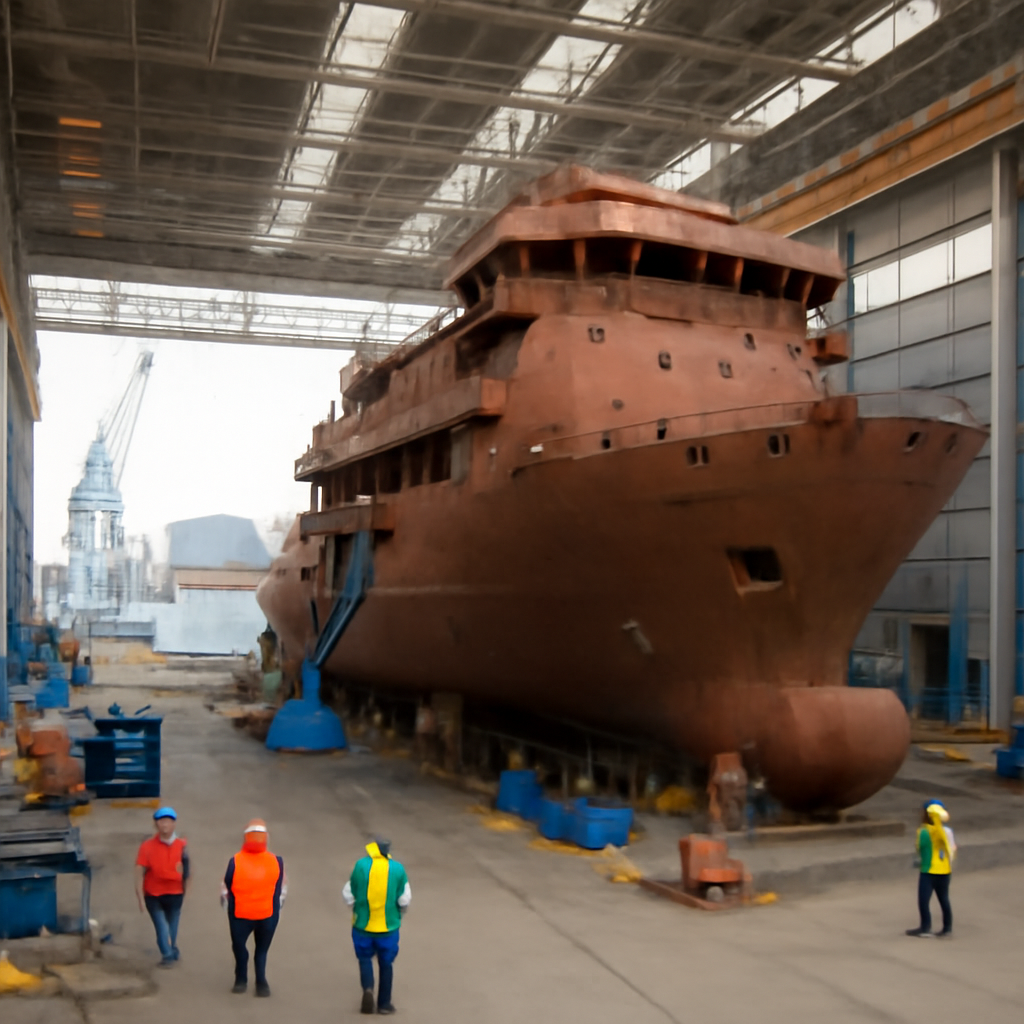
“U.S. commercial shipbuilding accounts for only 0.1 percent of the global market.”
Japan's fund and the Hakodate Dock revival
Nikkei Asia reported on October 2 that Japan’s government fund for revitalizing shipbuilding has begun to spur a wave of private investment. The fund, launched in fiscal year 2025, has already approved eight projects and will provide up to 311 billion yen ($1.97 billion) through 2034, with total spending expected to reach around 900 billion yen ($5.69 billion) once private investment is included. Among the projects, Hakodate Dock — which repairs vessels for the Maritime Self-Defense Force — plans to bring back a dock that has sat out of commission since an earthquake in 1993.
Tokyo has designated shipbuilding one of 17 strategic industries and partnered with industry on roughly 1 trillion yen ($6.33 billion) in public and private investment. Still, Japan faces chronic constraints: labor is a major limit, shipyards are booked three to four years in advance, and Japan won just 5 percent of new orders in 2025.
South Korea's U.S. investments and the $150 billion package
South Korean companies have taken a more direct route into revitalizing allied shipbuilding by pouring money into U.S. shipyards. The example cited is Hanwha’s purchase of Philly Shipyard and its pledge to invest $5 billion there. These moves fall under a wider South Korean-promoted initiative totalled at $150 billion that Seoul has touted as “Make American Shipbuilding Great Again.”
South Korea’s strength rests heavily on specialization: its shipbuilders hold roughly 70 percent of the global LNG carrier market and have developed production methods that compete on quality. But like Japan, South Korea struggles with labor constraints and faces rising competition from Chinese yards, which leverage scale in less complex vessel classes such as dry bulk and are increasingly competing for LNG orders as well.

This site is the portfolio.
OSINTSights runs on Cloudflare Workers, D1, R2, and Vectorize, with an AI pipeline on Hetzner ARM. Nubivance designed, built, and operates it. We do the same for clients.
See what we buildChokepoints: GTT, WinGD, and membrane technology
The story of shipbuilding is as much about subcomponents and design technologies as it is about steel and docks. The French firm GTT dominates membrane containment technology used in most LNG carriers, and the article warns that such specialized suppliers can become strategic chokepoints. One maritime technology already under Chinese control is WinGD, described as a nominally Swiss company wholly owned by China State Shipbuilding Corporation; its engines are the most popular choice for LNG carriers currently on order.
The source argues that allies should consider directing investment not only into hull production but into these upstream technologies of the future to avoid recurrent dependencies that can be weaponized — a pattern the article ties to China’s behavior with rare earths.
Overlap and the missing coordination framework
Despite allied momentum — U.S. ties with Japanese yards (including Mitsubishi Heavy Industries’ 2025 overhaul of a U.S. Navy vessel in Yokohama and a memorandum of cooperation signed last October) and South Korean capital flowing into U.S. yards — policies remain siloed. The U.S. Maritime Action Plan, the reporting says, largely treats allies as investors in American shipyards rather than as partners with distinct strengths and specialties.
Without a coordinating scheme, allies risk unnecessary overlap and competition. The article uses historical precedent: Japan’s earlier specialization in Moss-type LNG carriers left it vulnerable when markets shifted to membrane-type designs and South Korea gained ground. It warns that Japan’s planned return to LNG carrier construction around 2035 by Imabari Shipbuilding, Kawasaki Heavy Industries, and Namura Shipbuilding — possibly using South Korean technology — could replicate such redundancy unless choices about who builds what are settled.
What this means for policymakers, shipbuilders, and technologists
- Policymakers and regulators: Will need to weigh where to invest public capital — docks and yards, or the critical upstream technologies that can become chokepoints — and muster the political capital to create a coordinating framework across allies.
- Shipbuilders and procurement leaders: Face immediate operational limits — labor shortages and yards booked three to four years out — while deciding whether to compete in overlapping vessel classes (for example, LNG carriers) or specialize to leverage comparative advantages.
- Technologists and security teams: Should track control of key components and designs such as membrane containment systems and marine engines; the prominence of GTT and the Chinese ownership of WinGD are concrete examples of where supply and control risks concentrate.
The momentum is real: funds have been allocated, deals have been struck, and firms are moving. The single biggest constraint will be the political capital required to create even an imperfect framework that reduces redundancy and redirects funds toward strategic technologies. Allies may accept some overlap — no ally should rely on a single partner for critical ships — but the record shows that failing to coordinate can let one partner capture the next generation of capability. Will allied capitals choose to argue over who builds what, or to decide together which technologies and capacities must be protected and developed?