In the first quarter of 2026, Ukrainian ground robotic systems conducted about 24,500 missions, including more than 9,000 in March — a rate that pushed unmanned ground systems from the margins into daily operations and prompted Kyiv to set ambitious procurement and deployment goals.
Ukrainian scale-up and early humanoid experiments
Between November 2025 and March 2026 the number of Ukrainian units employing ground robots rose from 67 to 167. Ukraine’s Ministry of Defense announced plans to contract 25,000 ground robots in the first half of 2026 and stated an aspirational goal of transferring all frontline logistics to robotic systems where possible. Those operations, however, have so far been executed by inexpensive wheeled and tracked machines — “affordable, replaceable and adequate,” the record notes.
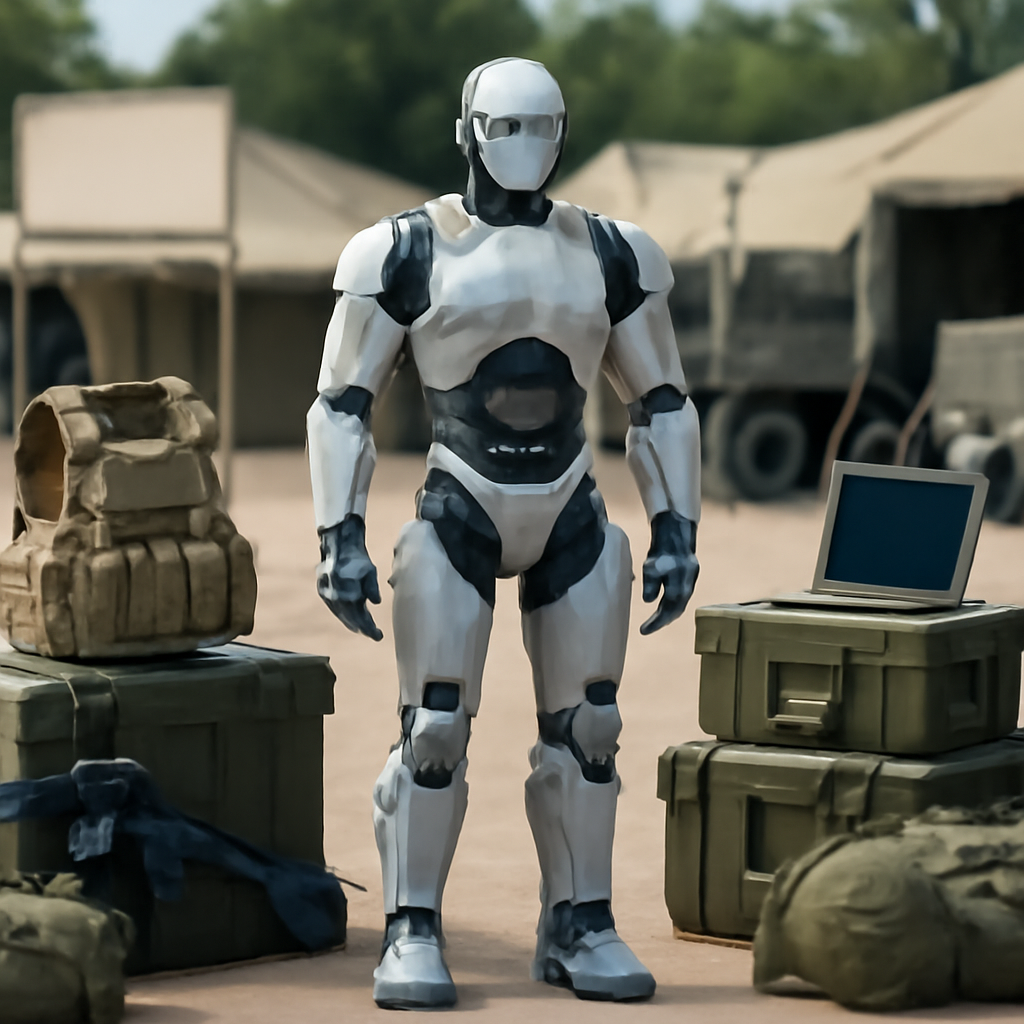
At the same time, experimentation with humanoid platforms has begun. Foundation sent two Phantom MK-1 humanoids to Ukraine in February 2026 for evaluation, with available reporting suggesting testing rather than verified direct combat employment. In July, Ukraine’s Brave1 initiative identified humanoid robots as a priority for forthcoming defense-technology grant competitions. Separately, China demonstrated a teleoperated humanoid that mirrored the movements of a human controller. These cases signal growing commercial and defense interest, even if operational utility has not yet been established.
Three mission sets where humanoids could matter
The core argument for humanoid robots is narrow and practical: most of the physical world is built for people. Doors, stairs, ladders, hatches, tools, control panels, vehicle cabins, ship passageways and industrial machinery assume human height, reach and dexterity. That structural fact points to three initial mission sets.
- Hazardous work in human-designed spaces — urban breaching, tunnel reconnaissance, explosive-ordnance disposal, shipboard damage control, inspection of damaged infrastructure, and handling chemical or radiological hazards. Early systems will probably be teleoperated because complexity, communications uncertainty and high consequences demand human-in-the-loop control.
- Physical interfaces to autonomous systems — as formations acquire hundreds of heterogeneous robots, humanoids could execute a commander’s intent locally by moving sensors, distributing batteries, organizing launch cycles, recovering disabled systems and adapting positions to changing requirements without assuming command authority.
- Maintenance and sustainment of robotic fleets — drones and ground vehicles require batteries, payload swaps, inspection, cleanup and repair. A dexterous humanoid that uses existing tools and infrastructure could service multiple platform types, increasing sorties while reducing human exposure.

The cyber insurance questionnaire just landed. Now what?
SOC 2, HIPAA, insurance renewals - someone has to own security strategy. Nubivance provides fractional CISO leadership without the full-time salary.
Get a security leadTechnology, survivability and control challenges
The battlefield imposes constraints absent in polished commercial demos. Commercial humanoids usually operate on smooth floors, near reliable power and within reach of technicians; battlefields add mud, rubble, rain, thermal extremes, blast effects, electromagnetic interference and deliberate attack. A robot that falls and cannot recover becomes an obstacle, and a platform that needs factory repair after minor damage may be less useful than a crude UGV fixed with common parts.
Military requirements should therefore emphasize endurance, field repair and graceful degradation over theatrical performance. Relevant technical needs listed include swappable power, sealed electronics, back-drivable and durable actuators, self-recovery after falls, interchangeable end-effectors, navigation without continuous satellite positioning, resilient low-probability-of-detection communications, and control modes that shift among teleoperation, supervised autonomy and preplanned action when links fail.
Cyber and survivability logic favors dispersion, concealment, low acoustic and electromagnetic signatures, rapid repair and the ability to abandon a mission rather than heavy armor that reduces endurance. Planners must also assume cyber compromise, spoofing and capture; sensitive mission data and software should be compartmented, encrypted and erasable.
Acquisition and force design: measured, comparative testing
Humanoids should be attached initially to organizations that already understand specialized equipment — engineers, explosive-ordnance teams, logistics units, maintenance formations and unmanned-systems units — rather than forming standalone “robot infantry.” Procurement should demand comparisons, not demonstrations: every proposed mission must be tested against a human team and the cheapest suitable robotic alternative using metrics such as cost per completed mission, mean time between failures, recovery and repair rates, operator workload, battery demand, transport burden and human exposure avoided.
Given the technology’s immaturity, the recommended procurement model is limited prototype batches, realistic field exposure, short update cycles and open interfaces for batteries, tools, payloads, control software and data links. Most near-term resources should remain with proven, cheaper unmanned systems until humanoid programs can demonstrate unique operational value.
What engineers, logistics units, and commanders will watch for
- Engineers and explosive-ordnance teams: whether teleoperated humanoids can reliably enter contaminated or confined spaces, manipulate standard tools and extend specialists’ reach without introducing new risks.
- Logistics and maintenance formations: whether a humanoid can sustain multiple UAVs/UGVs across a night, reconfigure launch points, swap batteries or replace components using existing ship and pier fittings — effectively reducing human movements and increasing sorties.
- Commanders and acquisition authorities: whether humanoids offer measurable cost-per-mission improvements and whether open interfaces prevent closed ecosystems that would complicate mixed robotic fleets; they will demand comparative metrics before expanding programs.
Humanoid robots are unlikely to arrive first as massed mechanical infantry. As Yavuz Turkgenci, a retired three-star general and the author of the analysis, puts it: “Humanoids are the humans missing from the digital battlefield.” Their fate will hinge less on mimicry of soldiers than on whether they can sustain a wider unmanned force at acceptable cost — exploiting human-designed infrastructure and reducing risky human tasks, or remaining impressive machines in search of a mission.