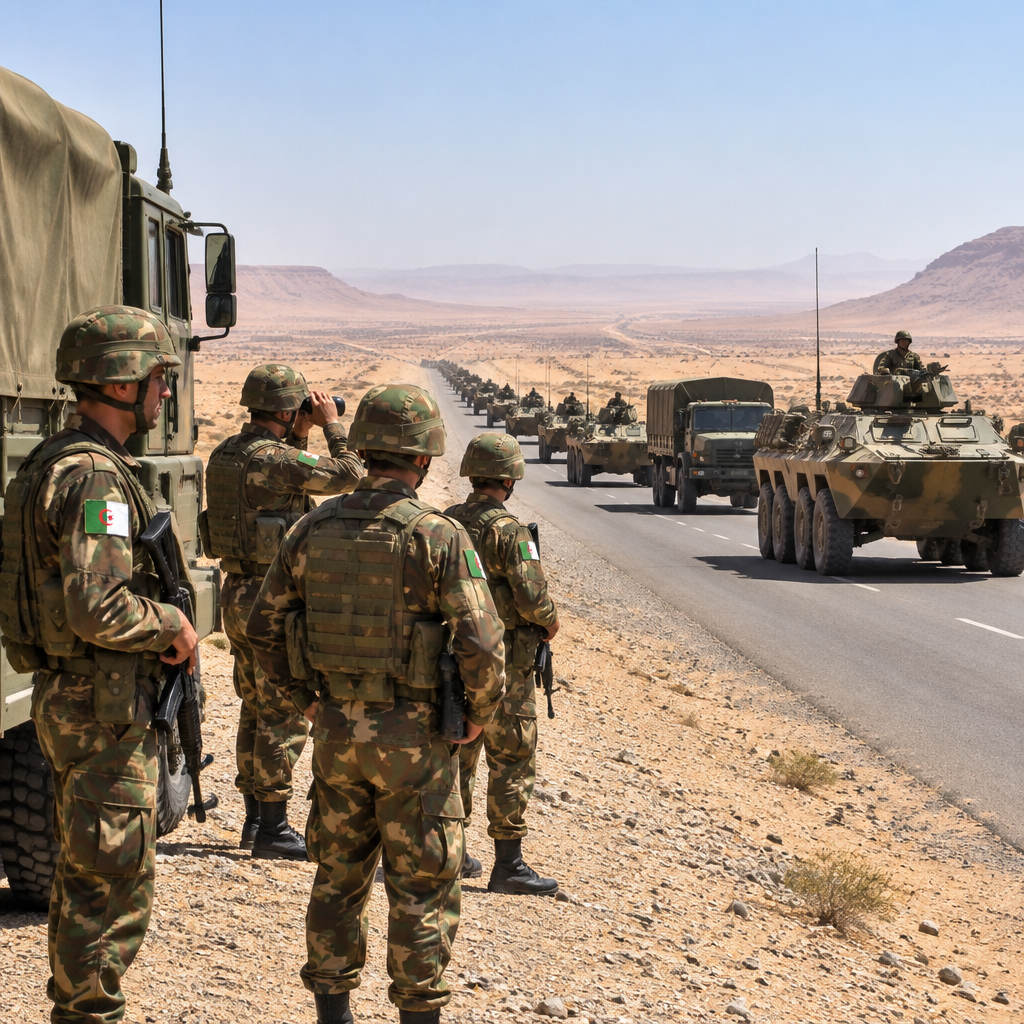
“We are not sending our soldiers to wage war in Niger, but for a mission to secure economic infrastructure,” Senator Belkacem Boulghiti said after Algeria’s parliament approved a foreign troop deployment.
Parliamentary approval under the 2020 constitution
Algeria’s parliament met in closed sessions in late October and cleared a proposal to send units of the People’s National Army (ANP) to Niger. The Council of the Nation, the upper house, unanimously approved the measure on 25 October, and the People’s National Assembly ratified it later the same day. President Abdelmadjid Tebboune submitted the request on 22 October; on 26 October he decided to send the ANP units, a day after the parliamentary votes.
The vote used a procedure introduced by the 2020 constitutional revision. Under Article 91, the president may authorize a deployment abroad if at least two‑thirds of the members of each chamber approve. The Niger mission is the first deployment abroad to be approved under that Article; the provision exists alongside Algeria’s rules for United Nations and African Union peacekeeping operations.
Mission purpose, mandate and geographic focus
Official statements and parliamentary remarks frame the deployment as focused on protecting Algeria’s energy interests and fulfilling a bilateral agreement with Niger. The order clears ANP units to move under a protocol signed on 21 October and places Sonatrach’s oil facilities in Niger at the centre of the mission’s focus.
Senator Boulghiti’s comment — “we are not sending our soldiers to wage war in Niger, but for a mission to secure economic infrastructure” — articulates how Algerian authorities describe the mandate. Madama, in northern Niger, has been reported as a possible location for Algerian units.

This site is the portfolio.
OSINTSights runs on Cloudflare Workers, D1, R2, and Vectorize, with an AI pipeline on Hetzner ARM. Nubivance designed, built, and operates it. We do the same for clients.
See what we buildEnergy projects named in the record
The deployment is tied directly to Algerian industry activity in Niger. The report names Sonatrach’s Kafra project and notes that the Kafra Sud‑Est 1 well, drilled by Entreprise Nationale de Forage (ENAFOR), lies about 85 km from the Algerian border. Construction of the Algerian section of the Trans‑Saharan Gas Pipeline began in June; that pipeline is described as intended to carry Nigerian gas to Europe through Niger and Algeria. Those projects are cited by officials as the economic infrastructure the deployment aims to secure.
Bilateral diplomacy and the 21 October protocol
The parliamentary vote followed a protocol signed on 21 October by ANP Chief of Staff General Saïd Chanegriha and Niger’s defence minister, General Salifou Mody. President Tebboune received General Mody twice: on 13 October and again on 21 October, the day the protocol was signed. The decision to deploy ground units thus builds on formal defence arrangements that Algeria and Niger concluded in October.
Prior military movements and regional incidents
The ground deployment follows a series of earlier military and diplomatic steps between Algiers and Niamey. In late August, Algeria’s Ministry of National Defence said two patrols of Su‑30 fighters and an air‑to‑air refuelling aircraft landed in Niamey at Niger’s request. That move came after a mutiny in Niamey overnight from 28 into 29 August, which President Tebboune later described as a “coup attempt.” In an interview broadcast on 3 October, Tebboune said the jets were sent because some parties had “gone too far,” calling the mutiny a provocation against Algeria.
Other recent actions include Algeria’s handover of four helicopters to Niger on 9 August and a diplomatic incident in April when Algeria shot down a Malian drone; that shooting prompted Niger, Mali and Burkina Faso to recall their ambassadors from Algiers. SIPRI estimates cited in the report put Algeria’s 2025 military spending at more than $25 billion, described as the highest in Africa.
What this means for Sonatrach, the ANP, and Niger’s government
- Sonatrach and energy projects: Sonatrach’s facilities and the Kafra project are explicitly named as mission priorities; the company’s operations in Niger will be the stated rationale for Algerian force protection measures.
- The People’s National Army (ANP): The ANP is cleared to undertake its first foreign deployment since 1973 and to operate under a bilateral protocol signed on 21 October, signalling a shift from prior patterns of Algerian military posture.
- Niger’s government and defence ministry: Niger requested earlier air support and concluded the 21 October protocol; the deployment formalizes a security arrangement between Niamey and Algiers and anchors Algerian forces near infrastructure Algeria identifies as strategically important.
The record in the official account ties the deployment to economic infrastructure and a formal protocol, while also documenting a string of military and diplomatic moves through August–October that preceded the 26 October order. The legal path—Article 91 of the 2020 constitution—provided the mechanism for approval, and the signed protocol fixes the conditions under which ANP units may move. The next visible steps will be where units are placed on the ground and how Sonatrach’s assets and the Kafra project are protected under the protocol.
Original story on Quwa: Algeria to Deploy Troops to Niger in First Foreign Deployment Since 1973