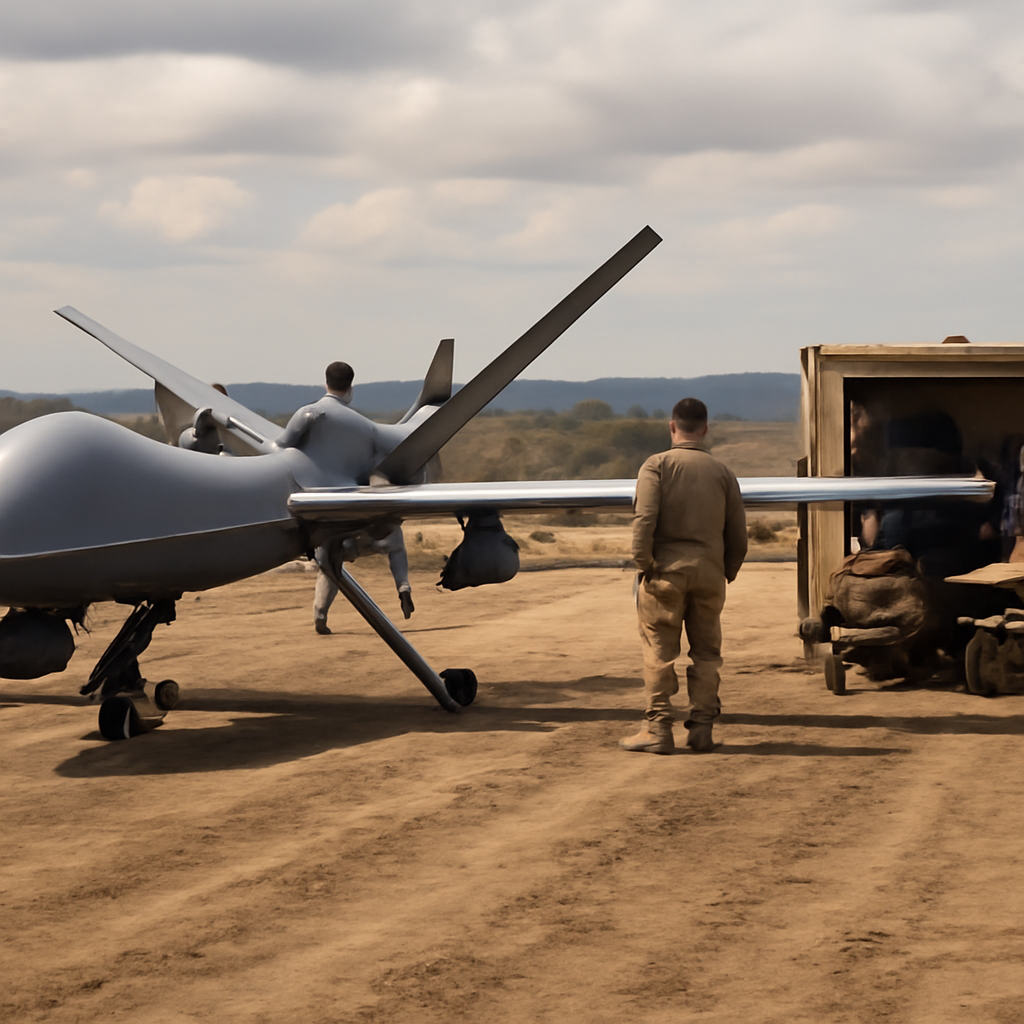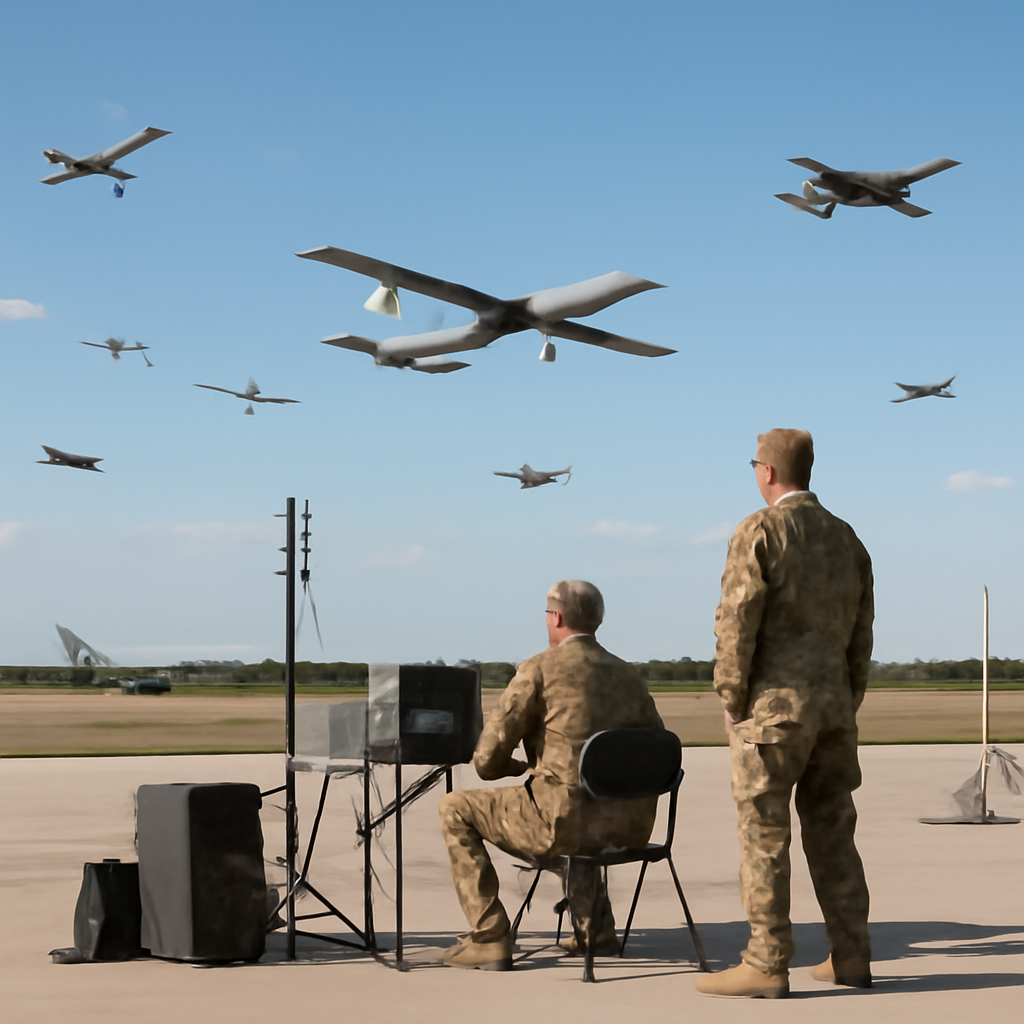
"full range of airborne threats, spanning from inexpensive 'hobby drones' to the most advanced adversary fighter and large-scale aircraft," the Air Force RFI says.
What the Air Force asked industry to build
The U.S. Air Force has issued a Request for Information (RFI) seeking a family of aerial targets that can represent an unusually broad spectrum of airborne threats. Responses are due September 28. The service wants systems that can be treated as "attritable or expendable when required," and that together can reproduce the speed, maneuverability, size, radar signature, infrared signature, electromagnetic emissions and electronic warfare capabilities of many different aircraft classes while remaining inexpensive and simple enough to be produced in quantity.
Performance and signature expectations for fighter-like targets
For targets intended to represent advanced fighter aircraft, the RFI specifies supersonic capability "up to and exceeding Mach 1.6 at 40,000 feet," plus high agility and high‑G maneuvers. The Air Force also calls for precise low‑observable radar cross‑section profiles, multispectral infrared signatures, active radio‑frequency emissions and integrated electronic‑attack capabilities so that targets can recreate the sensing and electromagnetic environments presented by sophisticated combat aircraft.

Audit-ready is a season. It shouldn't be.
Evidence in spreadsheets, controls drifting between audits, frameworks multiplying on flat headcount. Nubivance runs continuous compliance on Rapid7 Cyber GRC - SOC 2, HIPAA, ISO 27001, PCI, CMMC.
End the scrambleRequirements for transports, bombers and AEW&C replicas
Different metrics are set for larger airframes. Targets meant to emulate C‑130‑sized multi‑engine aircraft must match physical scale, slow subsonic flight envelopes and propeller or turbofan propulsion characteristics, while providing representative physical volume, RF and IR emissions and realistic radar returns—explicitly to support missile‑seeker verification and warhead lethality assessment. For strategic bombers and airborne early warning and control (AEW&C) platforms, the emphasis is on reproducing "massive physical dimensions, multi‑spectral thermal signatures, and heavy‑aircraft radar strategic threats."
UAV groups and swarm representation
The proposed family spans uncrewed classes from Group 1 through Group 5. Group 5 targets should operate at altitudes up to 50,000 feet. Group 3 and Group 4 targets are to fly at roughly Mach 0.5 to 0.8 and maneuver between 3 and 6 Gs. Group 1 and Group 2 targets should fly below 150 knots and be capable of operating in swarms, enabling evaluation of weapons and sensors against massed small‑UAS threats and one‑way attack drone barrages.
Openness to commercial, dual‑use and non‑traditional approaches
The RFI explicitly invites "commercial, modified commercial, dual‑use, and non‑developmental solutions" and states the government is "particularly interested in non‑traditional, commercially derived, or dual‑use solutions" that offer advantages in cost, scalability and simplicity over legacy systems. That language signals a preference for exploiting existing commercial technologies, manufacturing methods, propulsion systems and readily available components rather than pursuing a pure, clean‑sheet defense program.
What this means for technologists, procurement leaders, and weapons testers
- Technologists and developers: The Air Force is asking for combinations of aerodynamic performance, signature control, emissions generation and electronic‑attack capability that are technically demanding—especially when the requirement includes supersonic, high‑G flight plus controlled low‑observable radar and multispectral infrared characteristics.
- Procurement leaders and manufacturers: The RFI pushes for affordability and mass producibility—targets "treated as attritable or expendable"—which favors commercially adapted manufacturing and non‑traditional suppliers that can deliver scale and lower unit cost.
- Weapons testers and sensor developers: If the family meets the RFI’s goals, testers would be able to exercise the entire kill chain—detection, tracking, seeker acquisition, guidance and terminal engagement—against far broader and more realistic threat sets than many current targets permit.
The RFI frames a clear trade: combine high‑fidelity threat representation with the economics of mass production. Current options range from the subscale BQM‑167A (in service since 2007) to converted fighter QF‑16 full‑scale aerial targets; the Air Force wants something that can bridge that gap and, where appropriate, be expended rather than conserved. Examples cited in the RFI and supporting material include fifth‑generation‑type threats and larger platforms such as China's Y‑9 transport, the KJ‑3000 AEW&C conversion of a four‑jet cargo airframe, and J‑20 stealth fighters as higher‑end targets the new family should be able to help replicate.
Whether industry can deliver supersonic, high‑G flight combined with controlled low‑observable signatures, multispectral thermal behavior and active electromagnetic effects at a low enough unit cost to permit routine expendability is the central question the RFI places before vendors. The Air Force has set the deadline for initial responses; what comes next will determine whether the service can move from a mixed set of legacy targets toward an affordable, scalable fleet that can be configured to represent almost any fixed‑wing threat.
Contact the author of the original coverage: thomas@thewarzone.com