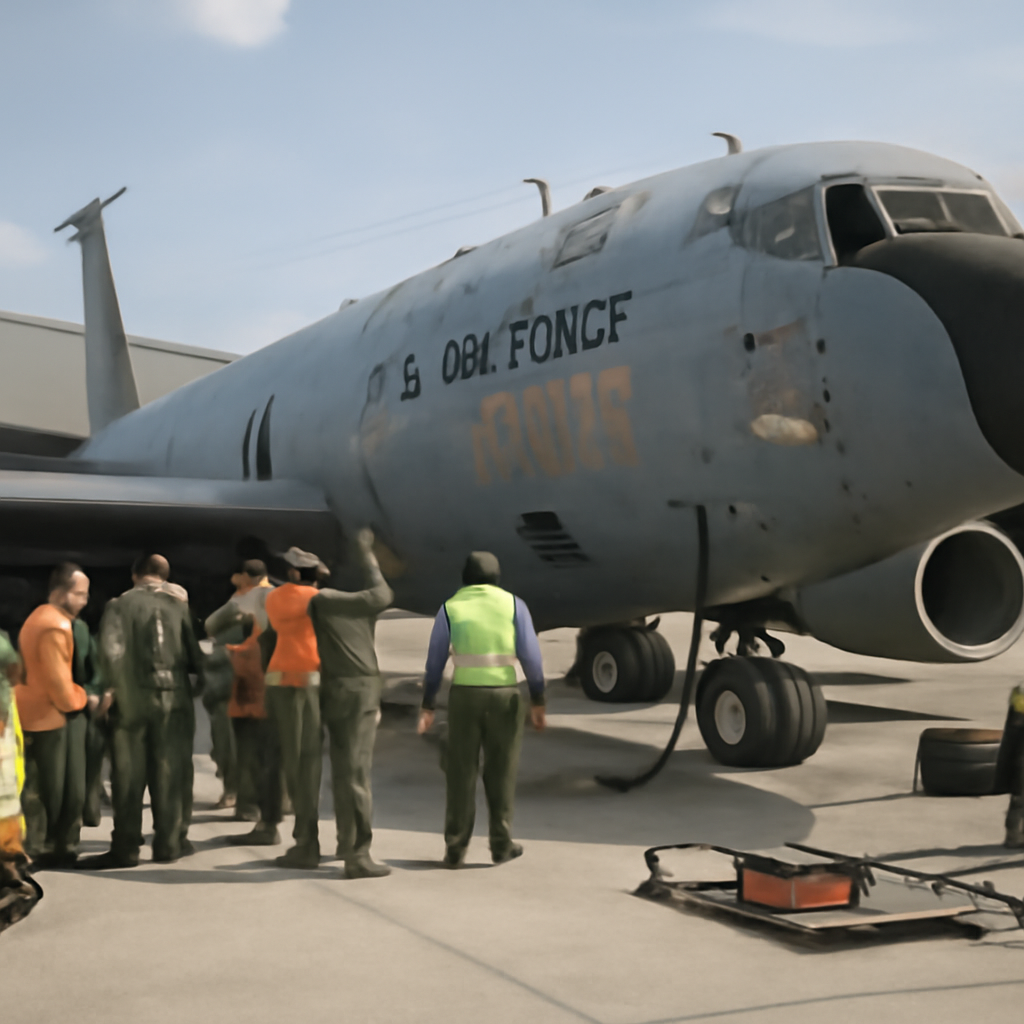
"That aircraft is smoking," Tulley said.
How the attack unfolded, according to AMC commander Lt. Gen. Daniel H. Tulley
Lt. Gen. Daniel H. Tulley described a sudden, defensive moment on the ground: "A KC-135 ops crew is in the jet," he said. "KC-135 maintenance team is about to launch this jet. Unexpected Alarm Red [an attack warning]. Everyone jumps in a bunker." After airmen returned from cover, Tulley said they found a "fully loaded KC-135" with "holes in it" and smoke. The jet carried roughly "two hundred thousand pounds of jet fuel." It took 48 hours to drain that fuel; meanwhile, Tulley said, "first on the scene was I think the pro super [production superintendent] and the expediter. They immediately began to collect the fuel… They start to patch the holes. They start to fix all the systems."
From patched field repair to transoceanic ferry flight
Tulley said the on-the-spot repairs, led by production and expediter personnel, were sufficient to allow the tanker to make a transoceanic flight back to the United States "to be fully repaired." He did not name the attack location during the panel discussion, but the article notes prior reporting that five tankers were reportedly damaged in an Iranian long-range strike on Prince Sultan Air Base (PSAB) in Saudi Arabia on March 14 — a finding later confirmed in a Department of War Inspector General report released earlier this week. Photographs shared with the reporter show two shrapnel-damaged KC-135s transiting the U.K. on their way home; Tulley said he could not confirm whether either pictured jet was the one he described.

This site is the portfolio.
OSINTSights runs on Cloudflare Workers, D1, R2, and Vectorize, with an AI pipeline on Hetzner ARM. Nubivance designed, built, and operates it. We do the same for clients.
See what we buildAFMC, Tinker, and the Aircraft Battle Damage Repair capability
Lt. Gen. Linda Hurry, commander of Air Force Materiel Command (AFMC), said AFMC's "aircraft battle damage repair team" patched the aircraft "back together to get it back to Tinker [Air Force Base in Oklahoma] that can put it completely back where it needed to be." Tinker, the article notes, is home to the Expeditionary Depot Maintenance (EDMX). According to the Air Force language quoted in the reporting, EDMX is "responsible for maintaining the Air Force’s sole source for Aircraft Battle Damage Repair (ABDR) rapid repair capabilities for the entire tanker and bomber fleets."
Forward maintenance at RAF Mildenhall and RAF Fairford
The Air Force pushed maintenance forward into Europe to avoid sending aircraft all the way back to the continental United States for routine or deferred work. Air Force Chief of Staff Gen. Kenneth S. Wilsbach said, "We moved some maintenance actions forward, so they didn’t have to – the aircraft didn’t have to go all the way back to the states... We put some of them in Europe, so they could get through some normal safety inspections that were either due or deferred." Tulley credited General Hurry's team with bringing "a lot of capability forward at Mildenhall Air Base," and offered a concrete example: repair of aerial refueling booms in the U.K. instead of returning them to the U.S. — "I think we turned 30 booms instead of bringing them all the way back to the states," he said.
Air Force Global Strike Command (AFGSC) applied a similar approach at RAF Fairford. AFGSC commander Gen. Stephen L. Davis said his command "pushed maintainers and support personnel forward to RAF Fairford" and staged bombers forward after missions in the Middle East so they could be sustained in Europe. He described an extended posture: the bombers "have been there for now six-plus months" and have been "conducting nearly daily operations out of there." Davis contrasted readiness metrics in different postures: "When bombers are back at home base, they build readiness. When we deploy it forward, they consume readiness."
What this means for AMC, AFMC, and forward maintainers
- Air Mobility Command (AMC): AMC demonstrated that field-level improvisation — rapid fuel collection, temporary patching, and systems work — can enable an airframe to survive and ferry back to depot repair, sustaining operational availability after battle damage.
- Air Force Materiel Command (AFMC) and Tinker/EDMX: The EDMX ABDR capability functions as the institutional repair anchor, taking patched aircraft to "put it completely back where it needed to be," underscoring the role of depot-level expertise after expeditionary fixes.
- Forward maintainers and European bases (RAF Mildenhall, RAF Fairford): Pushing maintainers, parts, and depot procedures forward reduced the need to cycle aircraft back to CONUS for deferred inspections and boom repairs — a change Wilsbach said "paid dividends in the readiness of our mobility fleet."
The account offered at the Air, Space and Cyber Conference sketches a practical, operational lesson: where possible, move maintenance and battle-damage repair closer to operations, and pair rapid field fixes with depot follow-through. The specifics — a smoking KC-135 with holes, two hundred thousand pounds of fuel drained over 48 hours, immediate action by a production superintendent and expediter, and the role of EDMX at Tinker — are concrete markers of how that approach worked in Operation Epic Fury.
Original reporting: How The Air Force Patched Up A Shrapnel-Damaged KC-135