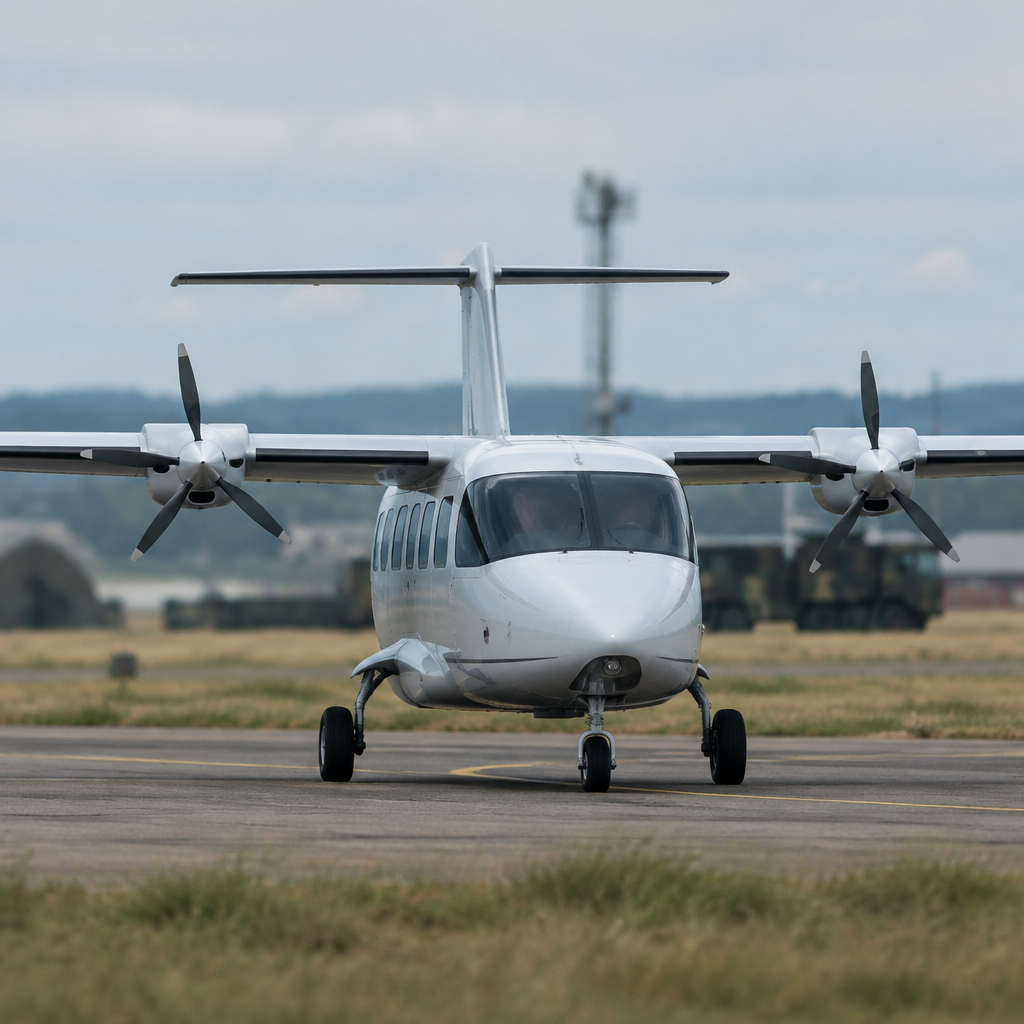
"The USAF has always been interested in what new technology can bring to the battlefield," Douglas Royce, senior aerospace and power systems analyst for Forecast International, said — and with a new AFWERX agreement, the Air Force is testing whether hybrid-electric, ultra‑short takeoff-and-landing aircraft can actually change how it operates in contested environments.
Electra Defense’s EL9: size, capability, and lineage
Electra Defense is developing the EL9, a nine‑seat hybrid‑electric airplane described by the company as comparable in size to a Cessna Caravan or Pilatus PC‑12. The EL9 is being designed to take off and land in just 150 feet, a performance metric that underpins the Air Force’s interest in “Ultra‑STOL” — ultra‑short takeoff and landing — capability for operations from short or improvised runways.
The EL9 builds on Electra’s existing EL2 two‑seat prototype and the company’s demonstrations of blown‑lift and hybrid‑electric propulsion. Electra has shown blown‑lift effects in previous demonstrations — most recently landing the two‑seat demonstrator at the Downtown Skyport in New York City — and is now scaling the technology to a nine‑passenger configuration targeted at both commercial and potential military uses.
AFWERX agreement and related funding
The Air Force, through AFWERX, awarded Electra a $4.7 million other‑transaction agreement to develop the EL9 prototype. Under that contract Electra must verify hybrid‑electric propulsion and conduct ground testing and acoustic flight testing; acoustic testing would check whether the aircraft can perform “battery‑only low‑signature ingress and egress for special operations missions,” the company said.
The award follows earlier Congressional moves to support electric aviation: the 2025 National Defense Authorization Act formalized the Air Force’s Agility Prime efforts and provided AFWERX with $4.96 million for “electrification of fixed wing aircraft.” The Air Force has also previously increased the funding ceiling of its operational testing contract with Joby Aviation, maker of autonomous eVTOL aircraft. Separately, in 2023 Electra received a potentially $85 million strategic funding increase award from AFWERX — a government‑private blended investment for a full‑scale preproduction aircraft and demonstrations of Ultra‑STOL and hybrid‑electric propulsion for runway‑independent operations and mobile power generation.

This site is the portfolio.
OSINTSights runs on Cloudflare Workers, D1, R2, and Vectorize, with an AI pipeline on Hetzner ARM. Nubivance designed, built, and operates it. We do the same for clients.
See what we buildOperational testing goals: Ultra‑STOL, contested logistics, and special operations
The Air Force’s contract explicitly ties the EL9’s flight testing to operational concepts. Electra said the testing will include analysis of whether the aircraft can enable “battery‑only low‑signature ingress and egress” for special operations and how the platform would perform in “contested logistics” and agile combat employment operations.
Royce cautioned the AFWERX contract “isn’t a signal that the USAF is ready to acquire this type of aircraft,” but he added that the vulnerability of traditional air bases to missile attack could push planners toward distributed operations. “Operating an ultra‑STOL platform from short or improvised runways may be a part of that concept,” he said. Electra’s own executives frame the nine‑passenger payload and 150‑foot field requirement as especially relevant to special forces missions: “The special forces use would make sense because having a nine‑passenger aircraft that can fly in and fly out of very short runways or roads would be useful for the way they operate,” Royce said.
Electra has partnered with Lockheed Martin Skunk Works to analyze how the EL9 “would help enable contested logistics operations in the Pacific,” according to Donn Yates, Electra Defense’s vice president and general manager. Electra is also integrating its models into simulations and war games to validate operational concepts before flying in exercises, a step Yates described as “actually even more compelling than actually doing an exercise” for understanding how the aircraft could plug into contested logistics systems.
Autonomy, digital controls, and optionally piloted design
Electra is designing the EL9 with all‑digital flight controls rather than the mechanical systems found on more traditional transports like the Cessna Caravan. Donn Yates emphasized that digital controls make autonomous behaviors and uncrewed flight “much easier,” and said the company is marketing the EL9 to commercial customers initially as a piloted aircraft while pursuing optional uncrewed capability.
Yates also pointed to Electra’s roots in Aurora Flight Sciences and the company’s long experience with autonomy. He said the EL9 is being designed for possible uncrewed operation and that Electra expects to make announcements in coming months about work toward an optionally piloted configuration with specific customers.
What special forces, Air Force planners, and Electra/Lockheed Martin will watch for
- Special forces: Will assess whether a nine‑passenger, ultra‑STOL platform can reliably insert and extract teams from very short or improvised fields, and whether battery‑only, low‑signature segments can reduce detection during ingress and egress.
- Air Force planners and AFWERX: Will use ground and acoustic flight testing, plus simulations plugged into war games, to evaluate contested‑logistics concepts and whether distributed operations using Ultra‑STOL aircraft are operationally practical given vulnerability concerns at fixed bases.
- Electra Defense and Lockheed Martin Skunk Works: Will focus on validating hybrid‑electric propulsion, blown‑lift performance at scale, software integration for digital controls, and the certification pathway the company expects to begin after a planned first flight by early 2029.
Electra plans to fly the EL9 by early 2029, which Yates said “begins the certification process” and edges the aircraft closer to inclusion in military exercises. Until then, AFWERX’s $4.7 million agreement will fund verification, testing, and war‑game integration — steps that will determine whether a small, hybrid‑electric, optionally piloted transport can move from prototype to a practical tool for short‑field logistics and special operations in contested settings.