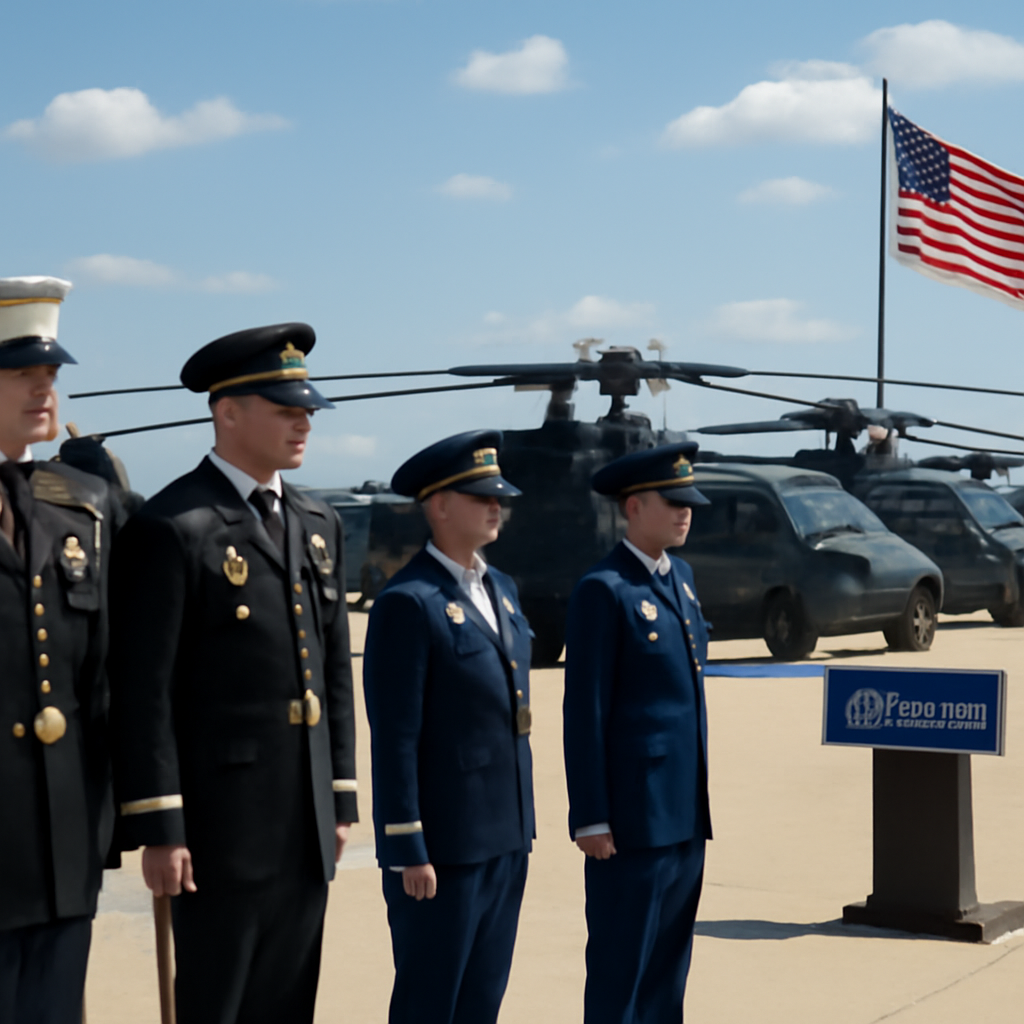
A total of 26 Jolly Green II helicopters are set to be based at Joint Base Andrews, and the Air Force has activated a new unit to fly them.
Activation of the 5th Helicopter Squadron at Andrews Air Force Base
The U.S. Air Force held a ceremony at Andrews yesterday to mark the formal activation of the 5th Helicopter Squadron (5 HS). The squadron has been stood up to receive and operate HH-60W Jolly Green II helicopters that will replace the UH-1N Twin Hueys currently assigned to the 1st Helicopter Squadron (1 HS). The Air Force said the 5 HS will “train aircrew and maintainers, establish operational and maintenance processes, and receive new aircraft as it prepares to execute the national security mission within the National Capital Region.”
HH-60W Jolly Green II: capabilities and planned modifications
The Air Force described specific performance benefits: “The HH-60W’s increased speed, range and carrying capacity will better deliver safe operations for U.S. senior leaders, service members, and the communities around the region.” The Jolly Green II also has in-flight refueling capability — an ability not present on the UH-1N or the MH-139 — and the helicopters destined for Andrews will receive additional modifications, including changes to main cabin seating, upgraded communications suites, and enhanced defensive capabilities.

This site is the portfolio.
OSINTSights runs on Cloudflare Workers, D1, R2, and Vectorize, with an AI pipeline on Hetzner ARM. Nubivance designed, built, and operates it. We do the same for clients.
See what we buildOperational roles in the National Capital Region and continuity of government
At Andrews, the HH-60Ws will take over Air Force District of Washington (AFDW) missions that include daily airlift sorties transporting U.S. and foreign VIPs around the National Capital Region (NCR). The helicopters will also be positioned to support continuity of government plans, including moving senior officials and lawmakers to safety following an attack or similarly serious contingency. The NCR’s airspace is described as “most densely defended and heavily monitored anywhere in the United States,” with complex flight and security constraints that have been a focus since a January 2025 mid-air collision involving an Army UH-60 Black Hawk and a PSA Airlines CRJ700 that occurred during a continuity of government training flight.
Fleet and procurement implications: HH-60W, MH-139, and congressional scrutiny
Twenty-six HH-60Ws will replace the current Twin Hueys at Andrews in a one-for-one swap, and the arrival will add about 60 personnel to the base. But procurement choices made earlier are now shaping operational trade-offs. The Air Force reduced its planned HH-60W buy from 113 helicopters to 91; with 26 assigned to the AFDW mission at Andrews, “roughly a third of the entire fleet” would be devoted to the NCR unless additional HH-60Ws are procured. The service originally planned to replace UH-1Ns worldwide with MH-139 Grey Wolf helicopters; the MH-139 acquisition has likewise been truncated, from 80 planned aircraft down to 56.
Those choices have prompted congressional attention. Members of the House Armed Services Committee wrote in a report accompanying a draft 2027 National Defense Authorization Act that the committee “remains concerned regarding the justification for transitioning these missions to an alternate rotary-wing platform.” The committee directed “the Secretary of the Air Force to submit a report to the congressional defense committees not later than December 1, 2026, assessing operational, cost, infrastructure, and readiness impacts of assigning any non-MH-139A rotary-wing aircraft to continuity of government and transport of United States government officials and security forces in the National Capital Region,” specifying comparisons of procurement cost, cost per flight hour, infrastructure and aircraft modification requirements, and training and manpower impacts.
How Air Force Global Strike Command, Congress, and 1st Helicopter Squadron are affected
- Air Force Global Strike Command (AFGSC): The Air Force is still acquiring MH-139s for AFGSC units that provide security around Minuteman III ICBM silos; the MH-139 program’s reduction to 56 aircraft frames into how AFGSC force structure is sustained.
- Congress (House Armed Services Committee): Lawmakers have required a December 1, 2026 report assessing the operational, cost, infrastructure, and readiness impacts of using non-MH-139 aircraft for NCR missions, explicitly including comparisons of procurement and per-flight-hour costs and required facility upgrades.
- 1st Helicopter Squadron (1 HS): The unit’s UH-1Ns will continue operating through the transition so as “to avoid any gaps in capacity to meet critical operational requirements.” The UH-1Ns are aging — three assigned to 1 HS saw combat during the Vietnam War — and one Twin Huey made a precautionary landing in an open field in Maryland last week after “experiencing unusual mechanical noise.”
The activation of the 5th Helicopter Squadron marks a concrete step in reconfiguring rotary-wing capabilities in the National Capital Region: 26 HH-60Ws, modified for VIP transport and continuity missions, plus a measured increase of 60 personnel at Andrews. The move tightens operational options around Washington, D.C., but it also concentrates a substantial portion of a smaller HH-60W fleet on one mission set and invites the scrutiny the House Armed Services Committee has prescribed — a report due by December 1, 2026 — while the service completes a transition expected to run through 2030.