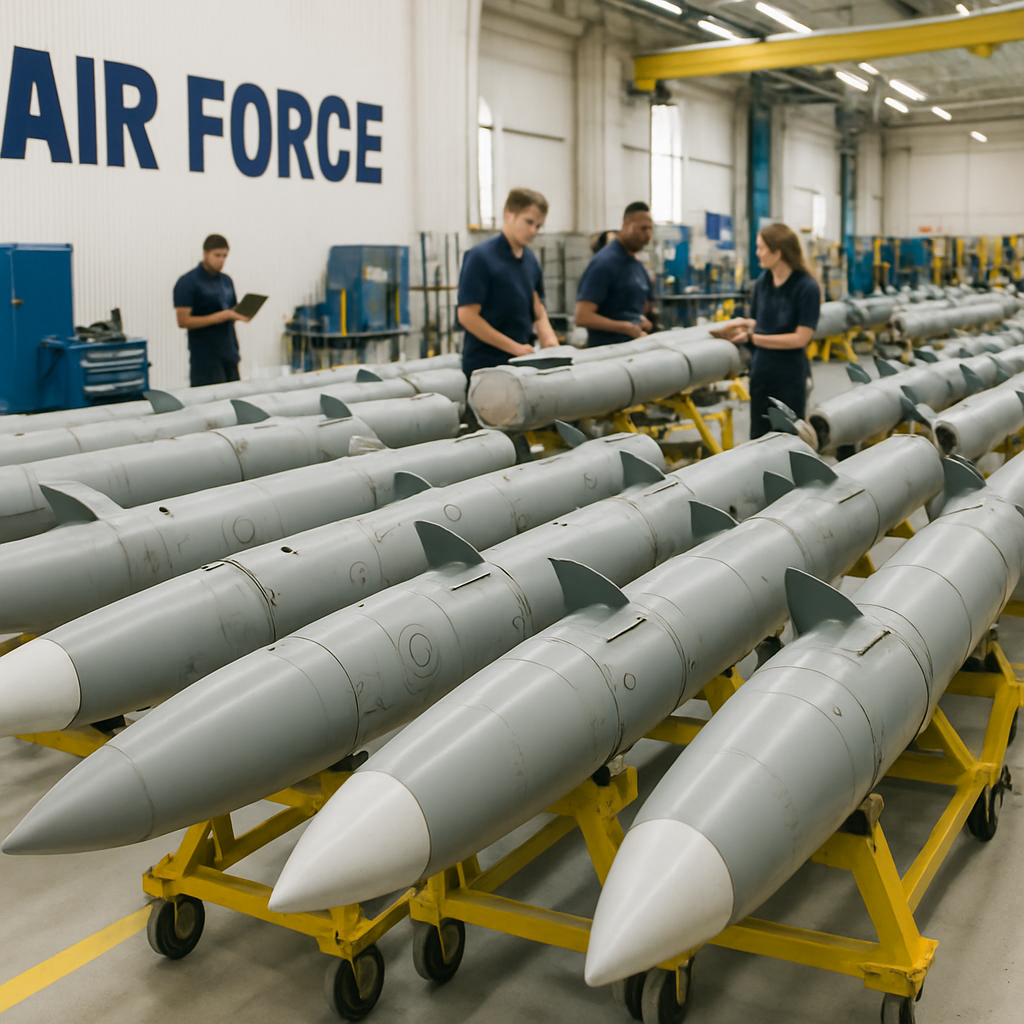
“Through these programs, we will be able to expand production, build up munitions inventories, and more rapidly replenish munition stockpiles,” Air Force Brig. Gen. Robert Lyons told lawmakers in March. That assertion anchors an aggressive buy plan: the Air Force’s fiscal 2027 budget documents disclose plans that could see nearly 27,000 copies of the Family of Affordable Mass Missile purchased and more than $12 billion allocated to stockpile the nascent weapon.
Scale: nearly 27,000 FAMMs and a $12 billion stockpile
The Air Force’s FY27 budget documents publicly reveal the first program of record for the Family of Affordable Mass Missile (FAMM). After initiating procurement in FY26, the service is requesting $300 million in reconciliation funds in FY27 to buy 1,000 FAMM units. Procurement then rises sharply in the Pentagon’s five-year projection: 5,300 in FY28 and climbing to 7,990 in FY31. Those projected buys add up to nearly 27,000 weapons and a planned spend of more than $12 billion to build inventory of the new, lower-cost cruise munition.
Procurement profile, variants and comparisons
The FAMM platform comes in multiple variants and is being pursued alongside other established munitions. The Air Force expects to seek multi-year procurement authority to buy FAMM in bulk, the budget documents say. By contrast, the Joint Air-to-Surface Standoff Missile (JASSM) is projected at a steadier annual buy rate of 860 units in the out-years, and the Advanced Medium Range Air-to-Air Missile (AMRAAM) would settle at 720 copies per year beginning in FY28. The budget documents also note classified quantities for the new Joint Advanced Tactical Missile.

Audit-ready is a season. It shouldn't be.
Evidence in spreadsheets, controls drifting between audits, frameworks multiplying on flat headcount. Nubivance runs continuous compliance on Rapid7 Cyber GRC - SOC 2, HIPAA, ISO 27001, PCI, CMMC.
End the scrambleAnduril, CoAspire and Zone 5: lugged, palletized and the ERAM parallel
The Air Force lists three active vendors on the FAMM program: Anduril, CoAspire and Zone 5. Budget materials highlight a “lugged” configuration that would allow fighters and bombers to carry the weapon, while the FAMM also traces its lineage to an earlier Enterprise Test Vehicle program that advanced platforms from Anduril and Zone 5. The Air Force disclosed a test of a lugged FAMM on April 13 but did not name the vendor for that test.
Separately, the service created an Extended Range Attack Munition (ERAM) effort to produce a platform intended for foreign military sales—specifically to aid Ukraine—according to a Defense Security Cooperation Agency notice. Zone 5 and CoAspire have been tapped for ERAM, the DSCA notice says. The FY27 request also includes a $55 million base-budget line item described as funding “the Extended Range” variant; an accompanying request for information suggests the extended-range version may be called FAMM-BAR, or “Beyond Adversary’s Reach.”
The RFI for that extended version sets a required range of over 1,000 nautical miles, names the target set as “slow moving maritime,” and identifies a palletized deployment method as primary with a lugged design as a possible secondary vector.
Engine awards: PBS Aerospace, Beehive and Technical Directions Inc.
The Air Force is also shaping an industrial base for FAMM engines. A recent $3 million award to PBS Aerospace, the American subsidiary of a Czech parent company, is intended to “technically mature PBS turbine designs” and prepare production facilities for high-volume FAMM manufacturing, an Air Force spokesperson told Breaking Defense. Two other contractors—Beehive Industries and Kratos subsidiary Technical Directions Inc.—received similar small-turbine development contracts, the spokesperson said.
“We are in discussions with multiple vendors to deliver this capability and expect to award contracts before the end of 2026,” the Air Force spokesperson added, signaling further engine-production decisions to come.
How policymakers, procurement leaders, and munition manufacturers will respond
- Policymakers and budget officials: Congressional action will be required to clear reconciliation funding and multi-year procurement authorities referenced in the FY27 documents; the $300 million reconciliation ask in FY27 and the $55 million base-budget line for the extended-range variant are specific fiscal items that will shape near-term decisions.
- Procurement leaders and combatant commanders: The Air Force frames FAMM and ERAM as a way to “expand production” and “provide more munition options to combatant commanders,” per Brig. Gen. Lyons. Commanders planning future operations will be watching delivery schedules and variant capabilities—lugged versus palletized and the promised extended range—when aligning force structure and mission sets.
- Munition and engine manufacturers: Named vendors (Anduril, CoAspire, Zone 5) and engine contractors (PBS Aerospace, Beehive, Technical Directions Inc.) will be focused on production rates and facility readiness; the service’s expectation of additional engine awards before end of 2026 and the multi-year procurement intent create incentives to scale manufacturing quickly.
The Air Force’s plan is one of the clearest public signs yet of a Pentagon-wide push toward mass-produced, lower-cost cruise munitions: the documents show steep ramp rates, vendor competition across lugged and palletized variants, and explicit investment in the small-turbine industrial base. The plan leaves open concrete near-term steps that will determine whether the projections become reality—vendor production quantities and dollar awards were not specified in the budget materials, and the service’s engine-contracting schedule anticipates more decisions before the end of 2026.