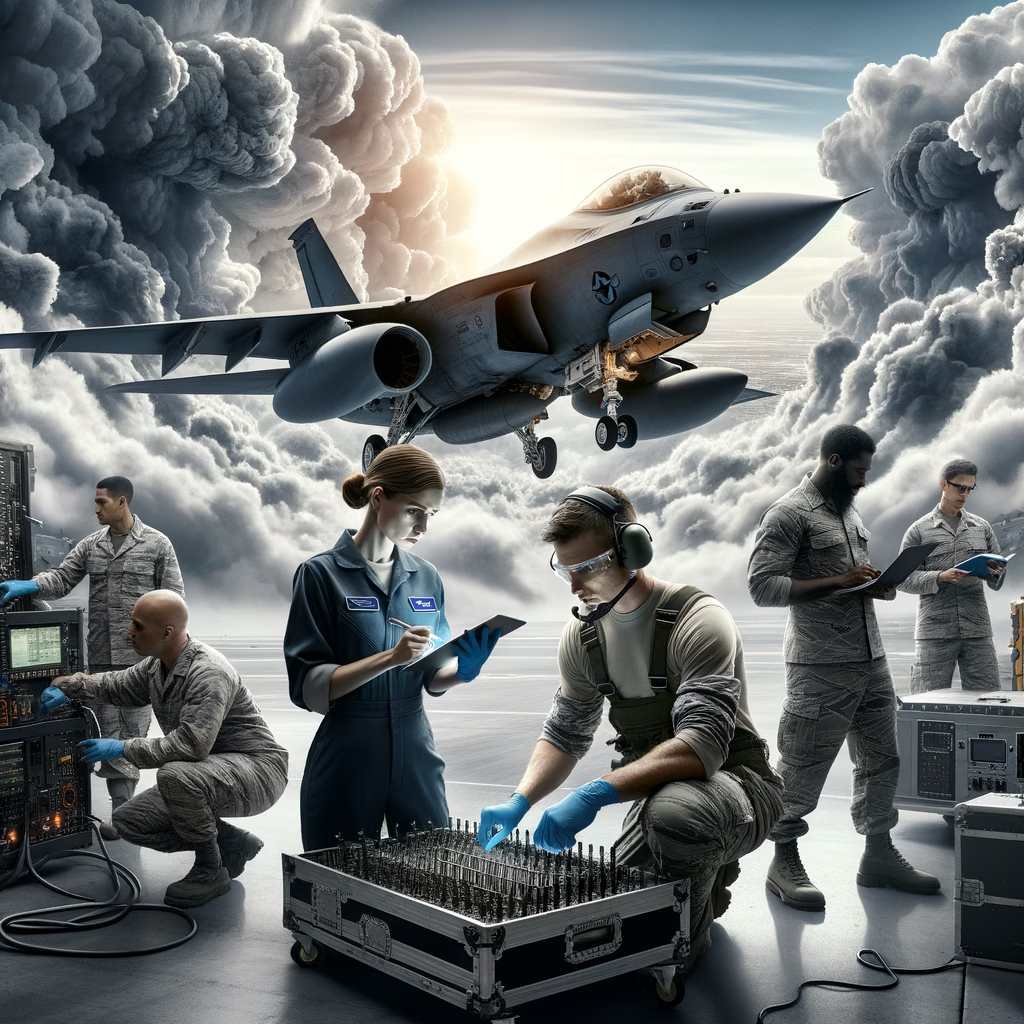
What do you do when your airfields are no longer sanctuaries and your adversary can strike at the speed of a satellite? For the U.S. Air Force, the answer has been to embrace a doctrine that prizes dispersion over concentration, flexibility over fixed plans: Agile Combat Employment, or ACE, introduced formally in 2021 as a hedge against more capable competitors and a changing battlespace.
ACE is not a single gadget or aircraft upgrade; it is a way of operating. It asks planners, maintainers and pilots to rethink how aircraft are staged, serviced and sustained so they can survive and fight under threat from long-range fires, cyber and electronic attack, and sophisticated intelligence, surveillance and reconnaissance (ISR). In short, ACE acknowledges that the era of large, static air bases may be giving way to one where mobility, redundancy and improvisation count as much as speed and sortie-generation rates.
At its core, ACE emphasizes several interlocking elements: dispersion of forces across multiple locations, smaller and more self-sufficient teams, rapid runway repair and alternate landing sites, prepositioned logistics, and resilient communications. The concept builds on lessons from recent conflicts and exercises, and on assessments of potential near-peer adversaries’ anti-access/area-denial (A2/AD) capabilities that threaten traditional basing models.
/ Dispersed basing and the use of austere or temporary sites to complicate enemy targeting
/ Small, expeditionary maintenance and logistics teams capable of rapid aircraft turnarounds
/ Hardened, redundant communications and integrated command-and-control to operate under contested conditions
/ Prepositioned munitions, fuel and spare parts, plus rapid runway repair and expeditionary airfield operations
Implementation has been gradual and deliberate. The Air Force has run ACE experiments and exercises across theaters to stress-test logistics, command relationships, and sustainment practices. Pacific Air Forces (PACAF) in particular has leaned into ACE given the geography and the stated priorities of Indo-Pacific deterrence. The result is an evolving mosaic of doctrine, tactics and investment decisions intended to make aircraft — and the aircrews who fly them — ready for a different, harder-paced kind of war.
Why does this matter? First, ACE attempts to blunt one of the most consequential trends in contemporary warfare: the melding of long-range precision fires, space-based ISR and cyber/electronic warfare that enables an adversary to find and reach high-value rear-area assets. Dispersing aircraft and logistics nodes makes attribution and targeting harder, raises the cost of attack for an opponent, and preserves operational tempo even after initial strikes.
Second, ACE is a test of the U.S. military’s logistical and organizational elasticity. Aircraft readiness under ACE depends on supply chains being nimble enough to support many small sites instead of a few large hubs. It depends on maintainers trained for austere conditions, and on command-and-control systems that can coordinate distributed forces in contested electromagnetic environments. Those are not trivial requirements; they stretch doctrine, budgets and industrial capacity.
Technologists see both opportunity and challenge. For software and communications engineers, ACE underscores the urgency of resilient, low-latency networks and hardened data links that let mission planners and pilots share targeting data while under electronic attack. It highlights the potential of predictive maintenance, portable diagnostic kits and modular systems that let crews repair a jet with limited infrastructure. Yet those technologies must be ruggedized, secure and interoperable — a demanding triad.
Policymakers face hard tradeoffs. ACE can complicate an adversary’s calculus and reinforce deterrence, but it requires up-front investments in training, mobility platforms, munitions prepositioning and stockpiles. Budget cycles and congressional oversight will shape how deeply ACE becomes institutionalized. There is also a political dimension: dispersing forces can mean a more visible footprint in partner nations, requiring diplomacy alongside operational planning.
For users — pilots, maintainers and planners — ACE changes daily routines. Maintenance crews may work in smaller teams under austere conditions, relying more on mobile tooling and pre-packed spares. Pilots must be prepared to operate from short or improvised strips, with fewer immediate support assets. That can increase stress and workload, making human factors and training investments as vital as hardware purchases.
From an adversary’s perspective, ACE raises the bar for effective targeting. A dispersed, resilient air posture complicates ISR collection and targeting timelines. But it also invites countermeasures: adversaries may invest in more persistent ISR, sophisticated munitions, or cyber operations aimed at logistics and command networks. In other words, ACE reshapes the problem set rather than eliminating it.
There are clear risks and limits. Sustaining dispersed operations over prolonged periods could strain the logistics and maintenance base, especially if supply lines become contested. The security of prepositioned munitions and fuel is a concern, as is the protection of small teams vulnerable to local sabotage or special-operations activity. Command and control in dispersed settings demands robust, survivable links; without them, distributed forces risk fragmentation rather than resilience.
Accountability and measurement also matter. Traditional readiness metrics — numbers of flyable aircraft, maintenance hours, munitions stocks — were built for centralized basing. ACE requires new indicators that capture operational agility: ability to surge from multiple sites, time-to-repair on a degraded runway, and the capacity to operate with intermittent communications. Developing and validating those metrics will be part and parcel of whether ACE becomes doctrine or doctrine in name only.
ACE is not a silver bullet; it is a strategic posture that buys time and complexity for defenders while imposing new demands on the force. If executed well, it will make U.S. airpower less brittle and more adaptable. If underfunded or poorly integrated, it risks becoming a bureaucratic label overlaid on an already taxed logistics and personnel system.
Ultimately, the Air Force’s adoption of ACE is a recognition that the shape of war has changed and that staying immobile is a vulnerability. The central question now is whether the institution — from the Pentagon budgeteers to the airmen on a forward strip — can sustain the cultural, technical and material changes that ACE demands. If history teaches anything, it is that doctrine without the daily disciplines to make it real is only paper; and in the coming decade, the difference between paper and practice may determine whether aircraft are ready to fly when they are most needed.
Source: https://modernbattlespace.com/2025/03/05/the-u-s-air-forces-ace-concept-preparing-aircraft-for-the-new-reality/



