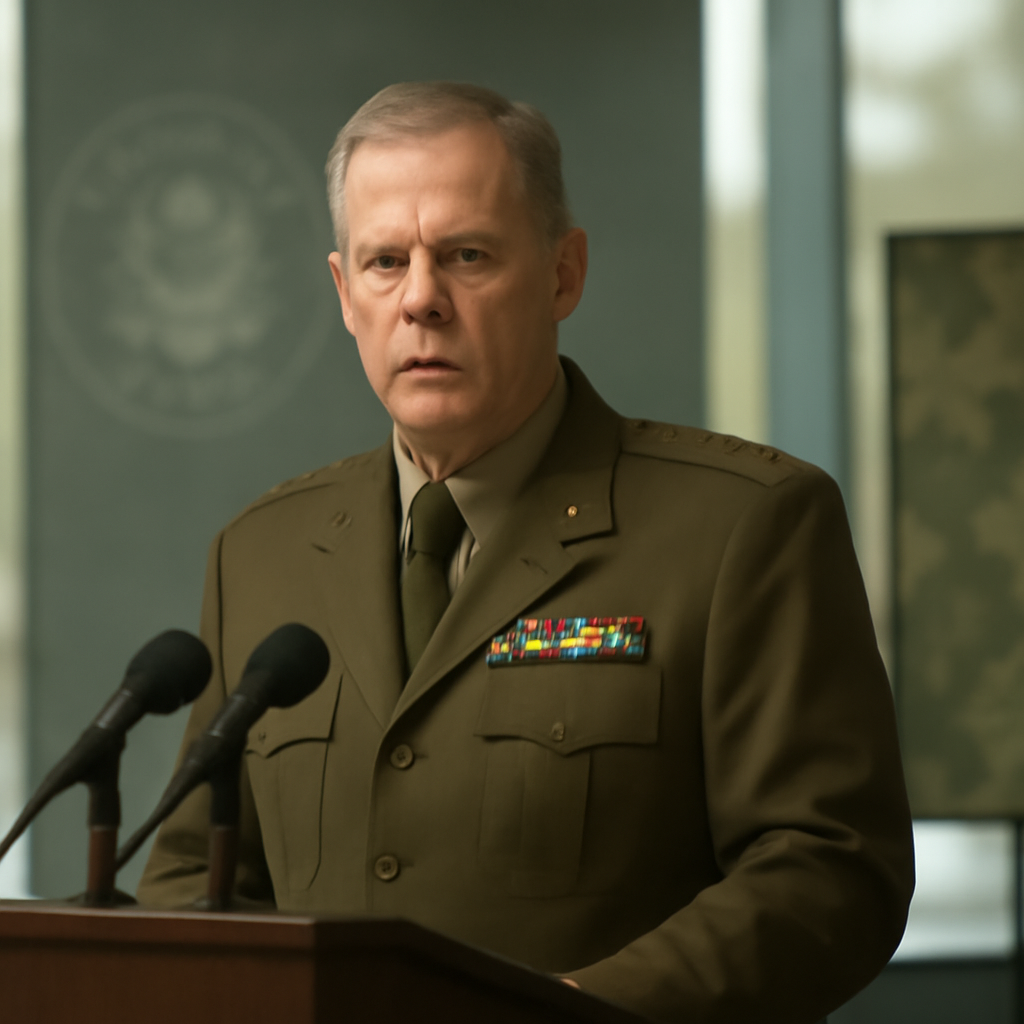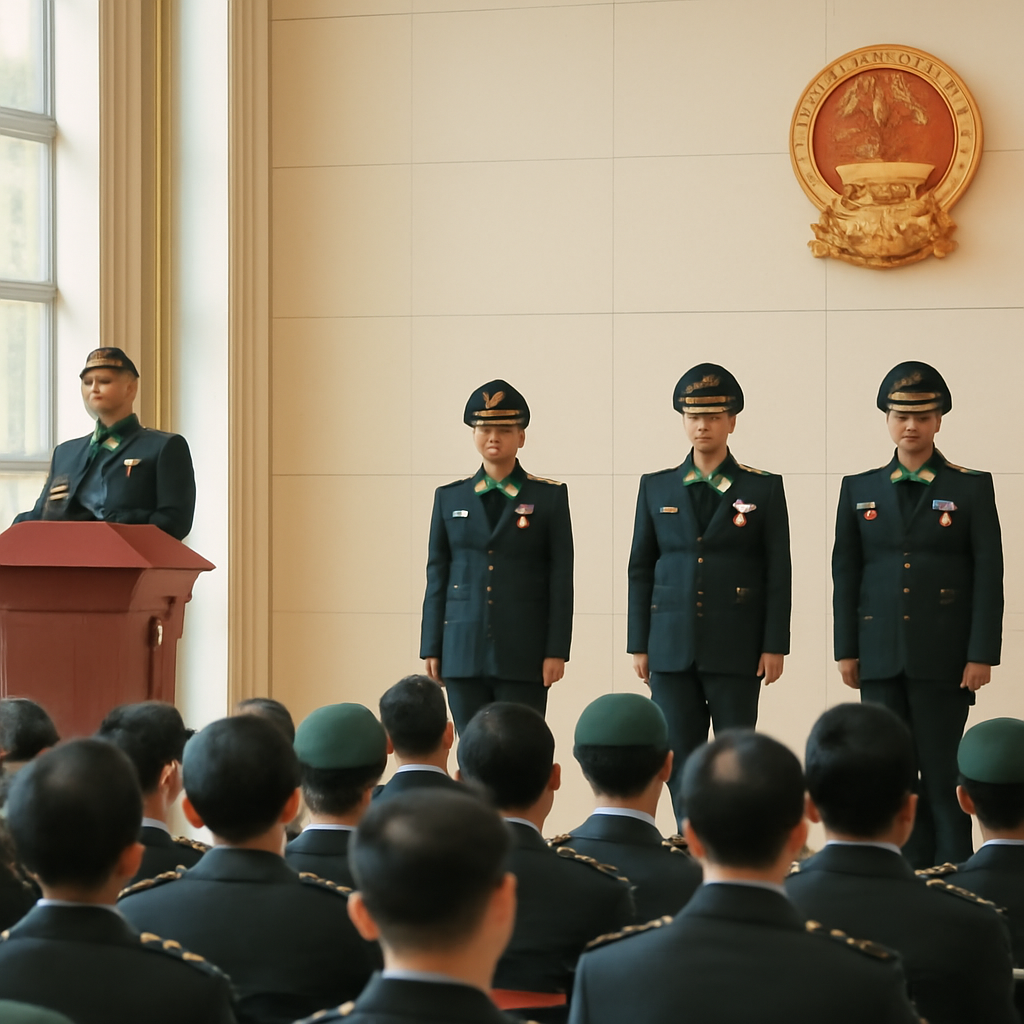
On 29 June, two newly promoted generals appeared alongside Defense Minister Dong Jun and Central Theater Command Commander Han Shengyan at a celebration of the 105th anniversary of the founding of the Chinese Communist Party — their first public appearance together with other senior PLA officers.
The 3 July promotion ceremony and the changing count of generals
China held a promotion ceremony for the rank of general on 3 July in Beijing, according to Xinhua News Agency. CMC Vice Chairman Zhang Shengmin presided and read out the promotion order signed by the president, who also attended. With the event, the number of active PLA generals rose from four to six. The six named active generals are Dong Jun, Han Shengyan, Wang Gang, Zhang Shengmin, Yang Zhibin and Zhang Shuguang.
Zhang Shuguang and the CMC discipline inspection apparatus
Zhang Shuguang, born in 1964, was promoted to general and appointed secretary of the Central Military Commission’s (CMC’s) Discipline Inspection Commission and director of the CMC Supervisory Commission. His career has been concentrated in the PLA’s discipline inspection and supervision system: he became a member of the 20th Central Commission for Discipline Inspection in 2022; served as director of the Case Review Bureau under the Discipline Inspection Department of the PLA’s former General Political Department; and later served as director of the Discipline Inspection and Supervision Bureau of the CMC Discipline Inspection Commission.
Zhang’s institutional overlap with Zhang Shengmin stretches back to 2017, when Zhang Shengmin became secretary of the CMC Discipline Inspection Commission while Zhang Shuguang was director of the CMC’s Discipline Inspection and Supervision Bureau. In December 2021, Zhang Shuguang was promoted to secretary of the Army Discipline Inspection Commission and awarded the rank of lieutenant general. In July 2026 he succeeded Zhang Shengmin as head of the CMC Discipline Inspection Commission and the CMC Supervisory Commission, placing him in charge of the PLA’s highest anti‑corruption and internal supervision apparatus.

Audit-ready is a season. It shouldn't be.
Evidence in spreadsheets, controls drifting between audits, frameworks multiplying on flat headcount. Nubivance runs continuous compliance on Rapid7 Cyber GRC - SOC 2, HIPAA, ISO 27001, PCI, CMMC.
End the scrambleWang Gang and the stabilisation of the air force
Wang Gang, born in 1965, was the other officer elevated to the rank of general and is the commander of the Chinese air force. Wang’s career is largely service‑level and operational-management oriented: he began as an aerobatic pilot, moved to air force headquarters as director of the Military Training Department in 2012, became assistant chief of staff of the air force in 2016 and was promoted to major general, then became air force chief of staff in 2022 and was promoted to lieutenant general. In July 2025 he visited Pakistan for exchanges with the Pakistani military and reportedly discussed observations from the India‑Pakistan air combat experience.
The promotion and Wang’s appointment as air force commander were presented in the source as moves aimed at internal management and morale stabilisation within the air force rather than immediate enhancement of external combat command. The report notes that service commanders focus on administration, force development, training systems and equipment planning, while theatre commands focus on operations; accordingly, any Taiwan‑related military operation would likely remain under the leading command of the Eastern Theater Command rather than the air force commander alone.
Generational continuity, purges, and the limits of immediate operational change
The promotions occur after what the source describes as a major wave of personnel turmoil and extensive purges earlier in the year, and they are framed as part of a post‑purge reconstruction of the PLA’s senior ranks. The two promotions — one a discipline inspection specialist (Zhang Shuguang) and one a service manager and former aerobatic pilot (Wang Gang) — are presented as measures to stabilise internal administration and restore control.
The source highlights a generational aspect: officers born after 1970 have not yet taken over the highest operational and service‑level posts, and many senior vacancies are still being filled by current deputies. Service commanders are being used to stabilise organisations and maintain continuity in internal administration while theatre commanders retain primary wartime operational command.
How air force personnel, the CMC discipline system, and theatre commanders are positioned
- Air force personnel and pilots: The appointment of Wang Gang — a former aerobatic pilot with long experience in training and internal management — is presented as intended to stabilise morale and reassure personnel worried by investigations such as those reported concerning Yang Wei and possible corruption allegations affecting aircraft development and design.
- The CMC discipline inspection system: Zhang Shuguang’s elevation places him as the inheritor of Zhang Shengmin’s discipline inspection network and the CMC’s internal coercive control mechanism, signalling a priority on restoring the military’s anti‑corruption and supervision apparatus ahead of larger personnel reshuffles.
- Theater commanders and operational command: The report stresses that theatre commands, not service commanders alone, remain the principal organs for combat operations; the Eastern Theater Command is identified as the likely leading command for any Taiwan‑related operations.
Taken together, the appointments are described in the source as signals that internal management, political loyalty and disciplinary rectification are currently the PLA leadership’s central concerns. The promotions are framed not as routine rank adjustments but as steps in rebuilding control over the PLA’s senior ranks while purges and replenishment continue — with potential implications for the timing and scale of any major external operations as the leadership restores organisational stability ahead of the Fifth Plenum and the 21st Party Congress.