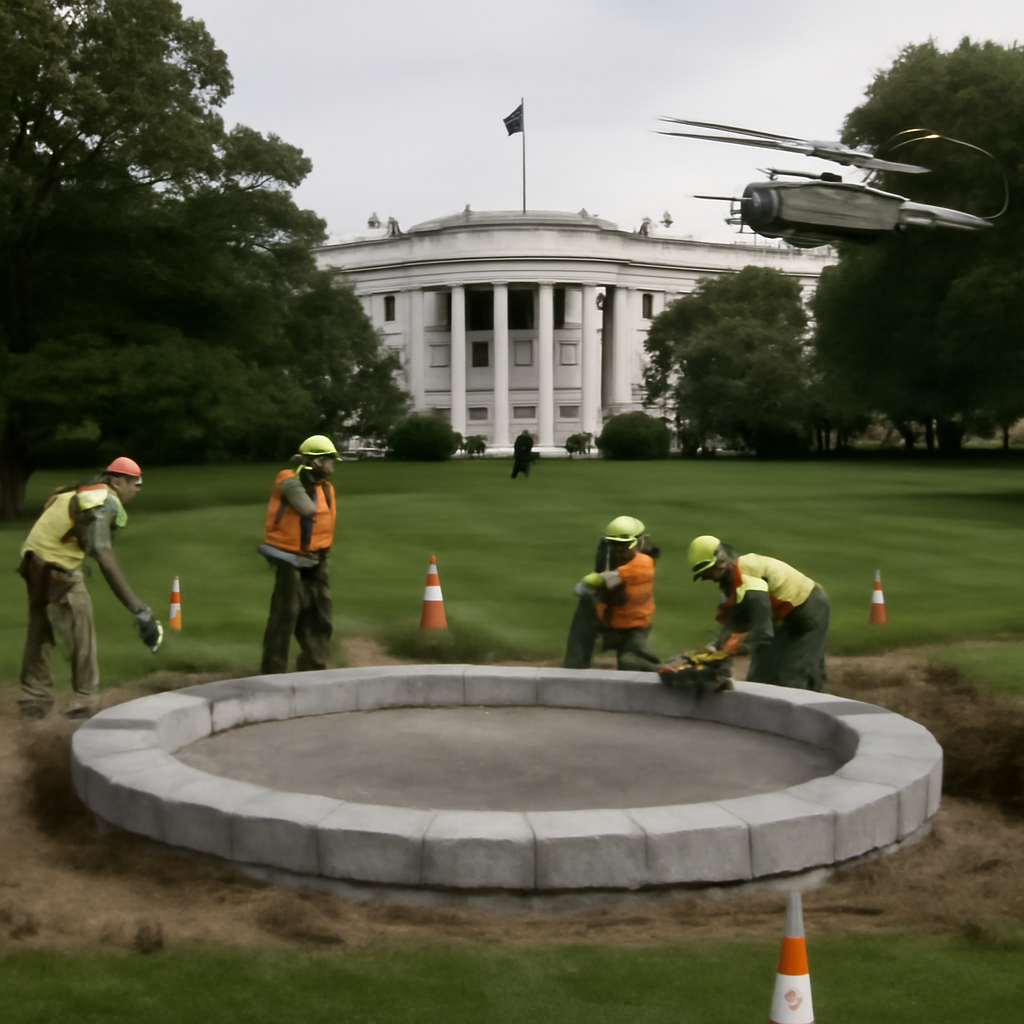
The president announced he has ordered a granite helipad on the South Lawn to protect the grounds from what he described as the "intense exhaust heat and rotor wash" of the new VH-92A Patriot helicopters. Trump said Sikorsky — the Lockheed Martin subsidiary that builds the VH-92A — will pay an estimated $5 million to $6 million in construction costs, and that the pad will be carved from granite and decorated with the White House seal and an eagle.
Why a hard-surface landing site
Trump framed the decision around repeated damage to the South Lawn when landing the new VH-92A aircraft. He said the VH-92As “are about two and a half times more powerful than the old ones,” and described incidents in which grass was “ripped out” and “singed.” He told reporters the operational mismatch forced an awkward and costly workaround — alternating between old and new helicopters — and that a permanent, hard-surface landing site would end that practice.
Sikorsky and Lockheed Martin responses and contribution mechanics
Lockheed Martin confirmed the contribution range President Trump disclosed and specified the payment was made to the Trust for the National Mall, “the National Park Service’s non‑profit organization.” In a statement Lockheed said: “Our engagement with the federal government is guided by rigorous ethics and compliance standards and conducted in full accordance with all applicable laws and regulations.” A Sikorsky spokesperson described the VH‑92A Patriot as “a recognizable patriotic asset known around the globe for safety, security and reliability,” and said it “brings increased capabilities for the no‑fail mission supporting the Commander‑in‑Chief around the world.”

This site is the portfolio.
OSINTSights runs on Cloudflare Workers, D1, R2, and Vectorize, with an AI pipeline on Hetzner ARM. Nubivance designed, built, and operates it. We do the same for clients.
See what we buildAircraft timelines and operational history cited
The source material places the VH‑92A’s delivery and entry into service in recent years: Sikorsky won a $1.24 billion contract and delivered the 23rd and final VH‑92A Patriot on Aug. 19, 2024, the same day then‑President Joe Biden took the first presidential trip on the new aircraft. The U.S. Marine Corps achieved Initial Operational Capability for the VH‑92A in December 2021, and Marine Helicopter Squadron One (HMX‑1) commenced operational missions with the aircraft in 2022. Communications-systems issues and the lawn‑damage problem both delayed the VH‑92A’s intended role as the sole presidential helicopter.
What the changes mean for the VH-3D Sea King and VH-60N Whitehawk
The announcement lays out a near-term fleet transition: aging VH‑3D Sea Kings currently used for presidential transport are “set to be retired completely sometime this year,” while the Marines expect to keep flying VH‑60N Whitehawk helicopters “through at least 2030” because of their performance in hot and high‑altitude environments. Trump said the new helipad will let the VH‑92A become the primary Marine One and finally allow the VH‑3D Sea Kings to retire “once and for all.”
Construction status, the White House grounds, and related projects
According to the reporting, satellite and ground‑level imagery show the helipad site is already deeply under construction, though the president did not provide a contractor name or a firm timeline. Trump said he chose granite rather than concrete because the material would be a “beauty” for public events, and suggested the pad could double for events or press conferences when not used for presidential transport. The reporting also notes recent damage to the South Lawn from a temporary setup for a UFC event on June 14, 2026 — an episode that the White House sources cited as making the timing for a hard‑surface pad more sensible.
The helipad declaration arrives as the White House is redeveloping the former East Wing into a ballroom and military center. The administration initially said that project would be funded by private donors but later sought about $1 billion in new Secret Service funding from Congress; of that total, $220 million was identified for the facility itself. That spending plan is now “caught up in a legal battle,” according to the source material, and questions raised previously about whether the new ballroom roof could serve as an alternative helipad remain unresolved.
What this means for HMX-1, Sikorsky/Lockheed Martin, and the U.S. Secret Service
- HMX-1 (Marine Helicopter Squadron One): The granite pad aims to remove a key obstacle to using the VH‑92A for regular White House operations and would permit the squadron to retire long-serving VH‑3Ds during 2026.
- Sikorsky / Lockheed Martin: The companies have publicly framed the financial contribution as support to the Trust for the National Mall and emphasized compliance with ethics and legal standards while highlighting the VH‑92A’s upgraded performance and reduced maintenance time.
- U.S. Secret Service / Congress: The helipad sits alongside larger security and facility funding debates — the administration’s $1 billion request for the Secret Service and the $220 million allocation for the new facility remain entangled in a legal dispute, complicating the broader infrastructure picture.
Practical questions remain. The reporting notes it “isn’t clear how the same issue will impact how the VH‑92s will be used when flying abroad,” where large fields and temporary landing zones are common. The White House has not supplied a contractor name or a definitive schedule; Lockheed and Sikorsky have described the contribution and the aircraft in broadly positive terms. For now, the South Lawn granite pad is a concrete — or granite — answer to a technical mismatch on the home turf, even as its implications for overseas operations and the broader security and construction funding disputes play out.



