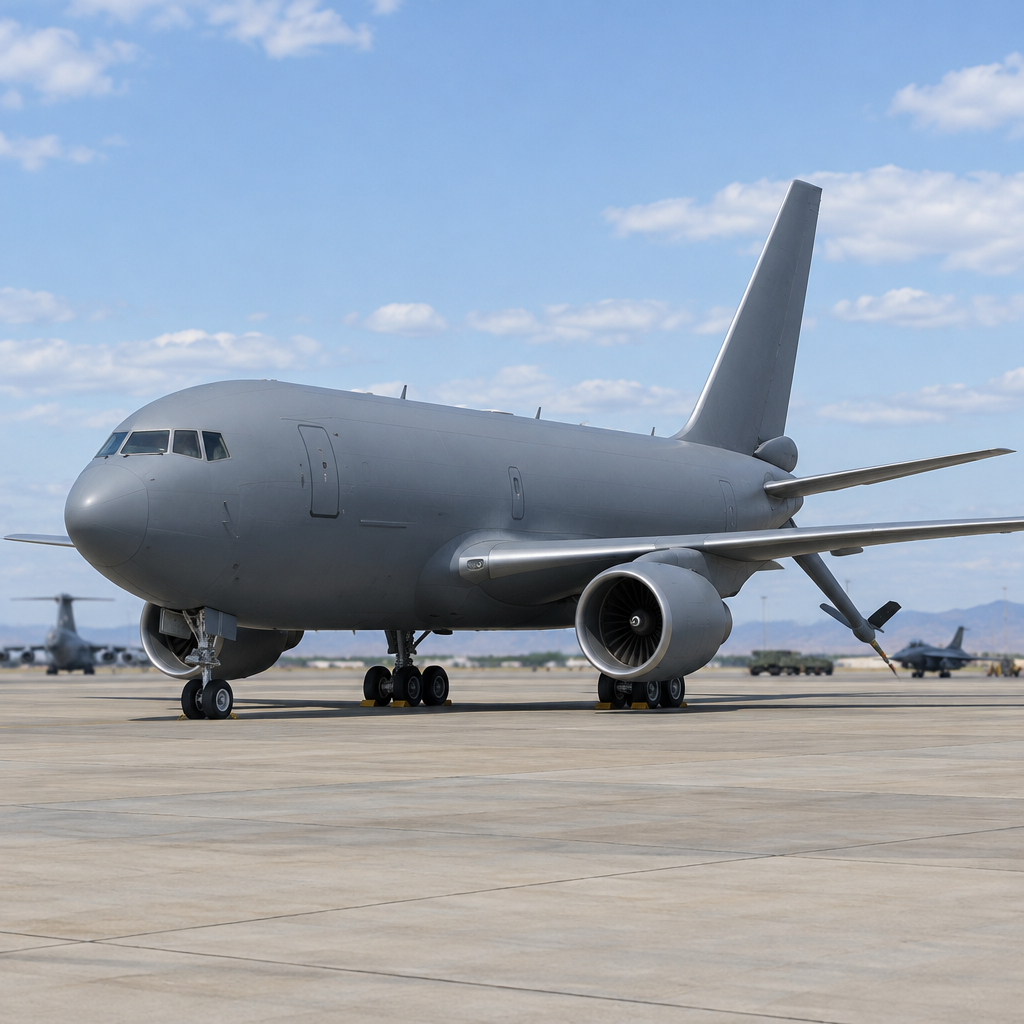
Assuming a fleet of 510 tankers, acquiring 260 KC-46s and 250 blended‑wing‑body refuelers could cost an estimated $397.6 billion — about $15.5 billion less than buying only the same number of Pegasus aircraft, according to a new report from Hudson Institute analysts Timothy Walton and Shane Dennin.
Hudson Institute report: Resilient Reach and its core recommendation
The report, titled Resilient Reach: Redesigning Aerial Refueling for Contested Global Operations, argues the Air Force must rebalance investments across new aircraft design, base infrastructure and mission systems to preserve aerial‑refueling advantage in a potential direct conflict with China. The authors say the service’s current posture relies on “vulnerable forward bases” and tankers with insufficient range, increasing the risk of defeat in a fight with Beijing.
KC‑46 Pegasus: operational successes, stated shortfalls, and procurement limits
The Hudson analysis acknowledges recent combat use — describing the KC‑46’s platform “success in recent combat operations like Epic Fury” — but concludes the Boeing‑built Pegasus “lacks the range, offload and survivability” needed against China. The report notes the Air Force last year unveiled plans to order up to 75 additional KC‑46s while studying next‑generation tankers; Walton told Breaking Defense that 75 aircraft “should be the upper limit of that buy” and urged prioritizing a new tanker rather than an extended KC‑46 procurement run.

Audit-ready is a season. It shouldn't be.
Evidence in spreadsheets, controls drifting between audits, frameworks multiplying on flat headcount. Nubivance runs continuous compliance on Rapid7 Cyber GRC - SOC 2, HIPAA, ISO 27001, PCI, CMMC.
End the scrambleBlended‑wing‑body refueler: the middle option the authors favor
Among five fleet approaches the report models — which range from buying only Pegasus tankers to mixes that include KC‑135s and specialized low‑observable refuelers — Walton highlighted a medium‑sized blended‑wing‑body (BWB) refueler as a “fiscally achievable plan.” The report’s representative fleet of 510 tankers anticipates 260 KC‑46s and 250 BWBs, with the combined research and development, procurement and sustainment bill estimated at $397.6 billion. The authors project a BWB could enter service around 2032 and note that the Air Force is already funding a BWB demonstrator designed by startup JetZero; the report used a “representative” BWB model and acknowledged other vendors could offer viable designs.
Airfield resilience, hardened fuel storage, and contested basing
Hudson recommends strengthening airfield resilience through infrastructure investments, improved defenses and more distributed fuel storage. The authors estimate such measures could cumulatively cost approximately $35.5 billion. The report points to recent Iranian strikes that “have destroyed US aircraft on the ground” as additional evidence of the need for hardened fuel storage and aircraft shelters. Walton said putting tankers under consideration for hardened aircraft shelters — or at least hangars that mask them from observation — is “probably most contentious,” noting Air Force Chief of Staff Gen. Ken Wilsbach has not favored measures to build more hardened shelters for large aircraft historically prioritized for fighters.
Mission systems, connectivity and self‑defense: the third cost bucket
The Hudson paper calls for equipping tankers with new mission systems to boost connectivity, operations and self‑defense; authors estimate these upgrades at roughly $13 billion. That total includes an $8 billion figure Walton tied to outfitting a fleet of 260 KC‑46s. The report notes the Air Force has incrementally equipped mobility aircraft with modern communications gear and is exploring self‑defense systems, but also warns the service has previously failed to meet ambitious connectivity targets and that limited resources could constrain adoption of communications, self‑defense and autonomy technologies.
What this means for the Air Force, Boeing, and JetZero
- The Air Force will face tradeoffs between buying additional KC‑46s, funding a clean‑sheet tanker program, and investing in base hardening and mission systems; the report explicitly frames these as budgetary choices that “might lead to some hard decisions.”
- Boeing, as KC‑46 manufacturer, stands to be affected by any cap on Pegasus buys; the report notes Air Force plans for up to 75 additional KC‑46s but quotes Walton arguing that number “should be the upper limit.”
- JetZero, whose BWB demonstrator the Air Force is funding, appears as a potential candidate for future mobility missions, but the report stresses its BWB model was “representative” and that other vendors could meet the requirement.
The Hudson analysis lays out numeric tradeoffs and a three‑pronged strategy — field a medium‑sized BWB tanker, harden forward infrastructure, and fit tankers with new mission systems — while acknowledging budget constraints. The report’s cost estimates total roughly $446.1 billion when adding the $397.6 billion aircraft figure, $35.5 billion for infrastructure and $13 billion for mission systems, and it leaves explicit decisions — how many KC‑46s to buy, whether to trim Pegasus procurement, and how to prioritize competing investments — to policymakers and senior service leaders.
The Air Force and Boeing did not immediately respond to a request for comment; the full report is authored by Timothy Walton and Shane Dennin of the Hudson Institute.