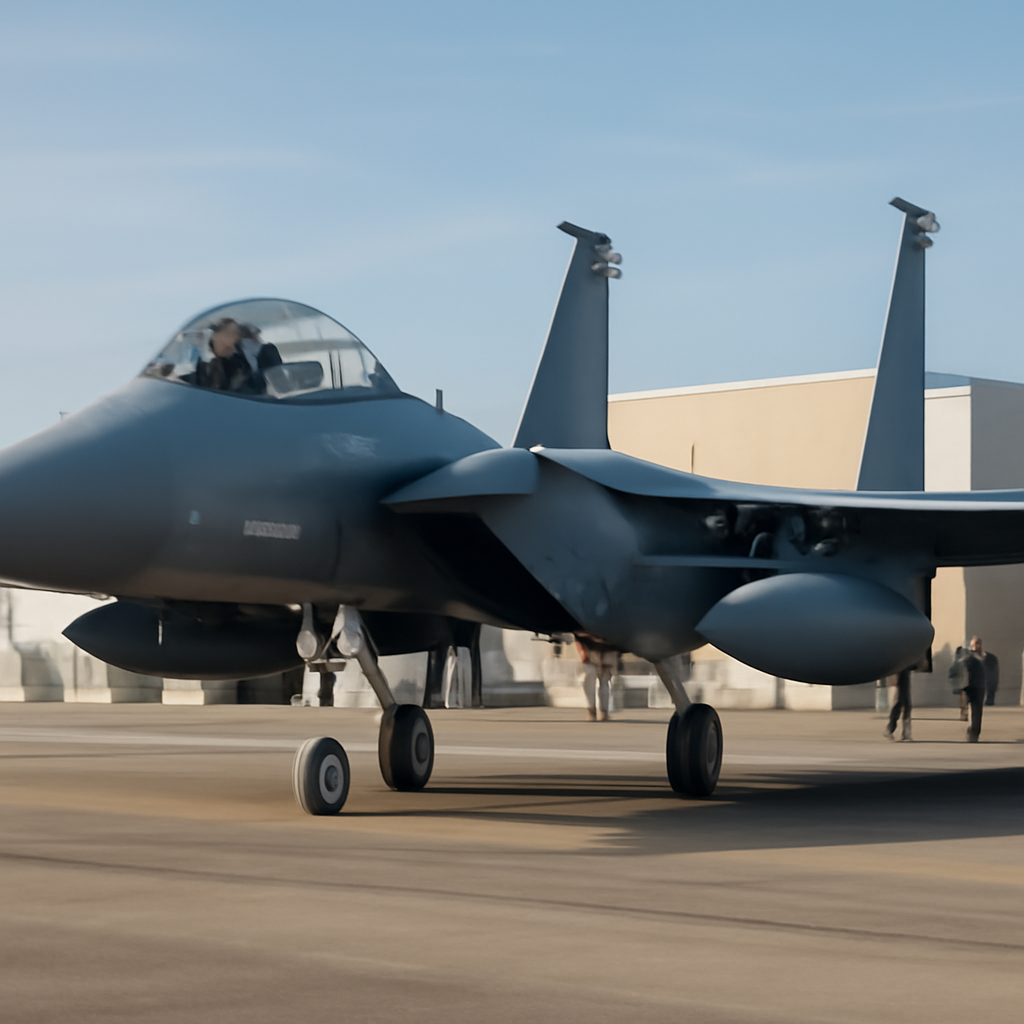
Departure and immediate routing
The jet that taxied out of Boeing’s St. Louis plant on August 28, 2026, is the first F-15EX Eagle II designated for permanent assignment to Kadena Air Base, Okinawa. The aircraft, serial 22-0022, flew test sorties from St. Louis in early August and carried the “ZZ” tail code by mid-month. After leaving St. Louis it flew to the 142nd Wing at Portland Air National Guard Base, Oregon, where that unit will perform final staging and integration work before the aircraft continues on to Okinawa.
What the F-15EX brings to the 18th Wing at Kadena
The Air Force positions the F-15EX as a capability leap over the legacy F-15C/D fleet it will replace. The jet brings modernized avionics and flight controls, an expanded electronic warfare suite, and greater weapons carriage — qualities the service highlights for operations across the Western Pacific. The aircraft’s open-architecture systems are intended to allow new sensors, weapons, and electronic-warfare capabilities to be added more readily than the aging C/D models.
The 18th Wing plans to base two active-duty F-15EX squadrons at Kadena. In the near term the Air Force has used rotations of F-15Es, F-22s and other fighters to fill capability gaps while the permanent EX presence is stood up.

This site is the portfolio.
OSINTSights runs on Cloudflare Workers, D1, R2, and Vectorize, with an AI pipeline on Hetzner ARM. Nubivance designed, built, and operates it. We do the same for clients.
See what we buildIntegration with allies and uncrewed systems
The 18th Wing intends to integrate the F-15EX with regional partners, including the Japan Air Self-Defense Force, building on existing bilateral training. Exercises such as Valiant Shield have also illustrated teaming between F-15EX aircraft and uncrewed systems; the source highlights an F-15EX working with the MQ-28 Ghost Bat, pointing to mixed formations in which crewed fighters provide weapons, sensing and command-and-control capacity for autonomous wingmen.
Program scale-up, technical refresh and production headwinds
The wider F-15EX program faces notable industrial and technical challenges. A Pentagon selected acquisition report released in August warned that a decision to expand the planned F-15EX buy from 129 to 267 jets — and to move from eight production lots to 12 — has introduced cost and schedule uncertainty. That extended timeline, the report says, raises obsolescence risks for systems such as radar, mission computers and engines and will require a “major technical refresh” and a “significant redesign effort.”
Program managers plan to mitigate those risks by rolling upgrades into operational flight program releases scheduled between 2031 and 2035, which the report describes as a “structured, risk-reduced pathway.” The schedule, however, carries concrete delays from a labor strike at the St. Louis plant from August to November 2025; the report characterizes those delays as “unrecoverable,” noting that Boeing was contracted to deliver all 12 jets from Lot 3 by early 2026 but would only field half of those by the end of the year.
To recover tempo, the Pentagon has instructed Boeing to ramp production to a rate of two jets per month. Program managers must also contend with ongoing parts shortages for critical systems and the supply-chain impacts of foreign military sales customers who share the industrial base.
How the 18th Wing, the 142nd Wing and Boeing are positioned
- 18th Wing (Kadena): Will receive two active-duty F-15EX squadrons and plans to integrate the jets with regional allies and current rotational deployments. The arrival window is expected to begin in fiscal year 2027, which starts October 1, 2026.
- 142nd Wing (Portland ANG): Acting as the coordination and preparation unit for the Kadena deployment, the Oregon unit will perform final staging and integration ahead of the jet’s movement to Okinawa and is already the first Air Force location with combat-coded F-15EX aircraft.
- Boeing: Tasked to accelerate production to two jets per month while executing a major technical refresh and managing parts shortages and recovery from the 2025 labor strike that produced documented schedule slips.
The movement of aircraft 22-0022 is both a tangible milestone for the 18th Wing and a reminder of the program’s broader tensions: an aircraft built and ready to hand over capability sits within a program that must still thread a complex industrial needle. The next firm milestones to watch, all called out in the program timeline, are the staged arrival to Kadena beginning in fiscal year 2027 and the operational flight program upgrades planned for 2031–2035 — concrete checkpoints for whether the promise of the Eagle II can be matched by steady production and timely technical refreshes.