"500lb class weapon desired, with the equivalent warhead with approximately 105lbs of explosive and associated fuzes," reads the Air Force Life Cycle Management Center's contracting notice for the new ERAM Glide request for information, spelling out both the size and the punch the service wants from unpowered glide munitions.
AFLCMC/EBI opens ERAM Glide and parallel powered ERAM RFIs
The Air Force Life Cycle Management Center’s Stand‑In Strike division (AFLCMC/EBI) issued a request for information (RFI) for an Extended Range Attack Munition Glide (ERAM Glide) on Monday, alongside a separate RFI for additional powered ERAM options. The RFIs expand an existing program that already includes two lower‑cost jet‑powered cruise missiles acquired under ERAM, "including batches of these munitions for Ukraine."
Technical requirements: warhead, navigation, and accuracy
ERAM Glide seeks a 500‑pound‑class weapon with "the equivalent warhead with approximately 105lbs of explosive and associated fuzes," and a warhead capable of "blast / frag / and limited penetration effects." For navigation, the notice requires "M‑Code GPS with a CRPA [Controlled Reception Pattern Antenna] antenna capable of operating in a GPS degraded environment." The RFI does not mandate a specific form of terminal guidance, but it does stipulate an accuracy of "CEP 50 w/in 10m both in non‑EMI (Electromagnetic Interference) and high EMI environments (includes GPS degraded)," i.e., a 50 percent circular error probable of within about 10 meters in both clean and contested electromagnetic conditions.

Audit-ready is a season. It shouldn't be.
Evidence in spreadsheets, controls drifting between audits, frameworks multiplying on flat headcount. Nubivance runs continuous compliance on Rapid7 Cyber GRC - SOC 2, HIPAA, ISO 27001, PCI, CMMC.
End the scrambleRange, glide ratio, and the absence of a fixed range target
The ERAM Glide notice does not present a fixed range requirement. Instead it specifies a "glide ratio of at least 10:1, and >15:1." Because unpowered glide weapons rely on launch altitude, speed and tactics to determine reach, the RFI leaves range implicit: higher launch speed and altitude or tactics such as toss bombing extend the weapon’s stand‑off distance. The contracting notice also asks that proposed designs be at a high level of developmental and production maturity.
Existing candidates and design approaches: JDAM‑ER, Rusty Dagger, RAACM, and others
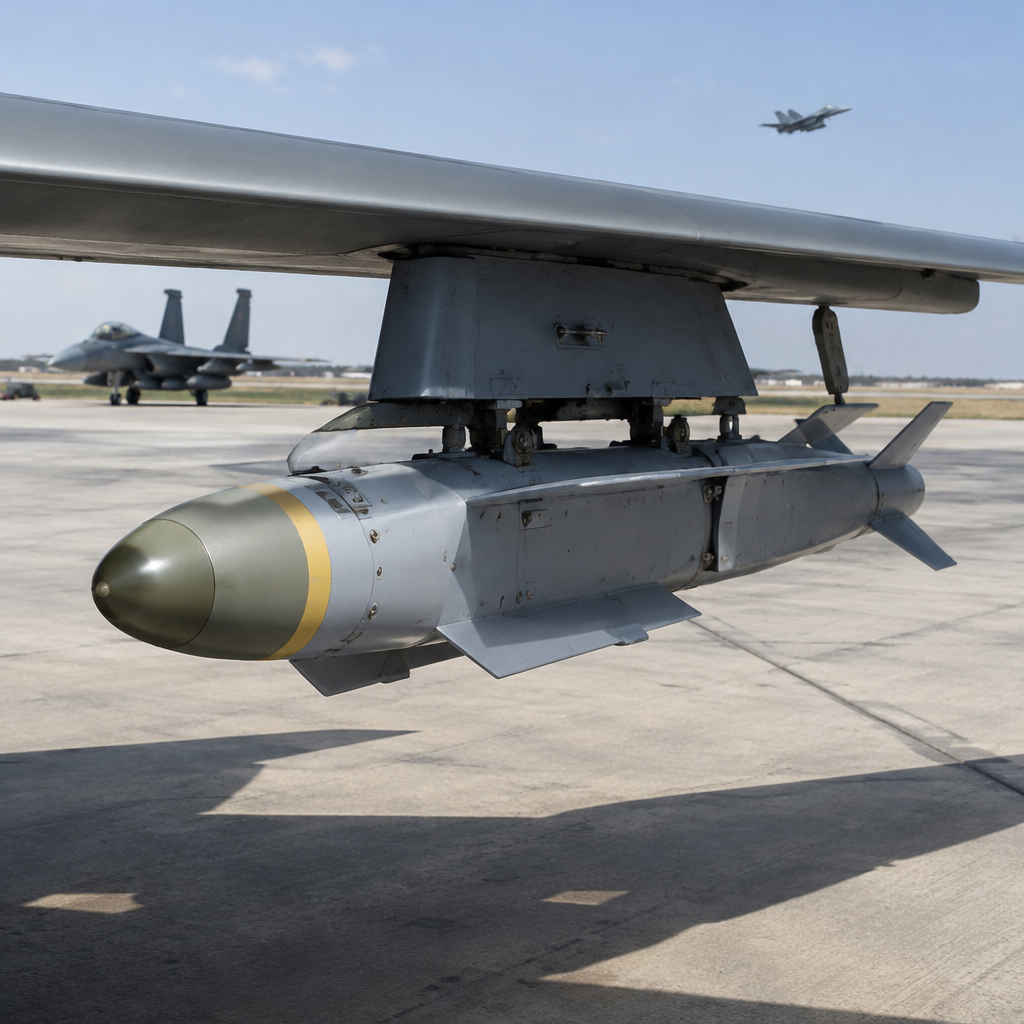
The RFI explicitly invites vendors to propose mature designs; the notice notes that there are "potentially relevant munitions in production today in the United States." Boeing’s Joint Direct Attack Munition‑Extended Range (JDAM‑ER) is cited as an example: a kit that converts unguided bombs into glide weapons, using a pop‑out wing to reach a maximum range "of around 45 miles (72.4 kilometers) depending on the aforementioned launch factors." By comparison, a standard JDAM "can also glide, but only for around 15 miles (24 kilometers) at most, according to the Air Force." JDAM‑ER kits come in 500‑, 1,000‑, and 2,000‑pound classes.
The notice points to other glide options on the market, including Israel’s Rafael SPICE family and the French AASM 250 Hammer, though many of those are smaller than the 500‑pound class sought. The GBU‑39/B Small Diameter Bomb is referenced as a 250‑pound example already in production.
ERAM Glide also invites proposals for unpowered derivatives of existing lower‑cost cruise missiles; eliminating engines and fuel could free weight and volume for larger warheads or lower mass, which can translate into greater glide range. A modular approach that permits powered or unpowered configurations is also mentioned as a possible path to reduced unit costs and sustainment benefits.
What this means for Ukraine, the U.S. Air Force, and defense vendors
- Ukraine: As the first known recipient of ERAM munitions, Ukraine’s early receipt of powered ERAM designs demonstrates that ERAM supply lines are already being used for allies; ERAM Glide could add additional, lower‑cost munition streams for export.
- The U.S. Air Force: The ERAM spiral feeds into the Family of Affordable Mass Missiles (FAMM) effort; the Air Force plans to acquire 28,000 lower‑cost cruise missiles in multiple configurations over the next five years through FAMM, and ERAM Glide is positioned to provide further options to replenish inventories cost‑effectively.
- Defense vendors: Companies with existing glide kits or mature cruise‑missile designs — and those able to offer unpowered derivatives or modular kits — are potential candidates for rapid entry, leveraging existing production lines and sustainment pathways.
The Air Force’s dual RFI approach — powered and unpowered — reflects a push for diversified, lower‑cost extended‑range options that mix maturity, affordability and resilience to contested navigation environments. How vendors balance glide ratio, warhead mass, GPS resilience and production maturity will determine which designs meet the Air Force's specifications and who supplies the next generation of mass‑producible, extended‑reach munitions.
https://www.twz.com/air/usaf-widens-lower-cost-cruise-missile-effort-to-also-include-glide-bombs