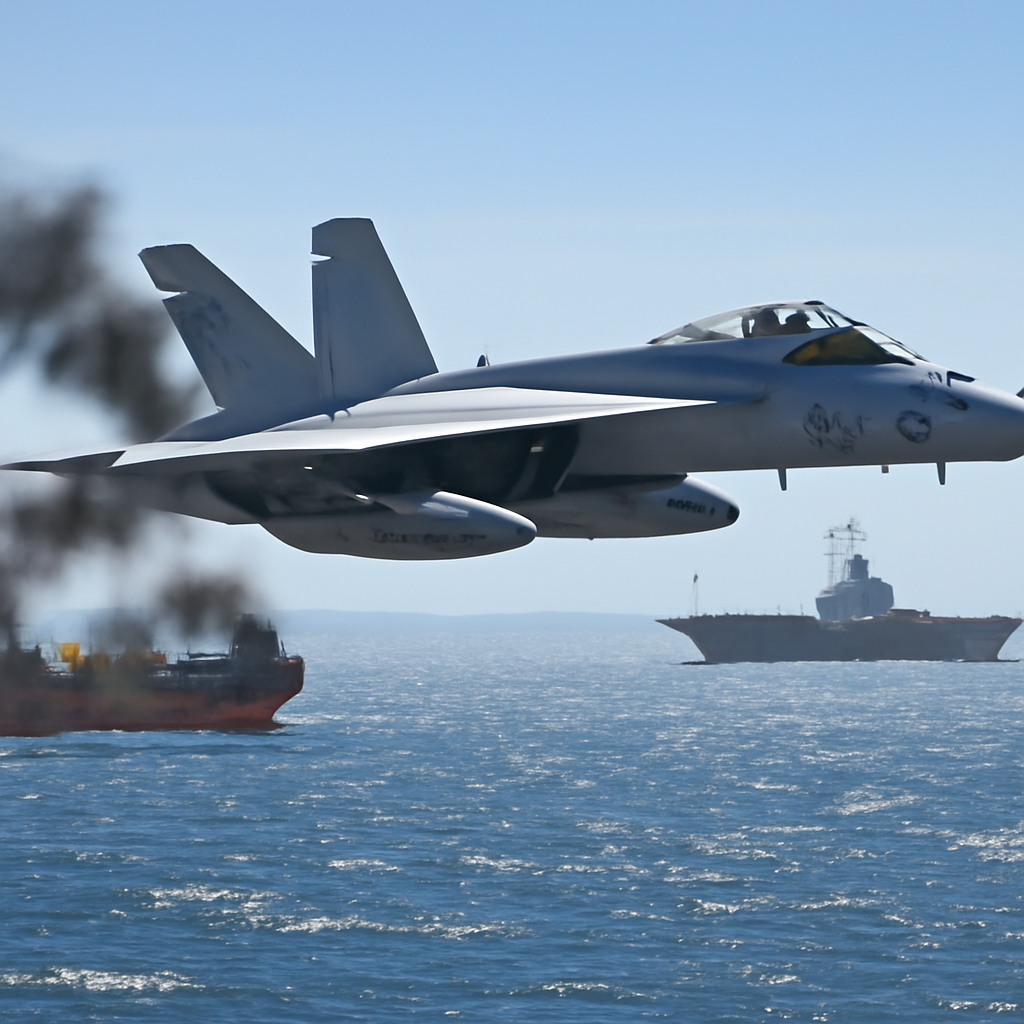
"A U.S. Navy F/A-18 Super Hornet from USS George H.W. Bush (CVN 77) disabled both tankers after firing precision munitions into their smokestacks, preventing the non-compliant ships from entering Iran," CENTCOM wrote on X.
CENTCOM says F/A-18 disabled M/T Sea Star III and M/T Sevda on May 8
U.S. Central Command posted that U.S. forces struck several empty oil tankers attempting to break a U.S. naval blockade on May 8. CENTCOM identified two vessels by name — M/T Sea Star III and M/T Sevda — and said they were disabled "prior to both vessels entering an Iranian port on the Gulf of Oman in violation of the ongoing U.S. blockade." The command credited a U.S. Navy F/A-18 Super Hornet operating from USS George H.W. Bush (CVN 77) with firing precision munitions into the ships' smokestacks to prevent them from entering Iran.
The specific weapons used were not disclosed by CENTCOM. The reporting notes that 500 lb laser-guided bombs are a likely candidate given the Super Hornet’s stores options, the precision required, and the observed effects; such weapons can be fitted with either high‑explosive or inert bodies, and the account suggests inert bodies were most probable to disable rather than destroy the vessels.
Tactics compared: smokestack strikes, gunfire, and Vulcan cannon disabling
The strikes mark a tactical variation in how U.S. forces have been neutralizing ships that attempt to run the blockade. The reporting places the smokestack strikes alongside two earlier methods: an Arleigh Burke–class destroyer firing five‑inch rounds (described as inert) to blast an engineering section and disable a ship, and a Super Hornet using its 20mm Vulcan cannon to disable a rudder on another vessel. The use of bombs dropped into smokestacks "to disable but not destroy" is described as a new technique in this sequence of interdictions.

This site is the portfolio.
OSINTSights runs on Cloudflare Workers, D1, R2, and Vectorize, with an AI pipeline on Hetzner ARM. Nubivance designed, built, and operates it. We do the same for clients.
See what we buildThe blockade’s scale and an intelligence estimate
The blockade has been in place since April 13 and, according to CENTCOM, has so far prevented more than 70 tankers from entering or leaving Iranian ports. CENTCOM said that those commercial ships have "the capacity to transport over 166 million barrels of Iranian oil worth an estimated $13 billion-plus." A separate, confidential CIA analysis — cited by The Washington Post and described in the reporting — concluded Iran can survive the naval blockade for "at least three to four months" before facing more severe economic hardship; that assessment was delivered to administration policymakers during the week of the strikes.
Regional exchanges: UAE attacks and U.S.–Iran firefights
These interdictions occurred amid broader kinetic activity. The United Arab Emirates’ Ministry of Defense announced on X that on May 8 its air defenses engaged two ballistic missiles and three UAVs launched from Iran, reporting three moderate injuries from that episode and repeating a tally it gave of total engagements since the campaign began: 551 ballistic missiles, 29 cruise missiles, and 2,263 UAVs. The UAE MoD also said attacks have killed 13 and injured 230, a figure the reporting notes cannot be independently verified.
The strikes followed a separate exchange in and around the Strait of Hormuz. CENTCOM said that, after Iranian forces launched "multiple missiles, drones and small boats" as USS Truxtun (DDG 103), USS Rafael Peralta (DDG 115), and USS Mason (DDG 87) transited an international sea passage, U.S. forces attacked several locations inside Iran. CENTCOM reported no U.S. assets were struck. Iran framed its action as retaliation for what it called a U.S. aggression against an Iranian oil tanker near Jask; later Iranian claims that U.S. destroyers were hit were denied by a U.S. official, who answered one question with the single word: "No."
Iran’s maritime and political responses: Ocean Koi (Jin Li) and rhetoric
Iran reported a separate naval action on May 8, saying its "naval commandos carried out a special operation to detain" an oil tanker it identified as Ocean Koi and directed the vessel to Iran's southern coast for judicial processing. The reporting notes that the ship is also known as Jin Li and that it had been sanctioned by the U.S. in February for transporting millions of barrels of Iranian oil.
Iranian officials used sharp rhetoric alongside that seizure. Foreign Minister Abbas Araghchi accused the U.S. of choosing "a reckless military adventure" whenever a diplomatic solution is near. An adviser to Iran’s Supreme Leader, Mohammad Mokhber, said Iran’s control over the Strait of Hormuz is an asset "on the scale of an atomic bomb" and that Tehran would not cede the capability it gained through war. A member of the Iranian Parliament’s National Security Commission, Ali Khodarian, warned that the Emirates "will remain a target" for supporting the U.S. and Israel and that "the Americans have realized that their naval blockade parade will henceforth face a military response."
What this means for the U.S. Navy, the UAE, and Iranian maritime operators
- For the U.S. Navy: CENTCOM imagery and statements show continued surface and carrier aviation activity — the command said it had redirected 57 commercial vessels and disabled 4 as of May 8 — and a willingness to employ a range of disabling techniques from gunfire to precision munitions on carrier aircraft.
- For the UAE: the Ministry of Defense’s reported tally of engagements and recent injuries underscore the burden placed on air defenses and the diplomatic strain from cross‑border missile and UAV launches claimed to originate in Iran.
- For Iranian maritime operators: sanctioned "dark fleet" ships such as Jin Li/Ocean Koi face detention risk, and the CIA assessment cited in reporting frames the blockade as a time‑limited pressure tool with an estimated three‑to‑four‑month margin before "more severe economic hardship."
Diplomacy continued alongside the firefights: the United States said it was awaiting a response from Iran to an American peace proposal, with Secretary of State Marco Rubio quoted as expecting a reply "today at some point." President Trump likewise said he expected an answer "supposedly tonight." The facts on May 8 present a mix of kinetic escalation, creative interdiction tactics and a ticking clock on economic pressure — and leave open whether those pressures will produce a negotiated pause or further military confrontation.