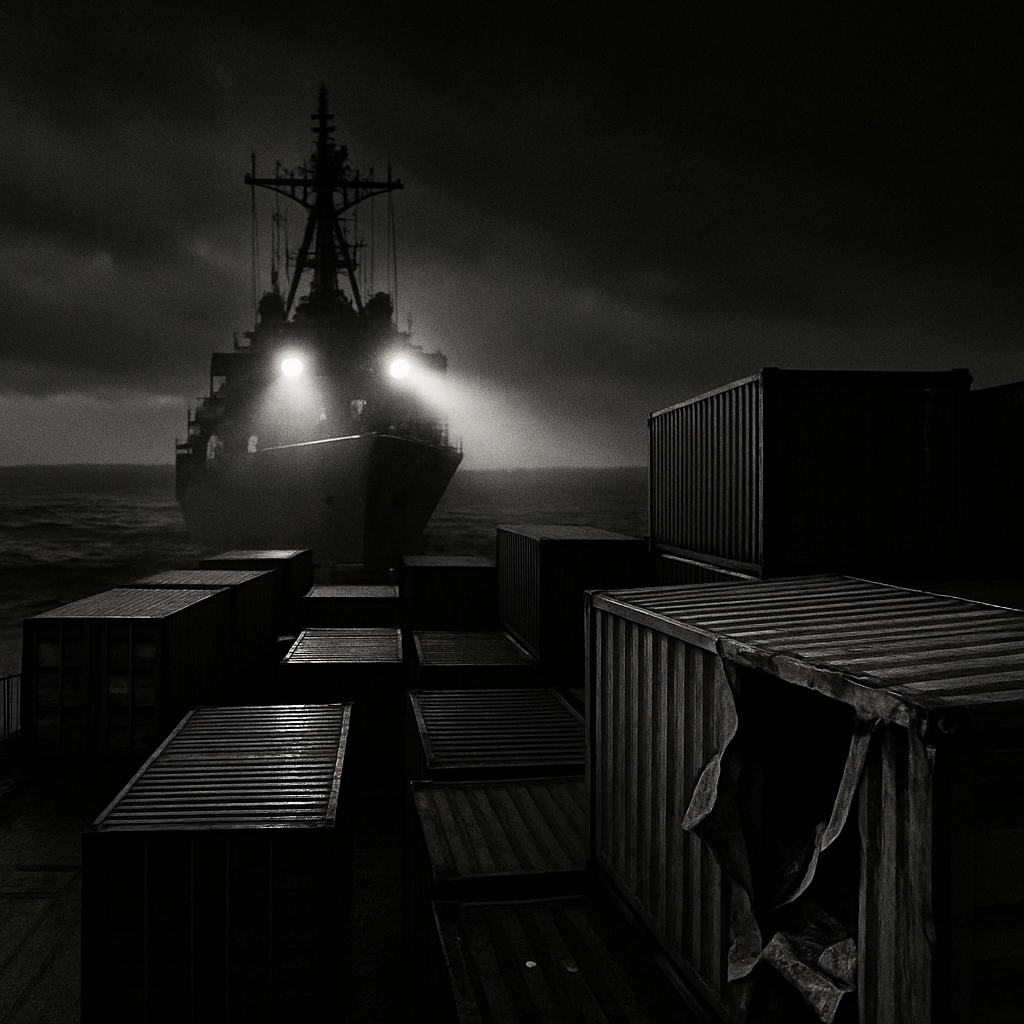
"Overnight, U.S. forces conducted a right-of-visit, maritime interdiction and boarding of the stateless sanctioned M/T Tifani without incident in the INDOPACOM area of responsibility," the Pentagon wrote on X on April 21, 2026.
M/T Tifani: a Botswana-flagged tanker boarded in the Indo‑Pacific
The vessel at the center of Tuesday’s action was the oil tanker M/T Tifani, described by the Pentagon as "stateless" and "sanctioned." Video released by the Pentagon shows roughly two dozen armed troops boarding two MH‑60S Seahawk helicopters on a U.S. Navy Expeditionary Sea Base (ESB) ship, then repelling onto the Tifani’s deck to search the vessel. The Pentagon said the boarding occurred in the U.S. Indo‑Pacific Command (INDOPACOM) area of responsibility and that the operation was conducted "without incident."
Where the ship was and who says what about its voyage
The Pentagon did not specify the exact location of the boarding. MarineTraffic.com placed the Tifani in the Indian Ocean, about halfway between Sri Lanka and Indonesia and roughly 2,000 miles southeast of Iran. Senior analyst Gregory Brew of Eurasia Group posted on X that the Tifani departed Iran’s Kharg Island on April 5 bound for Singapore, and that Kpler showed the ship still en route to Singapore with a shifted course several hours after the boarding. Brew noted the public signals suggested the ship was boarded and searched but not necessarily seized.

The cyber insurance questionnaire just landed. Now what?
SOC 2, HIPAA, insurance renewals - someone has to own security strategy. Nubivance provides fractional CISO leadership without the full-time salary.
Get a security leadPentagon messaging and operational posture under Operation Epic Fury
The action comes within the framework the Pentagon has dubbed Operation Epic Fury, launched on Feb. 28. Joint Chiefs Chairman Gen. Dan Caine had told reporters—The War Zone included—that the U.S. would "actively pursue any Iranian‑flagged vessel or any vessel attempting to provide material support to Iran" anywhere in the world. The Pentagon’s post on X warned that "International waters are not a refuge for sanctioned vessels" and said the Department of War would "continue to deny illicit actors and their vessels freedom of maneuver in the maritime domain." The Pentagon also said "multiple agencies" participated in the Tifani operation and declined to provide additional immediate details; requests for further information were circulated between the Pentagon and the White House.
Other recent maritime actions: Touska and broader interdiction efforts
This boarding followed U.S. forces firing on and seizing the Iranian cargo ship Touska in the Arabian Sea the previous Sunday. The Tifani action is notable because, according to The War Zone, it is the first interdiction of an Iranian‑linked vessel reported in the INDOPACOM region since the start of Operation Epic Fury on Feb. 28. The Tifani itself was listed as sanctioned under a 2018 executive order intended to counter Iranian malign activities, an order the report attributes to President Donald Trump’s first term.
Diplomacy in Pakistan: talks remain uncertain and sticking points are clear
While maritime enforcement has accelerated, the diplomatic track appeared fragile. Vice President JD Vance and other top U.S. officials were expected to depart for negotiations in Pakistan the day of this reporting, but Iranian officials had not formally committed to sending a delegation, Iran’s IRNA news agency reported. Pakistan’s Information Minister said a formal response from the Iranian side "is still awaited," according to Arab News. The principal issues identified as blocking agreement include the future of Iran’s highly enriched uranium, control of the Strait of Hormuz, the status of Iran’s ballistic missile inventory, and support for proxy groups such as Hezbollah and Yemen’s Houthis.
Market and shipping fallout: Kpler, Maersk, IMO and price signals
Shipping and energy markets are already adjusting to the disruption. Global market intelligence firm Kpler said recent events in and around the Strait of Hormuz have prompted rapid repricing—initially seeing oil fall and risk assets rise after the IRGC declared the Strait open, only to note that the reopening was conditional and short‑lived. Shipping giant Maersk urged ships to avoid the region, saying "as of now, transit through the Strait should be avoided." The International Maritime Organization, Secretary General Arsenio Dominguez told Bloomberg, is "working on an evacuation plan for hundreds of ships that have been stuck in the Persian Gulf" and said the plan requires clear signs of de‑escalation and assurance that mines are not present; Bloomberg reported about 800 ships remain stuck in the Persian Gulf.
On fuel prices, reporting cited mixed views in Washington. Energy Secretary Chris Wright told CNN that U.S. retail gasoline might not return to pre‑war levels until next year. President Trump expressed a different expectation in an interview with CNBC, saying he saw a faster drop and that he expects "we're going to end up with a great deal" with Iran. Analysts quoted by Axios—among them Rob Smith, S&P Global director of refining and marketing—said gasoline prices face an uphill battle to return to pre‑war levels, with optimistic scenarios pushing recovery toward 2027. Separately, Reuters reported China reduced domestic retail gasoline and diesel price caps, its first cut since the Iran war began; The Straits Times noted the cut could save a private car owner about $3.23 to fill a 50‑litre tank of 92‑octane gasoline.
Regional escalation beyond the sea: explosive drones and contested passage
The broader conflict footprint extended beyond interdictions at sea. The Wall Street Journal reported that Iraqi militias backed by Iran launched dozens of explosive drones at Saudi Arabia and other Gulf states over more than five weeks of fighting, with at least one Saudi assessment—described by a person familiar with it—estimating that up to half of nearly 1,000 drone attacks on the kingdom came from inside Iraq. Tehran’s military leadership, including Major General Ali Abdollahi of Khatam al‑Anbiya Central Headquarters, warned the Armed Forces would "duly respond to any breach of commitments" by adversaries and rejected what he called U.S. mischaracterizations of conditions on the ground, particularly regarding control of the Strait of Hormuz.
The boarding of the M/T Tifani underscores how the conflict’s maritime dimension has gone global, at least in enforcement posture. The immediate facts are specific: a U.S. right‑of‑visit and boarding in INDOPACOM, video of MH‑60S helicopters and troops repelling onto the deck, and public attribution of the vessel as sanctioned. What is not yet public is the ship’s final disposition—whether it was detained or released following the search—and how far the U.S. will follow this approach beyond the Middle East. With a ceasefire set to expire Wednesday and talks in Pakistan unresolved, the next 48–72 hours may determine whether these interdictions become an enduring, global pattern or remain episodic responses tied to specific intelligence and sanction enforcement needs.