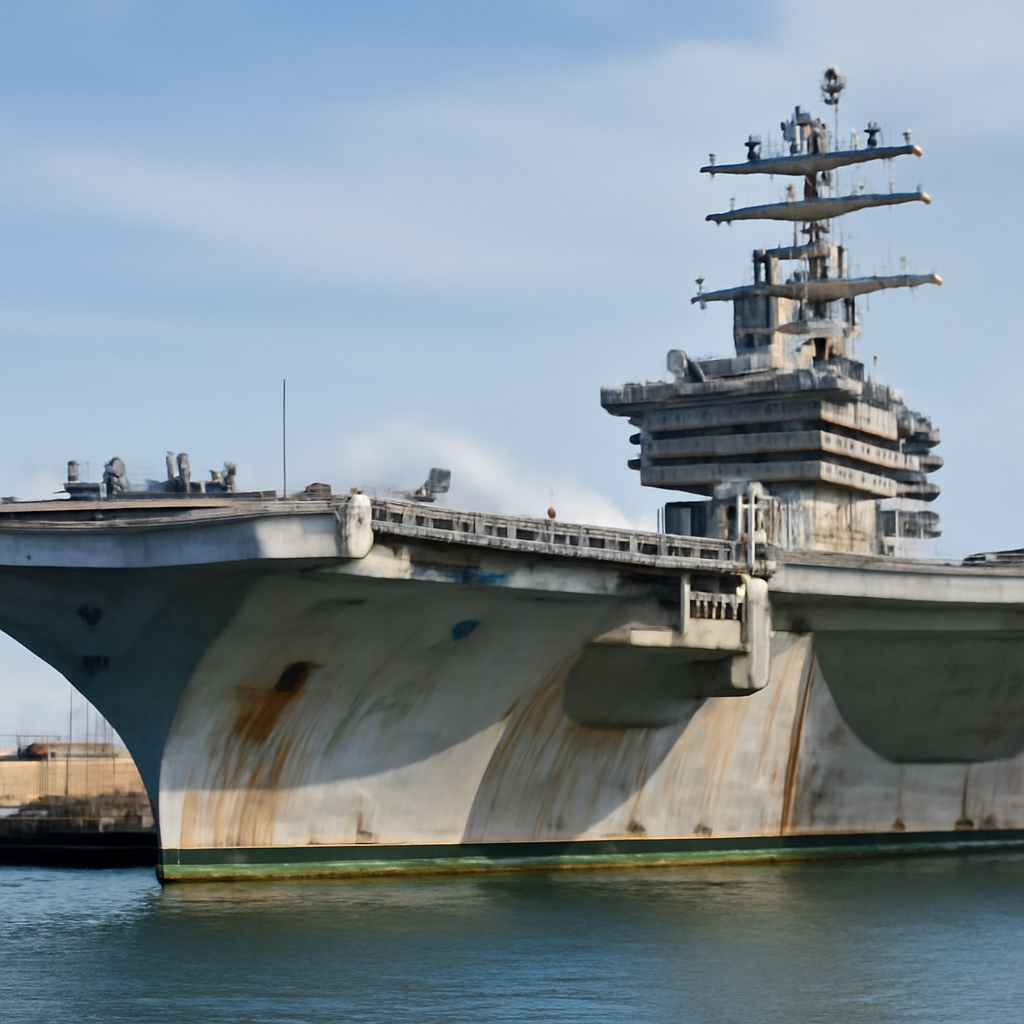
286 days at sea — with only brief, logistical stopovers — and the USS Abraham Lincoln arrived in Laem Chabang, Thailand, earlier today, its hull streaked with dark “running rust” and a bright green ring of algae at the waterline.
Arrival in Laem Chabang and the command’s statement
The carrier strike group led by the USS Abraham Lincoln entered the Thai port of Laem Chabang earlier today. Rear Adm. Robert E. Loughran, commander of Carrier Strike Group 3 (CSG-3), said in a press release: “Our arrival in Laem Chabang provides a well-deserved opportunity for our Sailors and Marines to rest and recharge. It also underscores the strong and enduring partnership and alliance between the United States and Thailand.” Thai media reported the carrier is expected to remain in Laem Chabang through the end of the weekend.
Visible wear: photos, rust, and algae
Photographs and video published alongside the arrival show substantial surface wear: large streaks of running rust along the hull, algae built up at the waterline, and visible wear around the edges of the flight deck and sponsons. The Navy released at least one official image of Lincoln arriving in Thailand; press agency photos and Getty images published the same visual details. The story describes the carrier as “very much worse for wear,” and notes that while carriers normally keep their appearance up, extended high-tempo operations limit what can be accomplished while at sea.

This site is the portfolio.
OSINTSights runs on Cloudflare Workers, D1, R2, and Vectorize, with an AI pipeline on Hetzner ARM. Nubivance designed, built, and operates it. We do the same for clients.
See what we buildFrom routine cruise to sustained combat operations
Lincoln and its strike group left San Diego in November 2025 for what was originally billed as a routine Pacific cruise. The group was redirected to the Middle East and arrived in that region in January 2026. CSG-3 took part in the opening salvo of strikes on Iran on February 28 as part of Operation Epic Fury and continued supporting Epic Fury and subsequent operations against Iran for months thereafter. Reports cited in the story say the decision to rotate the carrier out of the region was made last month after widespread reports of flagging morale and mental health among the crew.
Escorts, port stopovers, and the wider carrier picture
Three destroyers and a cruiser are named as part of the strike group: the Arleigh Burke-class USS Michael Murphy and USS Spruance are reported to be operating in the western end of the Indian Ocean; the USS Frank E. Petersen Jr. accompanied Lincoln to Thailand and is docked in Sriracha near Laem Chabang. The Ticonderoga-class cruiser USS Robert Smalls also escorted the carrier and “also arrived in Map Ta Phut, Thailand for their own scheduled port visit,” according to the Navy. The Lincoln made a stop in Guam in December 2025 and reportedly made another brief stop somewhere in the Middle East in July; both are characterized as logistical stopovers that did not allow personnel to disembark.
Morale, mental-health incidents, and leadership response
The story ties the ship’s extended deployment to increased reporting of morale and mental-health issues among crew members. Family members have publicly drawn attention to those concerns; the article reports one sailor had to be rescued last month after deliberately jumping overboard and at least one other individual reportedly attempted the same. The reporting notes that President Donald Trump and Secretary Pete Hegseth, among others, pushed back on concerns about mental health on the ship. Navy Adm. Brad Cooper, head of U.S. Central Command (CENTCOM), “acknowledged, but still downplayed, the seriousness of the mental health situation, in particular,” according to a statement shared on social media on August 16.
What this means for policymakers, sailors and families, and maintenance planners
- Policymakers and senior Navy leadership: Extended deployments play into decisions about rotation and force presence. Chief of Naval Operations Adm. Daryl Caudle said he wants to “really try to keep those [deployments] at seven months,” and aims for a Navy “that can sustain a seven-month deployment” while meeting combatant-command requirements.
- Sailors, Marines, and families: The carrier’s arrival in Laem Chabang is described as a “well-deserved opportunity” to rest and recharge; the reporting links extended time at sea to sharply elevated stress and publicized mental-health incidents among crew.
- Maintenance and shipbuilding planners: The Lincoln’s visibly worn condition underscores cascading impacts on maintenance cycles and deep overhauls when ships remain at sea for months-long extensions. The story places this case alongside other long deployments, noting the USS Gerald R. Ford completed a 326-day deployment in May and that the USS Theodore Roosevelt could be away for at least eight months.
The Lincoln’s arrival in Thailand offers immediate relief for the crew and a stark visual reminder of prolonged, high-tempo operations: rust and algae that, in the eyes of critics, carry political and operational optics as much as they do maintenance needs. The facts reported here leave a central question visible and concrete — can the Navy reconcile the demand for sustained presence with recovery, maintenance, and the mental-health of crews pushed to and beyond conventional deployment lengths?
Source: TWZ — USS Abraham Lincoln Looks Like It’s Been Through Hell After 286 Days At Sea