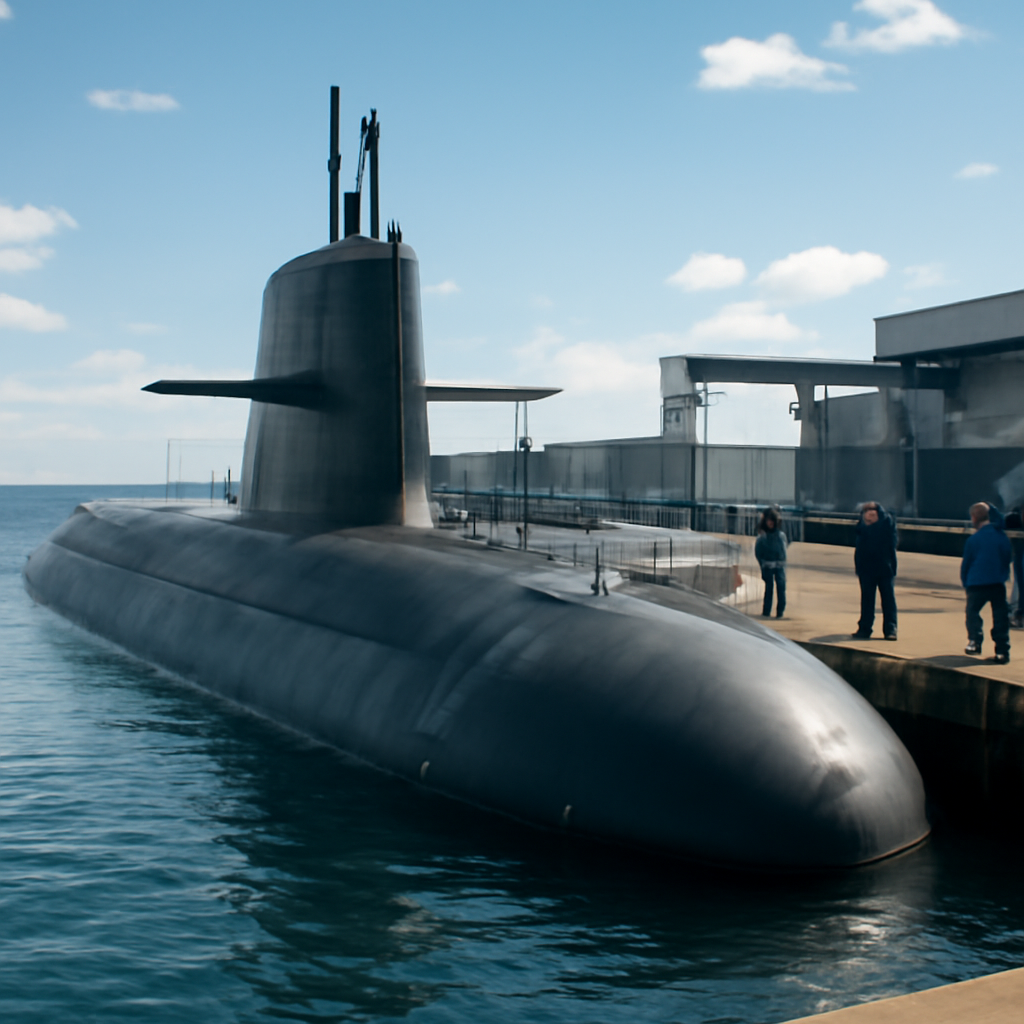
"A later Block V submarine will not have VPM and will be a Subsea and Seabed Warfare (SSW) focused platform," a Navy spokesperson told TWZ.
The Navy’s recategorization: Block V Virginias as SSGNs
In an August 3 press release, the Navy announced that future stretched Virginia-class attack submarines fitted with Virginia Payload Modules (VPMs) will be recategorized as guided-missile types (SSGN). The service said it plans to acquire 19 VPM-equipped Virginia-class SSGNs across the Block V and Block VI subclasses. General Dynamics Electric Boat later confirmed that "19 of the VPMs will be re-classified as SSGNs with two of the Block V SSNs to be built in non-VPM configurations," a Navy spokesperson told TWZ.
The seabed warfare one-off: replacing a unique mission
The Navy confirmed to TWZ that the second VPM-less Block V will be a one-of-a-kind seabed warfare configuration intended to conduct seabed espionage missions—tasks currently associated with USS Jimmy Carter, the sole Seawolf-class subvariant optimized for covert seabed work. The Navy declined to identify which Block V hull will receive the seabed warfare configuration, but said it will not be the future USS Oklahoma (SSN-802), and that the second Block V, USS Arizona (SSN-803), will be the first to feature the VPM.
That places the seabed-focused boat among the other ten planned Block V hulls (SSN-804 through SSN-813), which already carry names: USS Barb, USS Tang, USS Wahoo, USS Silversides, USS John H. Dalton, USS Long Island, USS San Francisco, USS Miami, USS Baltimore, and USS Atlanta.

This site is the portfolio.
OSINTSights runs on Cloudflare Workers, D1, R2, and Vectorize, with an AI pipeline on Hetzner ARM. Nubivance designed, built, and operates it. We do the same for clients.
See what we buildHow the new Virginia seabed design ties to USS Jimmy Carter
Public descriptions of USS Jimmy Carter show a number of specialized features that the new Virginia seabed variant is intended to replicate or supplement. Jimmy Carter carries a roughly 100-foot hull extension known as the Multi-Mission Platform (MMP) that can launch and recover remotely operated vehicles (ROV), uncrewed underwater vehicles (UUV), and other special payloads. The Seawolf sub also includes a reconfigurable command-and-control room, storage for missionized equipment, auxiliary thrusters, and features intended to help it land on the seafloor or maintain position—capabilities optimized for covert seabed espionage, including inspection, manipulation, and recovery of seabed objects.
General Dynamics Electric Boat on the VPM and seabed variant
General Dynamics Electric Boat has publicly described the VPM as "basically an 84-foot hull section that includes four additional missile tubes." At a 2022 summit, Kevin Graney, then president of Electric Boat, said the Virginia class program was "evolving … over time to accomplish new missions," and that the company was "repurpos[ing] some of those missile tubes that I referred to in the VPM design to perform those missions" for a seabed warfare variant. A slide from that presentation showed a rendering with a pronounced bulge under the center of the hull where the VPM would be fitted on other Block V boats—an arrangement consistent with the kinds of hull modifications used to support seabed operations.
Force structure context: Ohio-class SSGN retirements and SSN(X) timing
The Navy’s move to classify VPM-equipped Virginias as SSGNs comes as part of a broader effort to sustain special-mission undersea capability as the four Ohio-class SSGNs begin retirement. Those Ohio conversions have been heavily tasked with long-range strike, special-operations support, underwater command and control, and intelligence fusion. Block V Virginias are expected to be delivered between 2028 and 2034; by the tail end of that schedule Jimmy Carter—commissioned in 2005—will be almost three decades old. Separately, the Navy’s long-term shipbuilding plan says SSN(X), the planned next attack-submarine class, is not expected to enter service until the mid-2040s, making the Block V family a near- to mid-term answer to looming capability gaps.
What this means for the Navy, General Dynamics Electric Boat, and China and Russia
- The Navy: Gains a specialized seabed espionage platform inside the Virginia-class production line to supplement—or eventually supplant—Jimmy Carter’s unique mission set, while administratively reclassifying VPM-equipped boats as SSGNs to reflect their payload-focused role.
- General Dynamics Electric Boat: Will continue to evolve the existing hull form—modifying the VPM space and adding mission-specific structures—and is leveraging facilities in Connecticut and Rhode Island to adapt production lines to new mission fittings; company leadership changes were noted (Kevin Graney retired in 2024).
- China and Russia: The source notes both countries are expanding undersea infrastructure that can have dual-use applications, and that Russia has a long history of covert seabed operations—context the Navy appears to be addressing by fielding a dedicated seabed-capable Virginia-class variant.
The Navy has confirmed the existence and intent of a specialized seabed warfare Virginia-class submarine but has not yet named which Block V hull will carry that mission package. The program leaves a concrete near-term question: which of the ten unnamed or newly named Block V hulls will be converted into the service’s next dedicated seabed espionage platform, and when will the Navy disclose the specific modifications and operational plans? The answers will determine whether the Virginia family can bridge the gap the Ohio SSGN retirements create and how the undersea espionage mission will be sustained into the 2030s.
Source: TWZ — Navy Is Getting A Unique Virginia Class Seabed Espionage Submarine