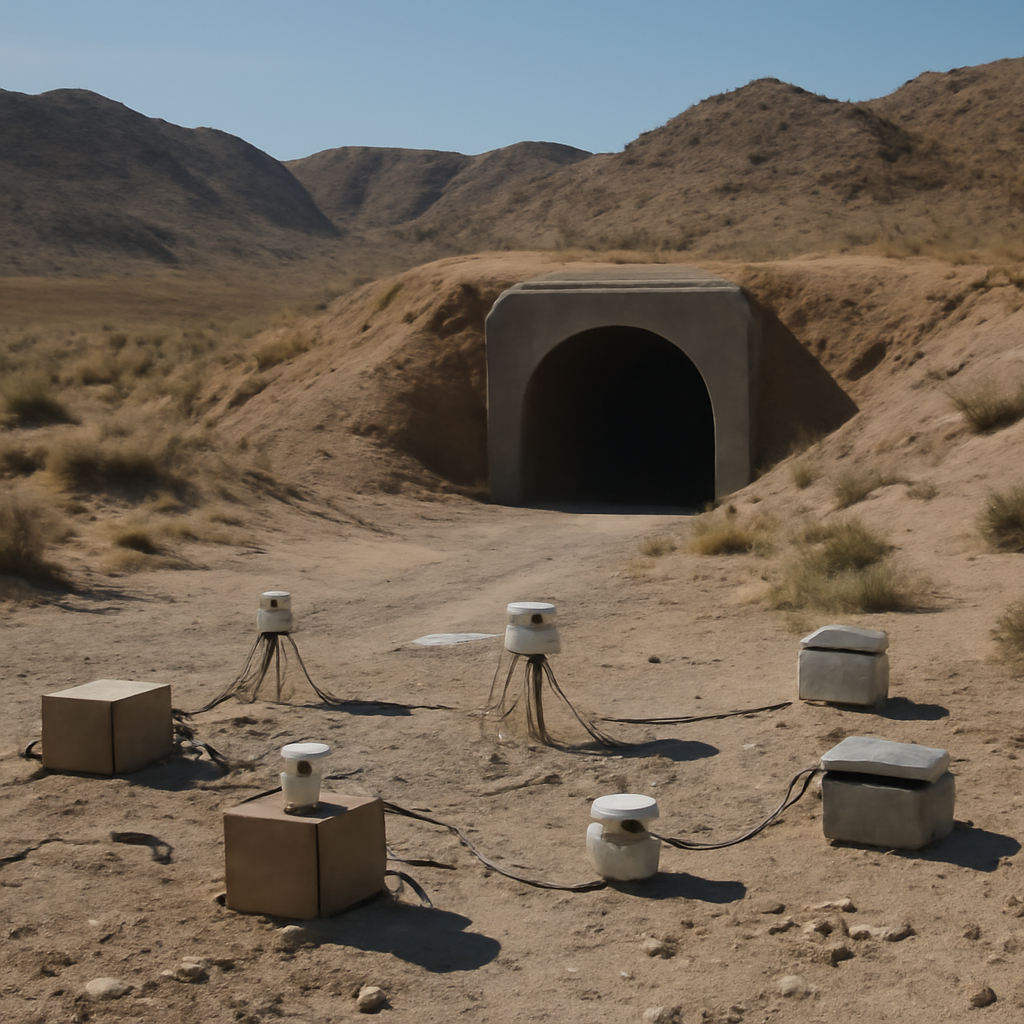
The National Nuclear Security Administration said that sentence as it described a live test in which conventional high-explosives and radiotracers were detonated inside a tunnel at the Nevada National Security Site. The goal was explicit: to replicate the seismic and other signatures of a so‑called "decoupled" underground nuclear detonation and to use the resulting measurements to improve how the United States detects and characterizes covert nuclear explosions.
The test: P Tunnel, Area 12, Nevada National Security Site
NNSA reported the experiment was conducted yesterday inside P Tunnel in Area 12 of the Nevada National Security Site (NNSS). The NNSS sits within the boundaries of the U.S. Air Force’s Nevada Test and Training Range (NTTR), and Area 12 occupies the northern end of the NNSS complex. The operation used chemical high‑explosives together with radiotracers to mimic the physical effects of a decoupled nuclear blast.
Why "decoupling" reduces detection signals
NNSA’s release explained the technical intuition at stake: in a conventional, or “coupled,” underground nuclear test the device is placed deep in a hole in close contact with rock, allowing much of the explosion’s shockwave to reach sensors. “In a decoupled test, by contrast, the device is detonated inside a large underground chamber, substantially reducing the explosion’s seismic signature.” The release likened decoupling to a stealth capability — “Just as a stealth aircraft looks smaller on radar, decoupling can greatly muffle the signals detected by nuclear detection sensors, making a large explosion appear smaller.”

Audit-ready is a season. It shouldn't be.
Evidence in spreadsheets, controls drifting between audits, frameworks multiplying on flat headcount. Nubivance runs continuous compliance on Rapid7 Cyber GRC - SOC 2, HIPAA, ISO 27001, PCI, CMMC.
End the scrambleSensors and data collected to refine detection
NNSA said researchers gathered measurements using "a broad suite of advanced sensors," listing accelerometers, seismometers, infrasound sensors, electromagnetic sensors, chemical and radiotracer samplers, and meteorological sensors. According to the agency, "together, these measurements will improve scientists’ understanding of the signatures produced by underground explosions and strengthen the United States’ ability to detect and characterize nuclear explosive events." The data will be used to validate scientific models and refine algorithms that NNSA called "critical to U.S. nuclear explosion detection efforts."
U.S. detection architecture: USAEDS, AFTAC, and surveillance aircraft
The United States already operates a global detection architecture. The U.S. Atomic Energy Detection Systems (USAEDS) network is overseen by the U.S. Air Force Technical Applications Center (AFTAC) and comprises more than 3,600 sensors positioned around the world. USAEDS is tied to the International Monitoring System (IMS) managed by the organization responsible for the Comprehensive Nuclear‑Test‑Ban Treaty (CTBT). AFTAC additionally supports monitoring with a fleet of specially configured WC‑135R Constant Phoenix aircraft that can detect unusual spikes in atmospheric radiation. Per AFTAC’s website, "once a disturbance is detected underground, underwater, in the atmosphere or in space, the event is analyzed for nuclear identification, and the findings are reported to command authorities."
Context: past allegations and diplomatic signals involving China and Russia
The NNSA announcement explicitly referenced recent international controversy over decoupled testing. At the annual Conference on Disarmament in Geneva in February, Thomas DiNanno, Under Secretary of State for Arms Control and International Security, said that China had conducted at least one such test at Lop Nur on June 22, 2020. The Comprehensive Nuclear‑Test‑Ban Treaty Organization (CTBTO) subsequently said the IMS had not detected an event matching that description at that location on that date; the Chinese government denied the accusation.
The U.S. has also accused Russia of secret, lower‑yield nuclear testing in the past. The source notes that Russia revoked its CTBT ratification in 2023 by action of President Vladimir Putin and a Duma law, and that the Russian government has said it is ready to conduct new nuclear tests if the United States pursues that course. Separately, the Wall Street Journal reported that the Trump administration has held talks with Chinese officials about the expansion of China’s nuclear arsenal and related testing allegations, and that those discussions have included the possibility of implementing new verification measures.
How NNSA and AFTAC, CTBTO, and China and Russia are positioned
- NNSA and AFTAC — continue to develop and refine detection: NNSA will use the tunnel experiment data to validate models and refine detection algorithms; AFTAC will remain the U.S. hub linking USAEDS sensor data and flight surveillance from the WC‑135R fleet to command authorities.
- CTBTO / IMS — verification contrasts: the CTBTO’s IMS earlier reported it had not detected the alleged 2020 Lop Nur event, underlining the challenge decoupling poses to international verification systems and the overlap between U.S. and IMS monitoring efforts.
- China and Russia — diplomatic and declaratory stances: China has denied the decoupling allegation reported by U.S. officials; Russia revoked CTBT ratification in 2023 and has said it could resume testing if the United States does.
NNSA Administrator Brandon Williams framed the Nevada experiment as a demonstration of U.S. technical advantage: "It takes nuclear expertise to detect nuclear activities and experiments like these [to] ensure America remains unmatched in detection," he said, adding the test signals a policy posture under the current administration. The immediate, concrete output of the operation will be data sets and refined algorithms intended to harden detection against a concealment technique that, according to NNSA, can substantially mute an underground blast’s signatures.
The test in P Tunnel is both technical research and a message: it produces empirical measurements to feed sensors and models, and it answers, in part, a diplomatic problem that has been cast in public accusations, denials, and talks. Whether the measurements collected in Nevada will materially change field verifications at sites abroad or alter the cadence of international claims and counterclaims remains to be seen; for now, the United States has invested a live experiment to make that judgment with better data.