"Our Fleet deserves and our national security requires the most comprehensive capability a surface combatant can provide, not just what we can make do with tradeoffs," the Navy's new shipbuilding plan declares.
The Navy has decided: Trump class battleships will be nuclear-powered
The U.S. Navy's latest annual shipbuilding plan states that the future Trump class large surface combatants — now explicitly labeled BBGNs, or nuclear-powered (N) guided-missile (G) battleships (BB) — will be fitted with nuclear propulsion. The plan envisions acquiring 15 of the ships between Fiscal Year 2028 and 2055, ordering roughly one every other year, with two ordered consecutively in FY2030 and FY2031. The Navy projects an initial unit cost of $17 billion per vessel.
Design, size and armament the Navy plans to put aboard each BBGN
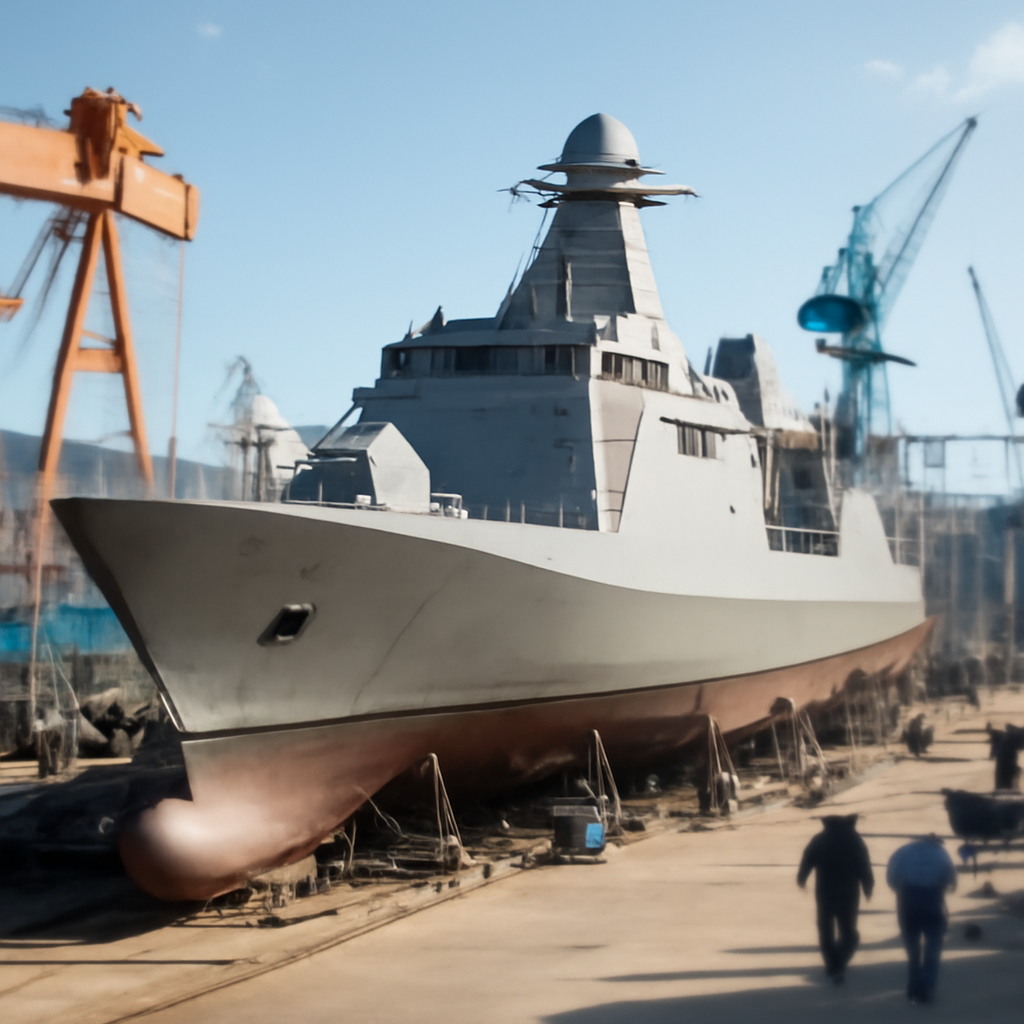
The plan describes a heavily armed, power-intensive design. Each Trump class hull is expected to displace about 35,000 tons, measure roughly 840–880 feet in length, have a beam of 105–115 feet, and be capable of speeds greater than 30 knots. The weapon suite the Navy lists includes large VLS arrays capable of launching a mix of nuclear and conventional missiles — including hypersonic types — an electromagnetic railgun, a pair of 5-inch naval guns, laser directed energy weapons, and multiple systems for close-in defense.
The Navy's graphics contain an apparent inconsistency: one annotated image lists "28 Mk 41 VLS" cells, a figure the shipbuilding plan and other official Navy material indicate is likely a typo given other references to 128 cells.

This site is the portfolio.
OSINTSights runs on Cloudflare Workers, D1, R2, and Vectorize, with an AI pipeline on Hetzner ARM. Nubivance designed, built, and operates it. We do the same for clients.
See what we buildWhy nuclear propulsion now — and the trade-offs the Navy acknowledges
The shipbuilding plan highlights nuclear propulsion for two main operational advantages: near-unlimited range and a significantly higher onboard power generation capacity to support electronic warfare, high-output lasers and other high-draw systems. The Navy frames the Battleship's role as delivering "high-volume, long-range offensive fires" and serving as a "robust, survivable forward command and control platform," capable of leading a Surface Action Group, integrating with a Carrier Strike Group, or operating autonomously.
But the plan and Navy leaders also acknowledge trade-offs. Nuclear reactors add complexity to basic design, increase upfront cost, and raise long-term operational and maintenance burdens — the same factors the service cited in moving away from nuclear propulsion on most surface warships in the past.
Industrial capacity, schedule pressure, and program timing
The Navy's choice comes as U.S. naval shipyards are already described as "under heavy strain." Newport News Shipbuilding, a Huntington Ingalls division, is identified as the only yard currently building nuclear-powered surface vessels — the Ford class aircraft carriers — work that has continued amid delays and cost growth. The same yards are also producing Virginia class submarines slated for transfer to the Royal Australian Navy under AUKUS and are building Columbia class nuclear ballistic missile submarines on a tight timeline, leaving "little, if any, margin" for new nuclear surface construction.
The first Trump class ship, to be named USS Defiant, is still scheduled to be ordered in FY2028 but is not expected to enter service until FY2036 — a timeline that guarantees the program will extend through the next presidential term and possibly beyond, leaving scope for major changes or cancellation.
Personnel and politics: departures, statements, and internal debate
The decision follows a public back-and-forth within the Navy and the White House. As recently as four weeks before the shipbuilding plan's release, then-Secretary of the Navy John Phelan told reporters that nuclear propulsion for the Trump class was "unlikely" and that the FY2027 proposed budget described the vessels as non-nuclear, featuring "diesel generators, gas turbines, [and] propulsion motors." Phelan also cautioned the $17 billion figure was an "early initial estimate" subject to change.
Phelan was dismissed the day after that roundtable; the source reports Hung Cao became Acting Secretary. The New York Times, citing anonymous sources, reported Phelan's exit was tied to disagreements with President Donald Trump over accelerating production and entry into service for the battleships. President Trump told reporters on April 23 that Phelan had "some conflicts with some other people, mostly as to building and buying new ships" and described himself as "very aggressive in the new shipbuilding." Chief of Naval Operations Adm. Daryl Caudle had earlier said nuclear propulsion would push construction timelines "outside the scope of what we want to do on the speed to get this thing in the water," underscoring the tension between capability and delivery schedule.
What this means for the president, the Navy, and shipbuilders
- The president: A decision to field a high-end, nuclear-powered battleship aligns with a stated priority of accelerating new shipbuilding and expanding front-end combat power, but it also ties a visible, high-cost program to political timelines and public scrutiny.
- The Navy: Gains a platform the plan describes as offering persistent power, command-and-control capacity, and heavy offensive fires — at the cost of increased acquisition complexity, a larger per-ship price, and prolonged development timelines.
- Shipbuilders and yards: Face added workload for nuclear construction on top of ongoing carrier and submarine programs, increasing pressure on schedules, workforce stability, and supply chains even as the Navy promises modular, digitally driven production methods to reduce rework and risk.
The Navy has now set a clear technical direction: nuclear propulsion for the Trump class. What remains is whether the industrial base, program budgets and political will can align to turn a 35,000-ton concept with 128 VLS cells, railguns and directed-energy weapons into a fleet of 15 operational BBGNs between 2028 and 2055 — and whether that path will alter the Navy's shipbuilding priorities as the program moves from plan to construction.