"For decades, the US Navy held a clear undersea advantage, but as adversaries’ submarines become quieter, they’re harder to detect," Donnelly Bohan, president and CEO of Sparton and senior vice president of Maritime Systems at Elbit America, told Breaking Defense.
The threat driving a sonobuoy revival
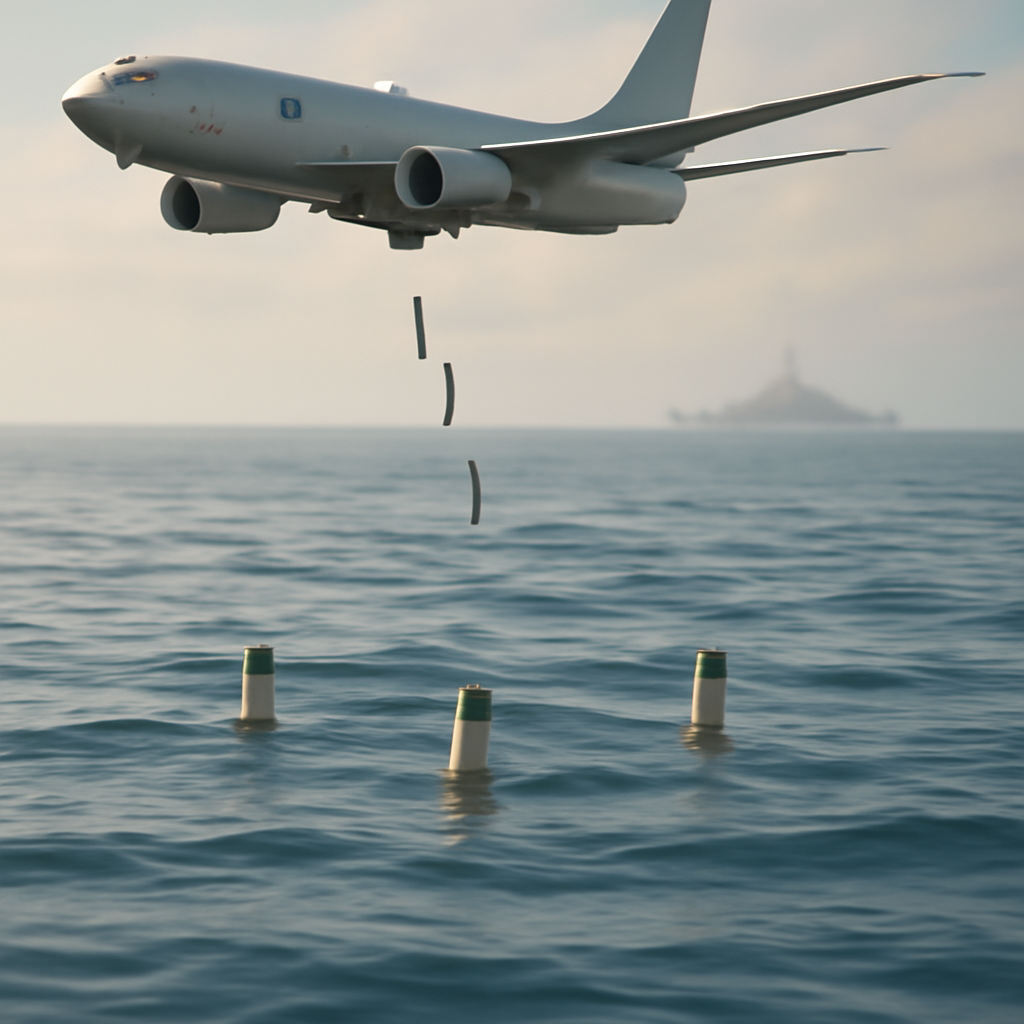
Bohan framed the current demand for improved anti-submarine warfare (ASW) sensing as a direct reaction to quieter submarines operated by China and Russia. When the Navy believes a submarine may be nearby, Bohan explained, it deploys sonobuoys: what may look like "a simple tube" when released from a P-8 aircraft actually delivers roughly "30 pounds of innovation" in precision sensing. That shift — quieter undersea platforms and a renewed emphasis on maritime dominance — is changing how the services prioritize sensors above, on and below the water, he said.
How modern sonobuoys work and why design matters
Sparton described sonobuoys as roughly four feet high and six inches wide, with internal metal buoys, power sources, and piezotech ceramic listening devices. A parachute slows the assembly on water entry and a float ensures it can rise to the surface to transmit data. Key engineering constraints include surviving the equivalent of about 100Gs on impact and reliably performing mission tasks after that shock.
Sparton produces both active sonobuoys, which transmit sound energy into the water, and passive sonobuoys that listen with high sensitivity. Different buoy variants are used depending on mission goals, and the company emphasized decades of work on "the science of sensing" and packaging sensors into the limited sonobuoy form factor.

Audit-ready is a season. It shouldn't be.
Evidence in spreadsheets, controls drifting between audits, frameworks multiplying on flat headcount. Nubivance runs continuous compliance on Rapid7 Cyber GRC - SOC 2, HIPAA, ISO 27001, PCI, CMMC.
End the scrambleOpen Buoy: modularity, faster qualification, and multi-mission payloads
Sparton developed an open, modular architecture called Open Buoy to accelerate the introduction of new sensors without requalifying an entire buoy each time. The company likened the approach to Lego bricks: with Navy-qualified top and bottom sections, any payload fitting the central bay's size, weight and power constraints can be integrated more quickly.
That approach, Bohan said, compresses qualification timelines "from years to months" and reduces costs by avoiding bespoke buoy designs. Open Buoy is intended to let non-sonar payloads — examples cited include electronic warfare, intelligence, surveillance and reconnaissance, and environmental sensing — be packaged in the same form factor and deployed from aircraft, surface vessels or unmanned systems. Each buoy becomes a node in a larger mesh network and an adaptable maritime sensor platform.
Scaling production: automation, machine learning, and workforce balance
Sparton reported integrating automation, machine learning and smart manufacturing selectively — specifically where those tools "improve quality, safety, and throughput." The company follows Navy guidance to automate "the dull, dirty, and dangerous" tasks while reserving complex, high-precision subassemblies for human workers.
Sparton cited concrete throughput improvements: tasks that once took more than a minute for an individual can now be performed in parallel — "42 units at a time — in just three minutes." The claimed outcomes are lower cost, greater consistency, and improved production resilience. Sparton also pointed to employee loyalty, noting some staffers with 30- and 40-year tenures, and reported it has delivered more than 6 million sonobuoys worldwide.
How PMA-264, Sparton, and the Navy are positioned
- PMA-264 (NAVAIR’s Air Anti-Submarine Warfare Systems Program Office): Identified by Sparton as the core Navy customer for the next-gen buoys, PMA-264 provides mission priorities that drive qualification and fielding decisions.
- Sparton / Elbit America: The company positions itself as both a legacy sonobuoy manufacturer and a developer of new maritime payload delivery systems and unmanned undersea capabilities, citing a 125-year history of innovation as enabling that pivot.
- The Navy and fleet operators: With quieter adversary submarines changing the character of maritime competition — particularly across the Indo-Pacific — the services, Bohan said, are recommitting to maritime dominance and seeking faster delivery of upgraded buoys and sensors to the fleet.
Sparton’s argument is straightforward and technical: quieter enemy submarines have narrowed an undersea advantage once held by the Navy, and modern sonobuoys must be faster to update, networked, rugged enough to survive extreme shock, and flexible enough to carry non-sonar payloads. Open Buoy aims to shorten qualification timelines from years into months, while selective automation aims to expand production capacity without sacrificing human craftsmanship on critical subassemblies.
The company’s data points — more than 6 million buoys delivered, a 125-year corporate history, pieces that survive ~100Gs, and the ability to produce 42 units in three minutes through automation — frame a technology and manufacturing response to a measured operational challenge. Whether those changes will restore a decisive undersea advantage will depend on qualification cycles at PMA-264, fleet adoption, and how adversary quieting trends evolve.