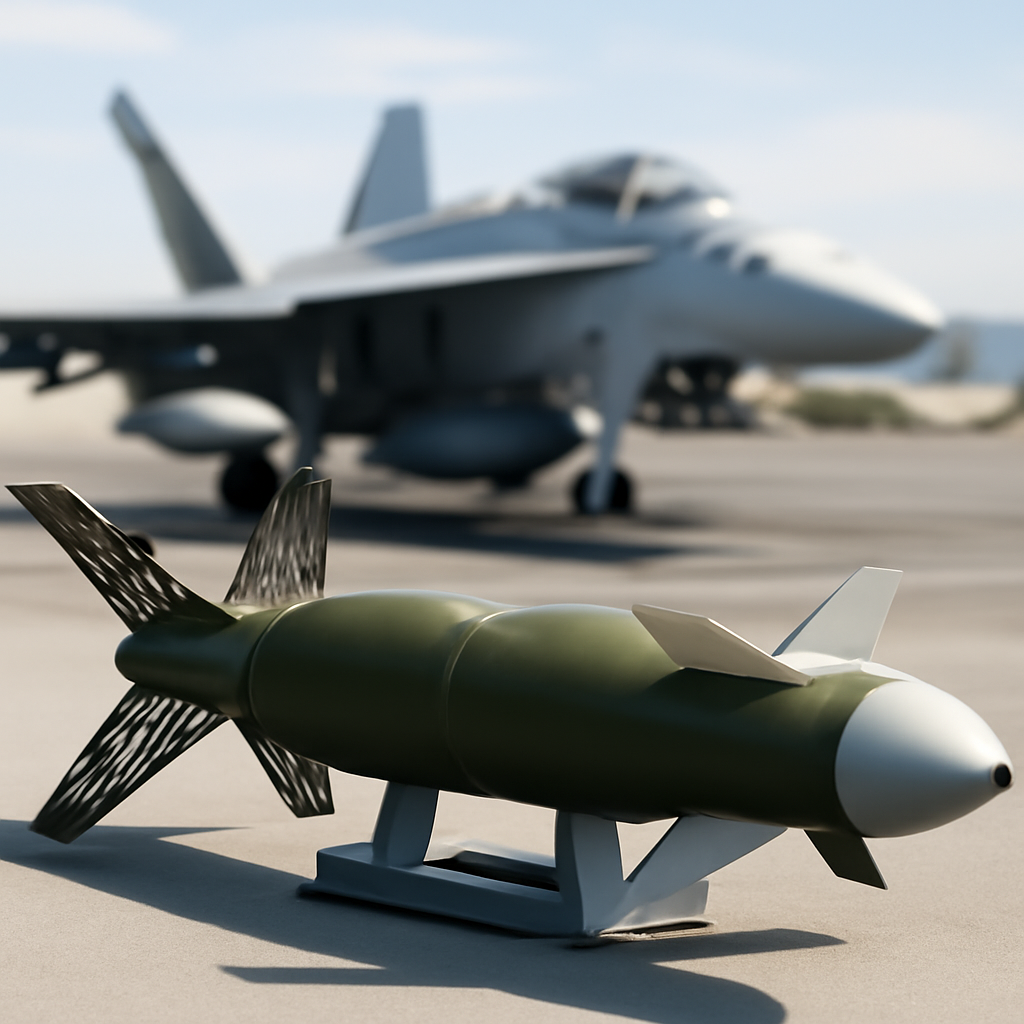
"evaluate current hard target defeat capabilities with 2000lb Joint Direct Attack Munition Extended Range (GBU-64 JDAM-ER) and provide recommendations on future JDAM-ER development to enhance HDBT penetration capabilities," according to Pentagon budget documents.
Defense Threat Reduction Agency budget request
The Pentagon’s proposed Fiscal Year 2027 budget for the Defense Threat Reduction Agency (DTRA) explicitly seeks work to assess and improve the JDAM-ER’s ability to defeat hardened, deeply buried targets (HDBT). The language in the budget documents frames the effort as an evaluation of current hard-target defeat capabilities for the 2,000‑pound JDAM-ER and a source of recommendations for future JDAM‑ER development to enhance penetration.
How the JDAM-ER is configured and where it already exists
The JDAM-ER is a kit that converts unguided bombs into GPS-guided weapons and adds wings to extend range. The U.S. designation for the 2,000‑pound-class JDAM-ER is GBU-64/B (also referred to in the source as RAAF GBU-64/B). Subvariants exist: the GBU-64(V)1/B, which uses the Mk 64 Quickstrike naval mine as its warhead, appears to be the only subvariant "officially confirmed to be in use anywhere across the U.S. military" at the time of writing. There is also a 500‑pound GBU-62(V)1/B pairing a JDAM-ER kit with the Mk 62 Quickstrike mine. Boeing has noted that the BLU-109/B bunker-buster warhead can be combined with the JDAM-ER kit; whether that specific configuration is already operational in U.S. service is unclear.

Audit-ready is a season. It shouldn't be.
Evidence in spreadsheets, controls drifting between audits, frameworks multiplying on flat headcount. Nubivance runs continuous compliance on Rapid7 Cyber GRC - SOC 2, HIPAA, ISO 27001, PCI, CMMC.
End the scrambleRange, flight profile, and new strike options
The standard (wingless) JDAM can reach targets up to about 15 miles, while the winged JDAM-ER extends maximum reach to roughly 45 miles, with range varying by release altitude and flight profile. That range matters: releasing penetrating munitions from farther away reduces exposure of launch platforms to air defenses, the budget documents and analysis note. The wing kit’s added drag can reduce a bomb’s kinetic energy on impact — a double-edged physical effect for penetration — and planners could program JDAM-ERs to glide to a point above a target before diving to increase destructive effect.
Crucially, the gliding capability opens operational options not typical for large bunker busters. Low-angle, near‑horizontal approaches could focus effects on the side of hardened structures, on tunnel entrances, or on the waterline of ships — places where lateral hits can magnify a warhead’s effectiveness and exploit weaker structural points. Lobbing precision-guided bombs into tunnel and cave entrances is already an established tactic, and JDAM‑ER glide profiles could extend that concept.
Skip bombing R&D and historical precedent
DTRA’s request also covers research and development in “skip” bombing capability to develop new tactics and weaponeering options that could enable deeper access for penetrating weapons. Skip bombing involves releasing munitions so they bounce off the surface of the ground or water, putting them further forward on a flatter trajectory. The practice has historical precedent: the source cites British use against German dams in World War II and heavy U.S. use against ships in the Pacific Theater during the same conflict. The budget documents link improved skip‑bombing tactics to the potential for deeper penetration of targets and more effective hits near waterlines.
What this means for the U.S. military, Iranian authorities, and allied air forces
- The U.S. military: DTRA’s program could add a lower-end, long‑standoff penetrating option to existing bunker‑busting arsenals, complementing heavier systems such as the GBU-57/B Massive Ordnance Penetrator, the Next Generation Penetrator concept, and new 5,000‑pound-class munitions already being fielded. The stated goal is to improve options for striking hardened and underground facilities while reducing risk to aircraft.
- Iranian authorities: The record in the source shows Iran taking measures to make underground facilities harder to reach, including adding earthen and rocky mounds and covering entrances and ventilation shafts at locations such as Fordow and Pickaxe Mountain. Those passive defenses are specifically noted in recent satellite‑image reporting referenced in the budget discussion, suggesting adversary mitigation efforts that new JDAM‑ER profiles would seek to overcome.
- Allied and partner air forces: Versions of JDAM‑ER using general‑purpose high‑explosive warheads have been in service in Australia and Ukraine for years, demonstrating that winged JDAM kits are already operational outside the U.S. Air Force and could be adapted further if DTRA’s recommendations support bunker‑busting configurations.
The DTRA effort, as stated in the Pentagon papers, is a focused technical push: measure current capability, test new profiles including skip bombing, and recommend how the JDAM‑ER could be evolved to penetrate hardened structures more effectively. The results could reshape tactical options below the largest bunker-busting weapons, offering commanders longer standoff, different angle-of-attack choices, and new tradeoffs between kinetic energy and guided flight profiles — while adversaries continue to harden and disguise underground access points. The next concrete step lies in the agency’s R&D and testing program spelled out in the FY2027 request.