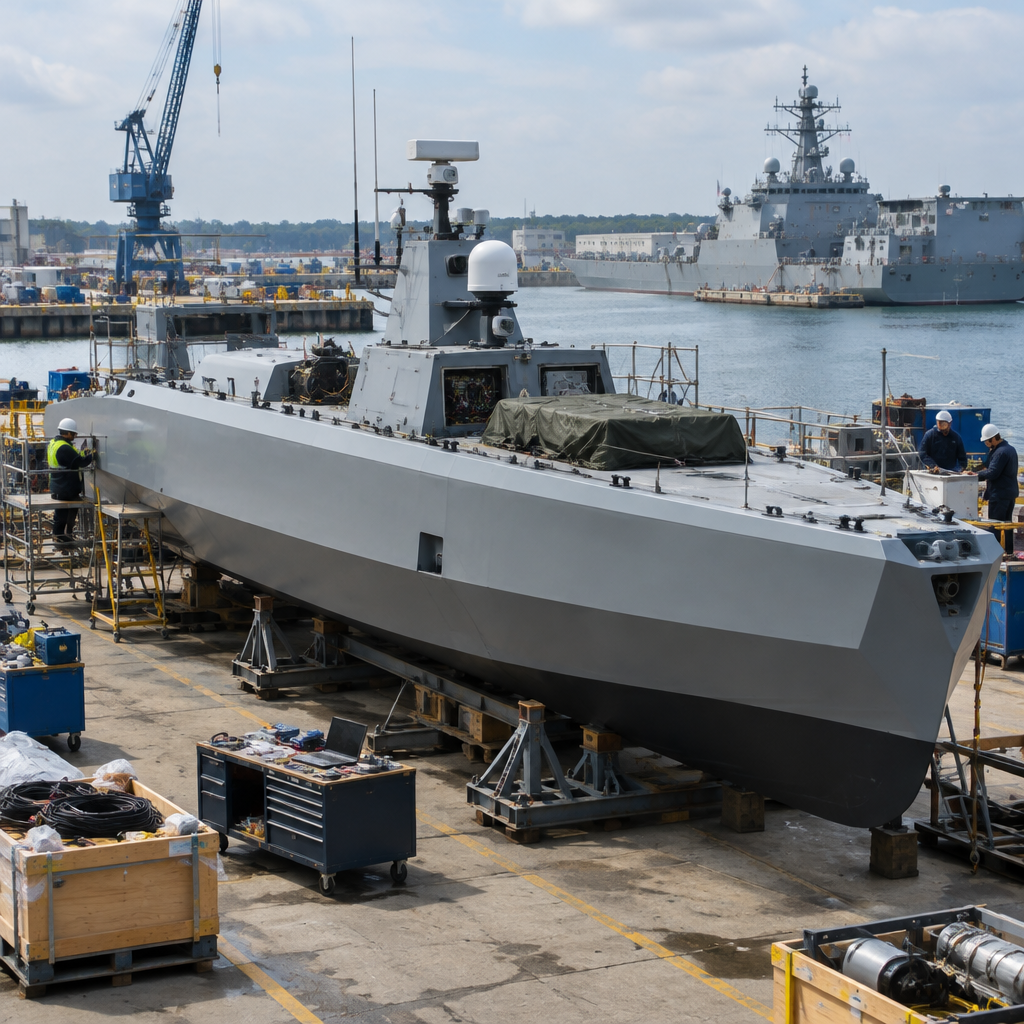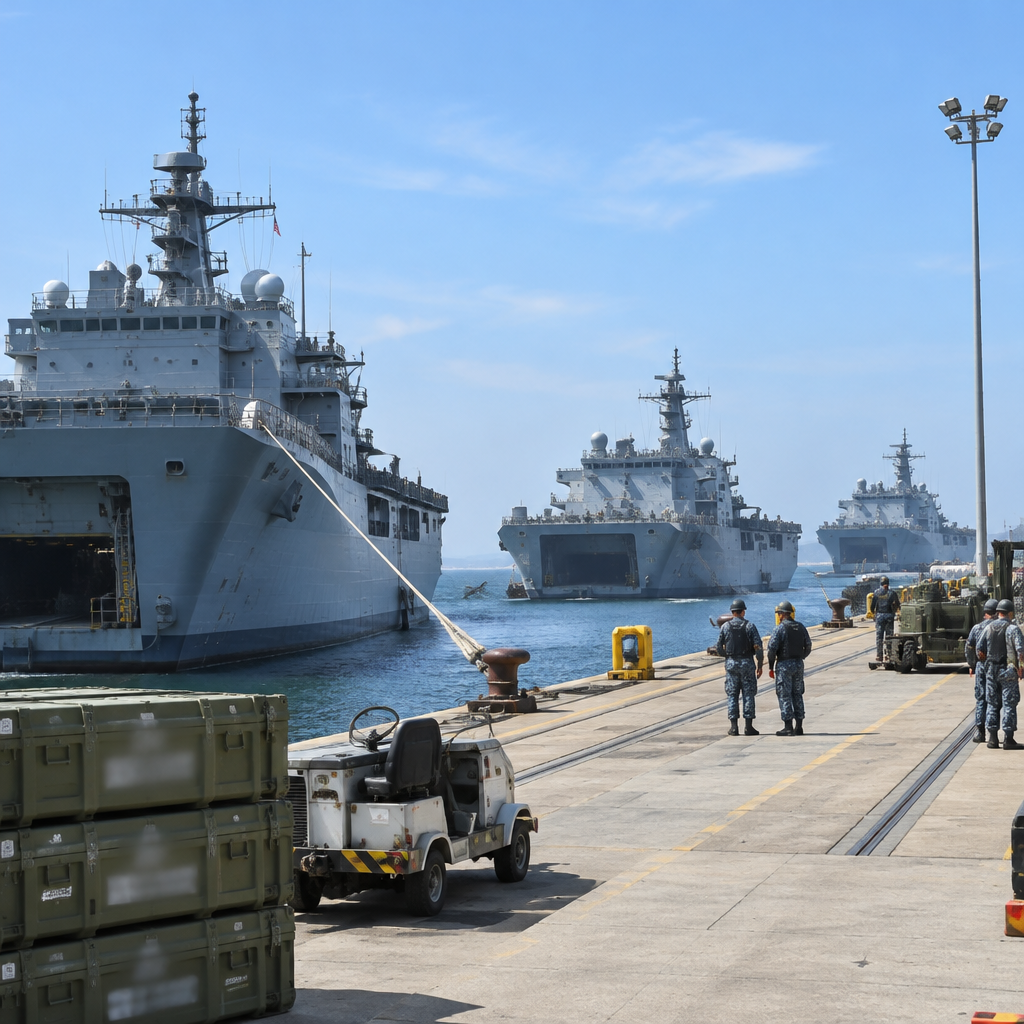
"Right now, I have 31 amphibious warfare ships," stated Shon Brodie, director of Maritime Expeditionary Warfare at the Marine Corps’ Combat Development and Integration directorate.
The 40-ship target and the call for 13 big decks
Navy and Marine Corps leaders have concluded that the Corps needs 40 amphibious ships to sustain a persistent 3.0 ARG/MEU presence — defined by Commandant Gen. Eric Smith as keeping three Marine Expeditionary Units (one East Coast, one West Coast, and one in Japan) deployed simultaneously. According to Brodie, the two analytical arms of the Navy and the Marines “have come to the conclusion that it takes 40 ships. That’s 13 big decks and 27 LPDs.”
By contrast, the Navy currently has 31 amphibious ships — the minimum mandated by Congress — and only nine amphibious assault "big deck" ships instead of the statutory 10. The shortfall reflects, in part, the scrapping of USS Bonhomme Richard (LHD-6) in 2021 after a devastating 2020 fire. Marines want to increase the statutory requirement from 10 to 13 big decks to match the analytical assessment of force generation needs.
How MEUs and ARGs are organized and why capability has grown
Marine Expeditionary Units, roughly 2,200 Marines each, are typically embarked on Amphibious Ready Groups (ARGs) that usually include an amphibious assault ship plus two transport docks or dock landing ships; larger Expeditionary Strike Groups add support vessels, surface combatants and sometimes a nuclear fast attack submarine. The big decks — the Wasp-class (LHD) and America-class (LHA) amphibious assault ships — carry Aviation Combat Elements that can include F-35B fighters, MV-22 tiltrotors and a mix of helicopters such as UH-1s, AH-1s, CH-53s and Navy Seahawks.
Those aviation additions have materially increased MEU utility. The article notes that MV-22s and F-35Bs, used in higher-end "Lightning carrier" configurations, have allowed MEUs in limited cases to perform tasks once reserved for aircraft carrier strike groups, expanding the operational demand placed on amphibious platforms.

Audit-ready is a season. It shouldn't be.
Evidence in spreadsheets, controls drifting between audits, frameworks multiplying on flat headcount. Nubivance runs continuous compliance on Rapid7 Cyber GRC - SOC 2, HIPAA, ISO 27001, PCI, CMMC.
End the scramblePath to 40: new construction, life extensions, and a multi-ship contract
Brodie said the only realistic ways to reach 40 ships are to build new vessels and perform service-life extensions on select ships now in the inventory. Lt. Col. Eric D. Flanagan, a Marine Corps spokesman, noted a multi-ship procurement contract is already underway: HII was awarded a $9.6 billion contract in 2024 for construction of three San Antonio-class amphibious ships and a contract modification for the next America-class large-deck amphibious ship, covering LPDs 33, 34 and 35 and LHA 10.
There is no set timeline for reaching the 40-ship goal; Brodie and Marines say they will await future congressional funding. Brodie also said Vice Chief of Naval Operations Adm. James W. Kilby and Assistant Commandant Gen. Bradford J. Gering plan to approach Congress later this month to convey the need for more ships.
Readiness, maintenance and the costs of extended deployments
The drive for more hulls comes alongside acute readiness and maintenance problems. Kilby’s Fiscal Year 2027 budget request statement reported the amphibious ship fleet had just a 47% combat surge readiness rate as of April. Brodie blamed chronic maintenance delays, competing budget priorities, early-retirement decisions made without required congressional approval, scarce spare parts and contractor oversight shortfalls for those problems.
Brodie described efforts to better track readiness through the newly created Amphibious Force Readiness Board (AFRB) and to shrink maintenance days and improve force generation. He warned of a compounding dynamic: extended deployments that push ships past scheduled maintenance windows create cascading delays in yards and facilities, turning extra days at sea into extra weeks or months in the yard.
Operational costs and conflict responses have also strained budgets. Chief of Naval Operations Adm. Daryl Caudle estimated Operation Epic Fury required the Navy to seek an additional $6–8 billion for Fiscal Year 2026, and Pentagon data obtained by Reuters shows the U.S. military “has spent over $47 billion so far to prosecute the war in Iran,” a figure the article says is more than 25% higher than the Defense Department’s July estimate.
What this means for Congress, the Navy, and HII
- Congress (including Rep. Adam Smith): Lawmakers will be asked to fund new amphibious construction and possibly adjust statutory fleet requirements. The article notes a political headwind: Democrats have won control of both the Senate and the House, and a leaked letter from Rep. Adam Smith signals a likely review of defense strategy and budgets, emphasizing a desire for a “realistic and sustainable approach” that avoids budgets in excess of $1 trillion or deep domestic cuts.
- The Navy and Marine Corps (Kilby, Gering, Brodie, Gen. Eric Smith): Service leaders are pressing for a larger fleet and better readiness tracking through the AFRB, while pursuing shipbuilding and selective service-life extensions. They are also prioritizing reduced maintenance times and preventing schedule slips caused by deployment extensions.
- HII and shipbuilders: The $9.6 billion 2024 multi-ship award positions HII as a key builder for the planned increase in LPDs and the next LHA, but any expansion toward a 40-ship fleet depends on future appropriations and sustained industrial capacity to build and sustain big-deck and LPD hulls.
The Marines’ ask is blunt: more hulls and more big decks to keep three MEUs persistently forward. The next concrete steps are already scheduled — Kilby and Gering will brief Congress, and the services will lean on multi-ship procurement and selective life extensions — but whether budget politics and readiness shortfalls can be resolved in time to reach a 40-ship fleet remains the central question.