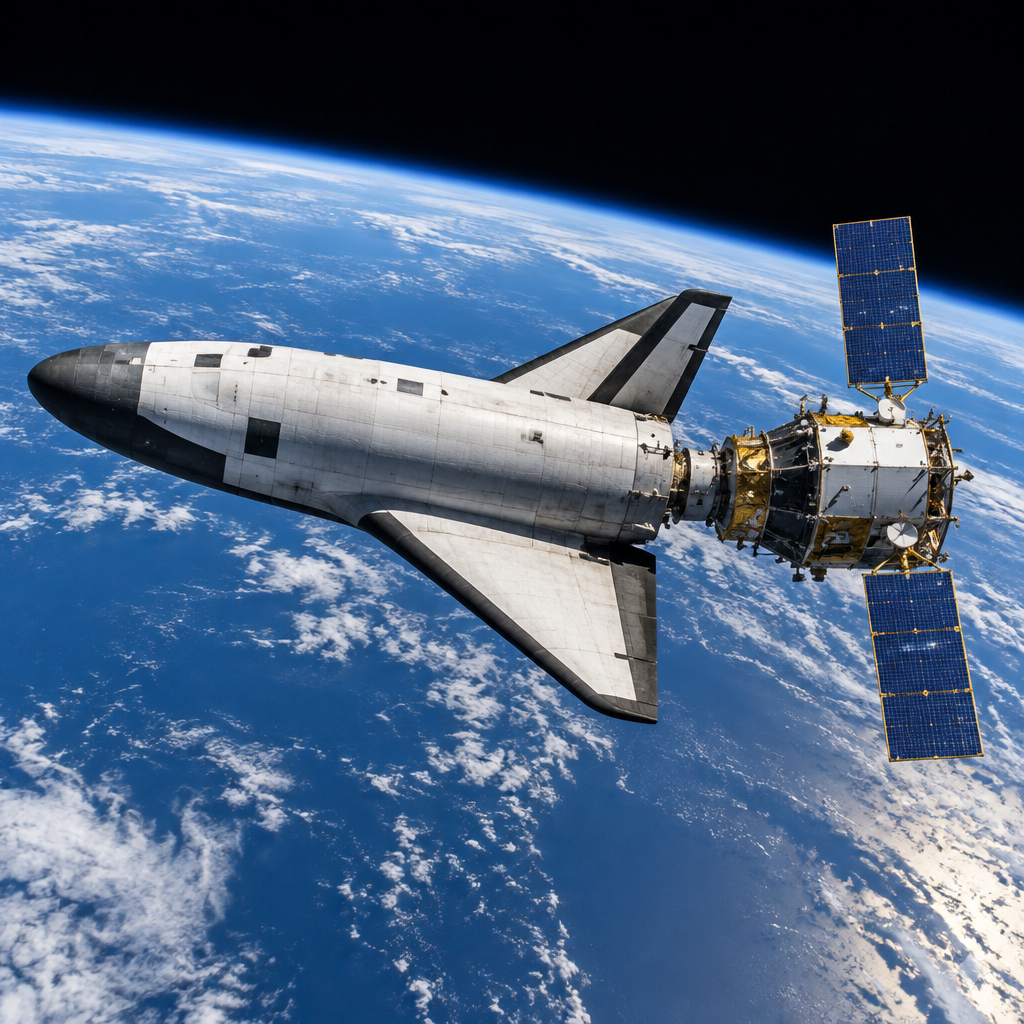
Vantor confirmed the image was taken on May 28, 2024, by the WorldView‑3 satellite at a range of just under 56 miles (90 kilometers), and that “there is a separate satellite docked to the aft section of the vehicle whose structure and solar arrays are visible,” the company told reporters.
DIA’s public confirmation and the image itself
The U.S. Defense Intelligence Agency (DIA) has publicly confirmed that a long‑circulating photograph indeed shows an experimental Chinese reusable spaceplane in orbit. The agency included a higher‑resolution copy of the on‑orbit image in a newly released unclassified report on “global security challenges outside of the Earth’s atmosphere,” a document the source says was released yesterday. The photograph was collected by a commercial satellite—Maxar Technologies, which now operates as Vantor—and that firm has provided additional detail after the DIA publication.
What the image shows and what Vantor added
The photograph depicts a small shuttle‑like vehicle with short wings, twin vertical tails, upward‑opening doors above a central payload bay, and an aft extension with deployed solar panels. Vantor confirmed to the reporter that the vehicle’s payload bay doors were visibly open and that a separate satellite appeared docked to the vehicle’s aft section. The company’s confirmation anchored previously uncertain attributions and supplied the precise capture date and sensor: WorldView‑3 on May 28, 2024.

This site is the portfolio.
OSINTSights runs on Cloudflare Workers, D1, R2, and Vectorize, with an AI pipeline on Hetzner ARM. Nubivance designed, built, and operates it. We do the same for clients.
See what we buildDesign parallels with the U.S. X‑37B, and a distinct wing planform
DIA’s report and the accompanying imagery underline that the Chinese vehicle’s core configuration is “nearly a dead ringer” for the United States’ X‑37B miniature space shuttle. Both vehicles display tricycle landing‑gear arrangements and the option for an extended payload module at the tail. The report notes one clear difference: the Chinese design’s wings have a much longer chord than the X‑37B. The X‑37B program itself has built two vehicles and flown eight orbital missions since 2010; the most recent U.S. Orbital Test Vehicle mission referenced in the source is OTV‑8, launched on August 22, 2025.
Observed Chinese flight activity and landing infrastructure
The source states that China has flown the experimental spaceplane on four separate orbital missions with the same vehicle since 2020. Three of those missions had concluded before a 2024 presentation by U.S. Space Forces‑Korea leadership that included a lower‑resolution version of the photograph. The third mission ran from December 14, 2023, to September 6, 2024, during which observers documented the release of multiple smaller objects into orbit—potentially from the spaceplane’s main payload bay, which the new on‑orbit image shows open. The source also reports a most recent launch “on February 7 of this year,” and states that the vehicle “has not yet returned, at least as far as we are aware.”
After missions, the vehicle appears to have landed at a secretive airbase in northwest China that has one of the world’s longest runways—16,400 feet—and which the source says has been massively expanded in recent years and “is now loosely akin to America’s top‑secret proving ground at Area 51.”
Other Chinese programs, and reusable launch work
The DIA report distinguishes two primary Chinese spaceplane models by name—Shenlong and Tengyun—but does not specify which is pictured. The name Shenlong has been applied commonly to the design China has been experimenting with, and images of a prototype or test article beneath an H‑6 bomber circulated in 2007. CASIC unveiled a Tengyun concept in 2016 as part of a two‑stage‑to‑orbit system using a mothership aircraft; CASIC was aiming for a live test of Tengyun in 2025, according to the source’s reporting as of 2020. Other Chinese entities—China Aerospace Science and Technology Corporation (CASC) and an AVIC subsidiary in Chengdu—have pursued spaceplane concepts as well, including a Chengdu design called Haolong that has been positioned as an option to resupply the Tiangong space station.
The source also notes progress on reusable launch boosters: LandSpace was reported to become the first in China to recover a reusable rocket booster on land in August, and CASC reportedly recovered a booster at sea the month before using a specially configured ship.
How the U.S. Space Force, Vantor, and Chinese aerospace firms are positioned
- U.S. Space Force and defense intelligence: DIA’s public inclusion of the image signals an intent to place China’s reusable‑spaceplane activity on the unclassified record and to underscore the capability implications—particularly for on‑orbit maneuvering, payload deployment, and rendezvous behavior.
- Vantor (formerly Maxar): the commercial imagery provider both supplied the higher‑resolution image and clarified the capture date, sensor, and the presence of a docked satellite and visible solar arrays—details that transform a low‑resolution speculation into a more concrete technical observation.
- Chinese aerospace firms (CASIC, CASC, AVIC, LandSpace): multiple organizations appear to be pursuing reusable vehicles and two‑stage concepts, and the source documents both demonstrators in the airframe‑launch spaceplane category and recent reusable booster recoveries that feed into a broader national effort.
DIA’s unclassified release, bolstered by Vantor’s confirmed metadata and visual observations, makes clear that a Chinese reusable spaceplane has been photographed on orbit with an aft‑docked satellite and open payload bay. The report also leaves a specific, concrete identification unresolved: DIA lists two primary models, Shenlong and Tengyun, but “does not specify which one is seen in the image.” That question—Shenlong or Tengyun—along with the provenance and purpose of the smaller objects released in prior missions, remains the next, observable fact to be settled by imagery and public reporting.