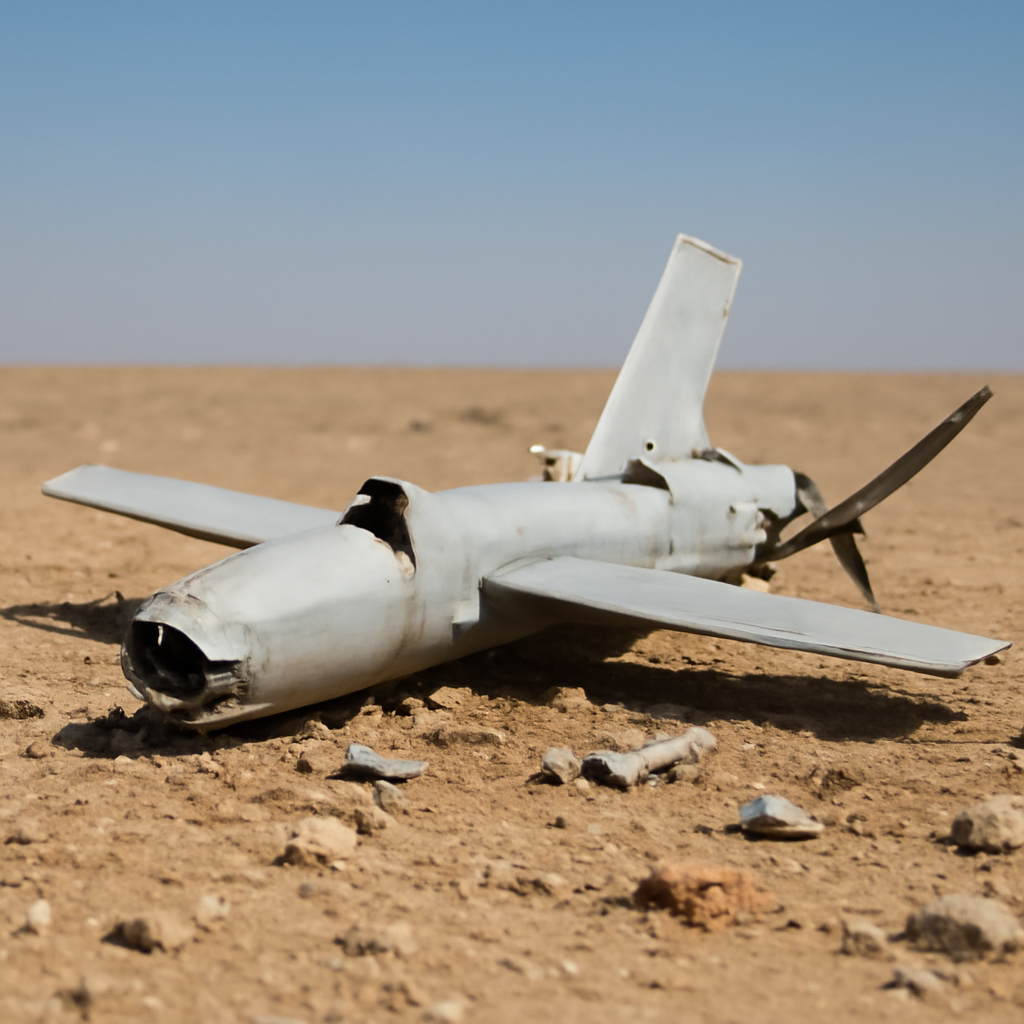
The ADM-160 wreckage and Iranian claims
Remnants photographed in Iran have been identified in open imagery as belonging to a Raytheon ADM-160 Miniature Air-Launched Decoy (MALD). Iranian state and military media reported the recovery after what they described as an interception earlier in the day, but the provenance, exact location and circumstances of the wreckage have not been independently established. Iranian sources also separately reported the destruction of an Orbiter-type reconnaissance drone over the Strait of Hormuz; it is unclear whether that report refers to the same incident as the MALD images or to a separate loss.
Visible markings on the wreckage include the CAGE code 15090, which corresponds to Raytheon, a detail pointed out in circulating social-media posts and imagery. While that marking and the wreckage’s visible features make the MALD identification credible, the available material does not by itself determine how the device was lost — whether by an Iranian interception, a malfunction, or an expected loss such as fuel exhaustion.
ADM-160 family: B model, MALD-J (ADM-160C), and capabilities
The ADM-160 family is an expendable store launched from another aircraft. The ADM-160B — developed under a Raytheon contract won in 2003 — differs significantly from the original A-model and features a more powerful turbojet and greater range. The ADM-160B is roughly 6.5 feet long, has a deployed wingspan of about 5.6 feet, and an operational range of around 550 miles. Rather than carrying a conventional warhead, MALDs carry equipment to reproduce the radar signature of specific aircraft or standoff weapons and can be programmed to fly intricate routes to emulate targets and provoke air defenders.
The related ADM-160C, known as MALD-J, adds electronic warfare capability to perform stand-in jamming and active electronic attacks against air defense nodes. The exact variant shown in the recently circulated images cannot be established from publicly available photographs at this stage.

Audit-ready is a season. It shouldn't be.
Evidence in spreadsheets, controls drifting between audits, frameworks multiplying on flat headcount. Nubivance runs continuous compliance on Rapid7 Cyber GRC - SOC 2, HIPAA, ISO 27001, PCI, CMMC.
End the scrambleOperational precedent: Operation Midnight Hammer, Epic Fury, and other uses
The possibility that MALDs were used against Iran attracted attention after Operation Midnight Hammer, the U.S. strike against Iranian nuclear facilities in June 2025, when U.S. officials described a complex deception plan using aircraft and decoys to disguise the true direction and composition of the attack. The opening hours and days of Operation Epic Fury also likely saw MALD employments, according to the reporting.
ADM-160s have also seen use outside the Iran context; the MALD family has been used extensively by Ukraine against Russia to provoke air defenses and as penetration aids for cruise missiles. The system has been integrated with a broad range of U.S. aircraft — imagery and mission markings on returning Air Force A-10C Thunderbolt II aircraft have included MALD mission marks among other ordnance.
Signals collection and probing Iran’s air defenses
The reporting emphasizes that MALDs serve a dual purpose in a contested environment. Primarily they act as decoys to draw air defense fire away from allied aircraft and standoff weapons. They can also be fired independently to trigger radar and surface-to-air missile systems, revealing locations, operating characteristics and aspects of command-and-control. Surveillance platforms — including those in the air and those in space — can collect the resulting signals data to build or update an electronic order of battle.
The piece notes that building and maintaining a detailed, current electronic order of battle is critical for contingency planning and any potential future air campaign, and that there is typically a burst of such activity prior to major operations. The reporting also names penetrating reconnaissance platforms that have been associated with intelligence collection in the region, citing sightings and reports of Israel’s RA-01 stealth flying wing and U.S. RQ-170 and RQ-180 aircraft as examples of assets likely used to collect this class of information.
What this means for Iran’s forces, U.S./Israeli planners, and Qatar and Pakistan
- Iran’s forces: Photographic evidence suggesting a MALD loss, if corroborated, would represent a tangible interception of a U.S. deception system but does not by itself indicate the full state of those defenses. Iranian claims should be viewed alongside the acknowledged possibility of malfunction or routine decoy exhaustion.
- U.S. and Israeli planners: The identification reinforces the ongoing need to probe and map Iran’s air-defense networks. MALD employment can serve both as survivability aids and as deliberate sensors to elicit signals for collection and analysis.
- Qatar and Pakistan (diplomatic actors): The report notes that Qatar and Pakistan are pursuing diplomatic efforts to restart negotiations even as both Tehran and Washington publicly raise the prospect of renewed strikes, which makes accurate, up-to-date intelligence on air defenses strategically important for any diplomatic de-escalation or contingency planning.
The MALD wreckage photographs are a reminder that low-cost deception and decoy techniques now play an outsize role in modern contestation: they can preserve expensive platforms, generate actionable signals intelligence, and shape adversary behavior without kinetic escalation. Whether this particular wreckage will be independently verified, whether it was shot down or suffered a malfunction, and how its loss will affect broader operations remain open points. The one concrete detail visible today is the CAGE marking 15090 on the tail remnants — a small, physical trace that ties these fragments to a well‑recognized decoy family and to the larger contest over electromagnetic and aerial dominance in the region.