The U.S. Air Force is aiming for a fleet of at least 500 collaborative combat aircraft (CCA) of all types by 2032, a numeric target that now guides an intensifying campaign of flight tests, missile shots and interoperability experiments across multiple drone programs.
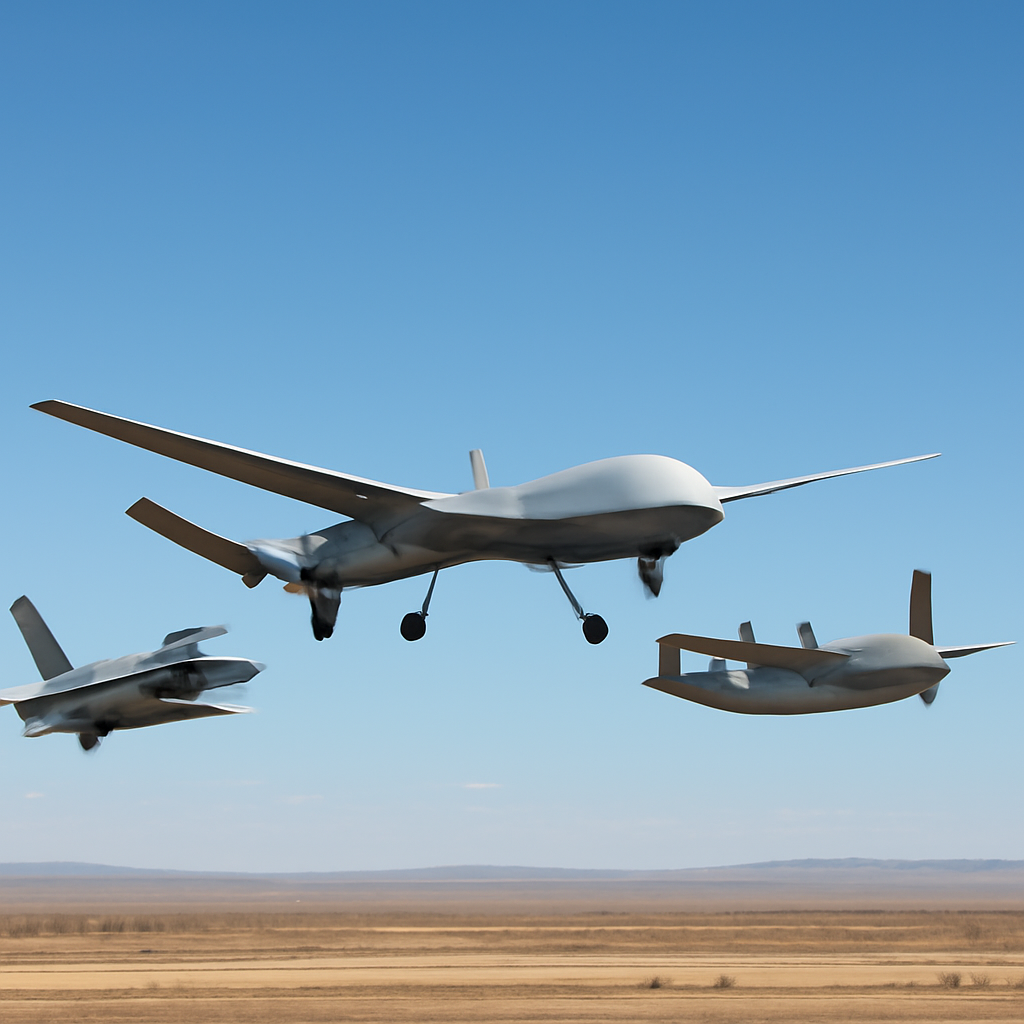
FQ-42 Vengeance seen flying with F-35A and F-15E
General Atomics Aeronautical Systems, Inc. (GA-ASI) released a photograph showing an FQ-42 Vengeance in flight alongside an F-35A Joint Strike Fighter and an F-15E Strike Eagle. GA-ASI also announced delivery of another Vengeance drone to Creech Air Force Base in Nevada, saying in a press release: “The FQ-42 that arrived at Creech will continue regular test and evaluation operations with the Air Force aimed at experimentation with the new aircraft.”
GA-ASI has previously said the XQ-67A Off-Board Sensing Station served as a prototype for the FQ-42 development, and the company points to prior flights of the FQ-42 together with MQ-20 Avenger and XQ-67A in various semi-autonomous and autonomous modes under collaborative control with human pilots in F-22 and F-35 jets.
Recent tactical milestones: missile shots and IRST demonstrations
Anduril’s FQ-44 Fury has recorded an air-to-air missile event: on July 15, 2026 Anduril posted that “YFQ-44A executed an end-to-end, beyond-line-of-sight strike against a simulated target,” and described it as “an important step in turning CCA into an operational capability.” The broader Air Force testing portfolio also included a demonstration in which a CCA test aircraft and contractor-operated F-5AT Advanced Tiger jets employed infrared search-and-track sensors (IRST) for cooperative engagements.
GA-ASI described that live exercise in detail: “The live exercise proved that a CCA and a manned fighter can collaborate to fuse sensor data from AMS-GRA-compliant sensors to track, engage, and eliminate an airborne target while using a Beyond Line of Sight (BLOS) data link to accomplish seamless coordination between the two aircraft.” The company said the test used BLOS communications to relay AMS-GRA-compatible sensor cues to the CCA’s TacACE (Tactical Autonomy Ecosystem) software.

The cyber insurance questionnaire just landed. Now what?
SOC 2, HIPAA, insurance renewals - someone has to own security strategy. Nubivance provides fractional CISO leadership without the full-time salary.
Get a security leadNellis, Creech and the Experimental Operations Unit
Operational test infrastructure has expanded in Nevada. Creech Air Force Base is being used for “regular test and evaluation operations” with Vengeance, while a dedicated test squadron at Nellis Air Force Base—the Experimental Operations Unit (EOU)—has been leading broader efforts to work through how CCAs will be fielded. The Air Force carried out a major round of testing at Creech in July, and the service plans to include both FQ-42 and FQ-44 types in a large-force employment (LFE) exercise in December.
Interoperability architecture: AMS-GRA and TacACE
The demonstrations emphasize plug-and-play interoperability. GA-ASI said the flight tests showed “many companies’ platforms can interoperate using the plug-and-play government reference architectures ecosystem,” a point the company used to stress that “the U.S. Air Force isn’t locked into using a single vendor or system.” Tests fused data from AMS-GRA-compliant sensors and used TacACE on the CCA side to accept commands relayed by manned fighters via BLOS links.
Infrared search-and-track sensors (IRST) have been repeatedly featured in demonstrations; GA-ASI has shown Avenger-class drones with podded IRSTs detecting and tracking aerial targets semi-automatically, and the recent F-5/CCA flights used IRSTs to support collaborative engagements.
What this means for technologists, procurement leaders, and operators
- Technologists and test squadrons: will continue refining sensor fusion, BLOS data links and TacACE autonomy modes during the Creech and Nellis trials to demonstrate semi-autonomous and directed-autonomy teaming with crewed fighters.
- Procurement leaders and planners: are working toward a stated force-size goal of at least 500 CCAs by 2032 and an initial operational fielding “toward the end of the decade,” meaning procurement decisions will be driven by which configurations prove interoperable in the December LFE and the Creech test campaign.
- Operational units and operators: must resolve practical matters the Air Force is “heavily focused” on now—how CCAs will be deployed, launched, recovered, supported, and operated day-to-day—as the service moves from experimentation to larger integrated exercises.
GA-ASI’s vice president for strategy and business development, Mike Shortsleeve, summarized the program’s intent at the Air & Space Forces Association conference: “We’re on path right now to do our air-to-air shot coming up here in the near future.” He framed the wider program around scale and directed autonomy: “This signifies that mass is certainly important again, but also autonomy is just as important,” and added that autonomy “isn’t just strictly this is going to go off and do its own thing. It’s going to be directed” and “work hand-in-hand [with humans].”
The immediate technical timeline is concrete: more flights at Creech, inclusion of FQ-42 and FQ-44 types in the December LFE, and continuing tactical demonstrations such as the FQ-44’s recorded missile shot. Longer-term questions—how the Air Force will operationalize launch, recovery and sustainment at scale as it pursues the 500-aircraft target—remain the focus of current test planning and the Experimental Operations Unit’s work.
Source: TWZ — General Atomics FQ-42A Vengeance CCA Now Flying Together With USAF Fighters