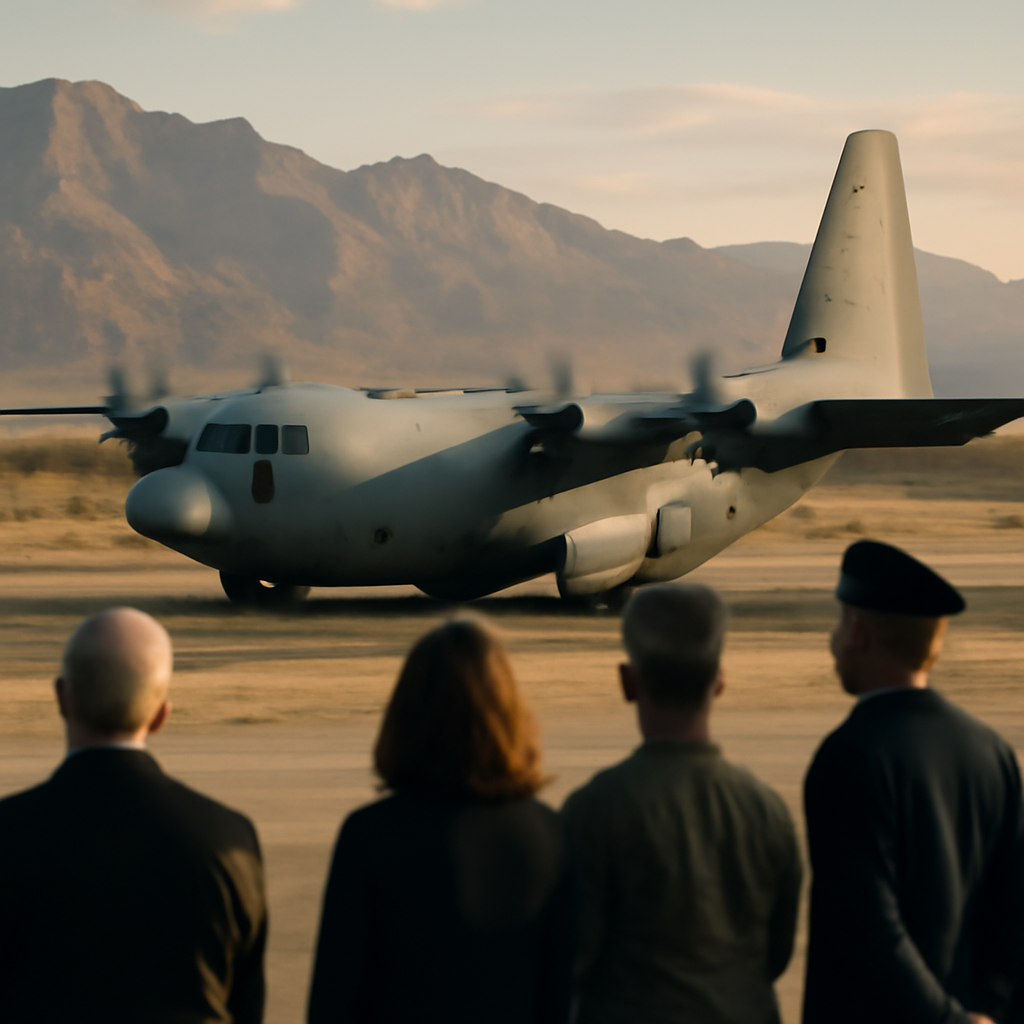
"This closes the door not just on my time in our squadron, but on an entire chapter of my life," Staff Sgt. Justin Franko said after the EC-130H Compass Call completed its final operational taxi at Davis-Monthan Air Force Base.
Final taxi at Davis-Monthan and the aircraft's retirement
The Air Force formally retired the EC-130H Compass Call during a ceremony on Sept. 18 at Davis-Monthan Air Force Base, Arizona, where the turboprop executed what service officials called its final operational taxi. The Arizona facility — home to the 55th Electronic Combat Group that operated the Compass Call and to the Military Aircraft Storage and Disposition Center known as the "Boneyard" — was also scheduled to receive the aircraft for inactivation and long-term storage on Sept. 22.
EC-130H Compass Call: more than 40 years of electronic attack
The EC-130H was a modified version of Lockheed Martin's C-130 turboprop, fitted with electronic attack equipment integrated by BAE Systems and L3Harris. Entering service in 1983, the platform was built to disrupt enemy communications and jam radars. The Pentagon has disclosed that the EC-130H even featured in the initial stages of combat operations against Iran earlier this year, identified as part of Operation Epic Fury.

Audit-ready is a season. It shouldn't be.
Evidence in spreadsheets, controls drifting between audits, frameworks multiplying on flat headcount. Nubivance runs continuous compliance on Rapid7 Cyber GRC - SOC 2, HIPAA, ISO 27001, PCI, CMMC.
End the scrambleEA-37B Compass Call: the planned successor
The Air Force is replacing the EC-130H with a new jet also to carry the Compass Call name: the EA-37B. Based on a Gulfstream G550 business jet and equipped with technology from BAE Systems integrated by L3Harris, the EA-37B was first delivered in August 2024. According to the Air Force, the EA-37B will fly at twice the altitude and at double the speed of its turboprop predecessor and will operate more powerful systems against adversaries. "We are retiring the EC-130; we are not retiring Compass Call," Col. Aaron Gray, commander of the 55th Wing at Offutt Air Force Base in Nebraska, said in the Air Force release.
Fleet size, partners, and operational posture
After a period of uncertainty over how many EA-37Bs would be procured, Air Force officials announced in April that the Compass Call fleet will be increased to 22 aircraft. International interest has already begun: Italy signed up last year to be the first export customer for the EA-37B jet.
The transition reflects a shift from a turboprop airframe to a faster, higher-flying jet and a consolidation of mission systems with the same industrial partners — BAE Systems and L3Harris — that supported the EC-130H.
What this means for the 55th Wing, maintenance crews, and allied partners
- 55th Wing (Offutt Air Force Base): The wing's electronic attack mission will continue under the Compass Call name, transitioning from EC-130H operations to EA-37B operations as the new fleet reaches maturity.
- Maintenance crews (755th Aircraft Maintenance Squadron): Personnel who maintained the EC-130H marked an emotional endpoint; Staff Sgt. Justin Franko, a dedicated crew chief with the 755th, framed the aircraft's final taxi as the close of a personal and professional chapter.
- Allied partners (Italy): With Italy already committed as the first export customer, partner nations will begin integrating the EA-37B into their own planning and maintenance pipelines as deliveries continue.
Advanced electronic warfare remains, in the Air Force's framing, a critical component of modern conflict. The service also noted that the Navy operates an airborne electronic attack platform — the carrier-launched EA-18G Growler — underscoring that dedicated airborne EW assets will continue to be a service-level priority across branches.
The EC-130H’s retirement closes a long-running chapter in airborne electronic attack while handing the name Compass Call to a markedly different aircraft: a faster, higher-flying jet built on a Gulfstream platform and fielded in growing numbers. The tangible next steps are clear in the record: final inactivation at the Davis-Monthan "Boneyard," an expanded EA-37B fleet to 22 aircraft, and ongoing deliveries and exports that will shape how the Compass Call mission is flown in the years ahead.