"Mines don’t have to be sophisticated," said Bryan Clark, director of the Hudson Institute’s Center for Defense Concepts and Technology.
The find, fix and finish kill chain
Navies described in the reporting use a straightforward but painstaking method to clear mined waters: find, fix and finish. Find means getting an image of everything on the seabed, from actual mines to anchors, discarded junk and terrain features that can mimic man-made objects. Fix is the slow, manual work of ruling out obvious non-threats and classifying remaining contacts. Finish is the dangerous business of neutralizing identified mines while managing the risk of detonating nearby explosives.
Mark Bock, vice president for strategy and business development at Advanced Acoustic Concepts (AAC), a Thales company, summed up the task: "This takes a long time and a lot of dedicated work. Oftentimes it means dwelling on each of those targets one by one. You can imagine how complex this process is in highly trafficked areas such as the Straits of Hormuz."
Crewed and uncrewed systems working in tandem
Traditional minesweepers — often built from wood or fiberglass to minimize magnetic signatures and equipped with sonar — have been retired in many fleets, including those operated by the US Navy. The gap is being filled by uncrewed systems alongside remaining crewed vessels. Towed sensor arrays can be mounted on either and feed data to human analysts or to classification systems.
Pairing a small number of manned minesweepers with several unmanned robots expands coverage, according to Bock: "You can throw a lot more unmanned vessels at a problem than you can manned vessels just from an economic perspective, but also just from a bulk and size perspective." Clark added logistical advantages: unmanned systems can be airlifted into a region and put "on the shelf" until needed.

Audit-ready is a season. It shouldn't be.
Evidence in spreadsheets, controls drifting between audits, frameworks multiplying on flat headcount. Nubivance runs continuous compliance on Rapid7 Cyber GRC - SOC 2, HIPAA, ISO 27001, PCI, CMMC.
End the scrambleSAMDIS, Angler, and the challenge of false contacts
AAC promotes two specific technologies for improving detection and neutralization. SAMDIS is described as a synthetic aperture, multi-aspect imaging sonar designed to illuminate targets from multiple angles in a single pass, boosting the chance of identifying true threats on an initial sweep. That capability aims to reduce the number of repeated passes traditionally needed to see an object from different perspectives.
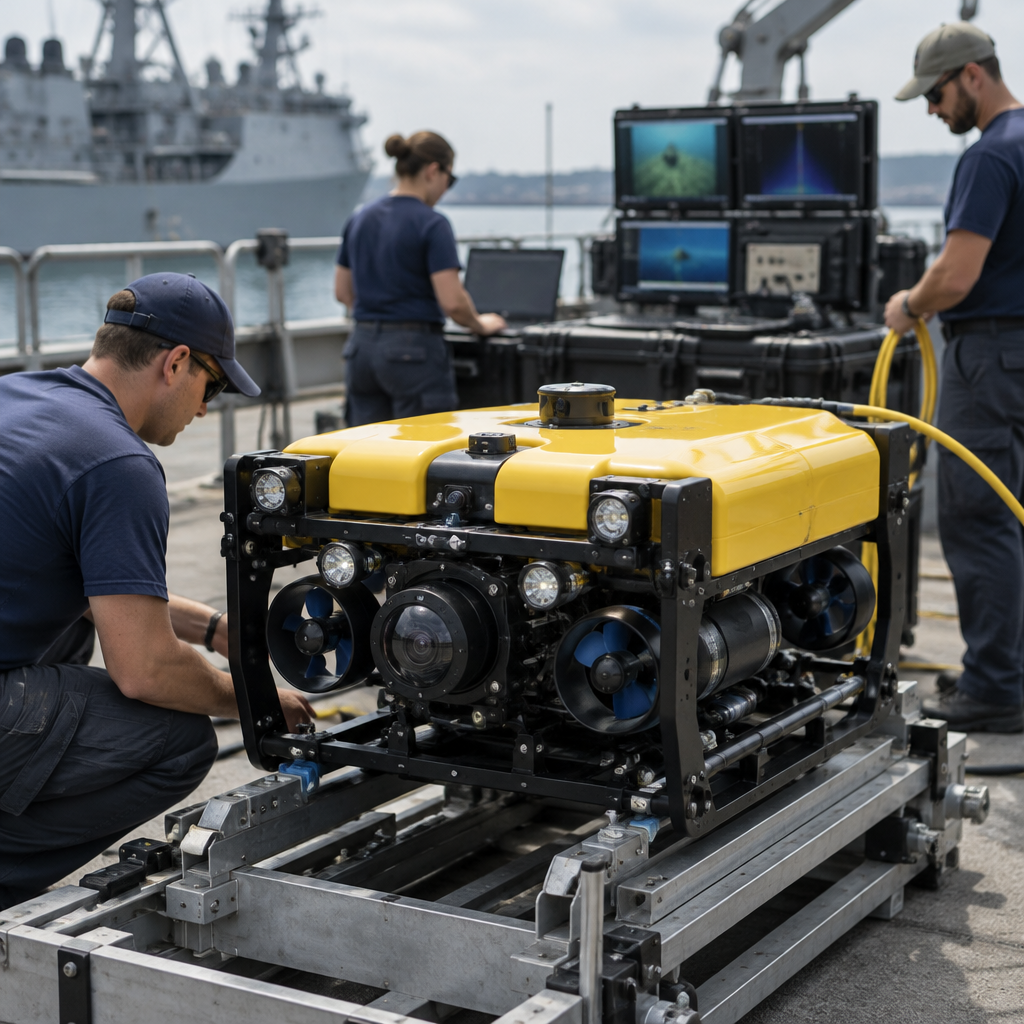
For neutralization, AAC’s Angler countermine remotely operated vehicle (ROV) is presented as a tool that can deliver effects without necessarily causing sympathetic detonation or a large surface explosion. Bock said Angler "does not necessarily cause sympathetic detonation" and can "observe the mine or seabed object and document the effects for the operators." He added that Angler has "semi-covert attributes" that allow operators to remain at a distance depending on the scenario.
The need for sophisticated imaging and effectors is acute because of what Bock calls a "huge false-target rate." Objects such as an "old refrigerator thrown onto the ocean bottom" can be roughly the same size as a mine and must be discriminated from true threats.
AI, onboard processing, and the Roomba analogy
Artificial intelligence and improved onboard processing are presented as the next levers to speed the find, fix and finish sequence. Bock pointed to AI-enabled change detection: by comparing sweeps, the system can highlight new objects or changes in classification or location. Clark emphasized cutting latency by processing and transmitting results immediately from the searching vehicles.
Clark used a consumer analogy to describe persistent, automated searching: "It becomes kind of like a Roomba, where the robots go up and down the route looking for mines in the water column. They’ll stay near the surface and then look down into the water, and as long as the water is not extremely deep, they’ll be able to see the first 100 or 200 feet of water and detect mine-like objects." The implication is a future in which repeated, coordinated sweeps and immediate data transmission allow rapid chaining from detection to neutralization.
What this means for navies, commercial shipping, and technology developers
- Navies and mine-clearance operators: Retirement of many traditional minesweepers, including those of the US Navy, increases reliance on unmanned systems and hybrid tactics that mix a few crewed platforms with many robots. Expect emphasis on rapid deployment and shelf-stored unmanned assets.
- Commercial shipping and port operators: In strategic chokepoints such as the Strait of Hormuz, even simple mines can halt military and commercial traffic until areas are cleared. Faster detection and less-obvious neutralization techniques aim to shorten those stoppages and reduce visible explosions that might signal clearance operations to adversaries.
- Technology developers and vendors: Demand is for multi-aspect imaging sonars, AI-enabled change detection, onboard processing and discreet neutralization effectors. AAC’s SAMDIS and Angler are offered as concrete responses to those needs; developers will be measured on false-target reduction, rapid classification, and the ability to operate at standoff distances.
Remote mine hunting is not a technology problem alone; it is a systems problem that ties sensors, AI, logistics and tactical decisions together. The reporting closes on a simple operational vision: "You should be able to get to a point where you can do this in a way that is just robot after robot after robot," Clark said — an image of persistence built from many small, standoff platforms rather than a few large, crewed sweepers. Whether that vision shortens the time waterways are closed, or lowers the risks to sailors and commerce, will hinge on reducing false targets, improving onboard processing and fielding neutralizers that leave little spectacle to alert an adversary.